Question
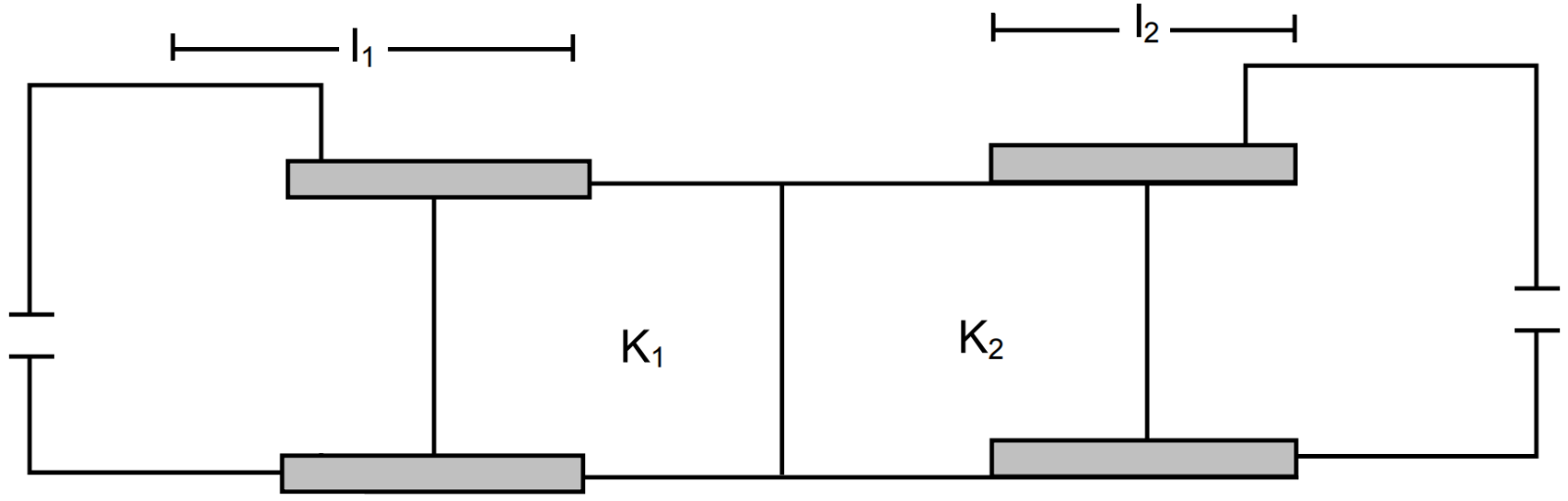
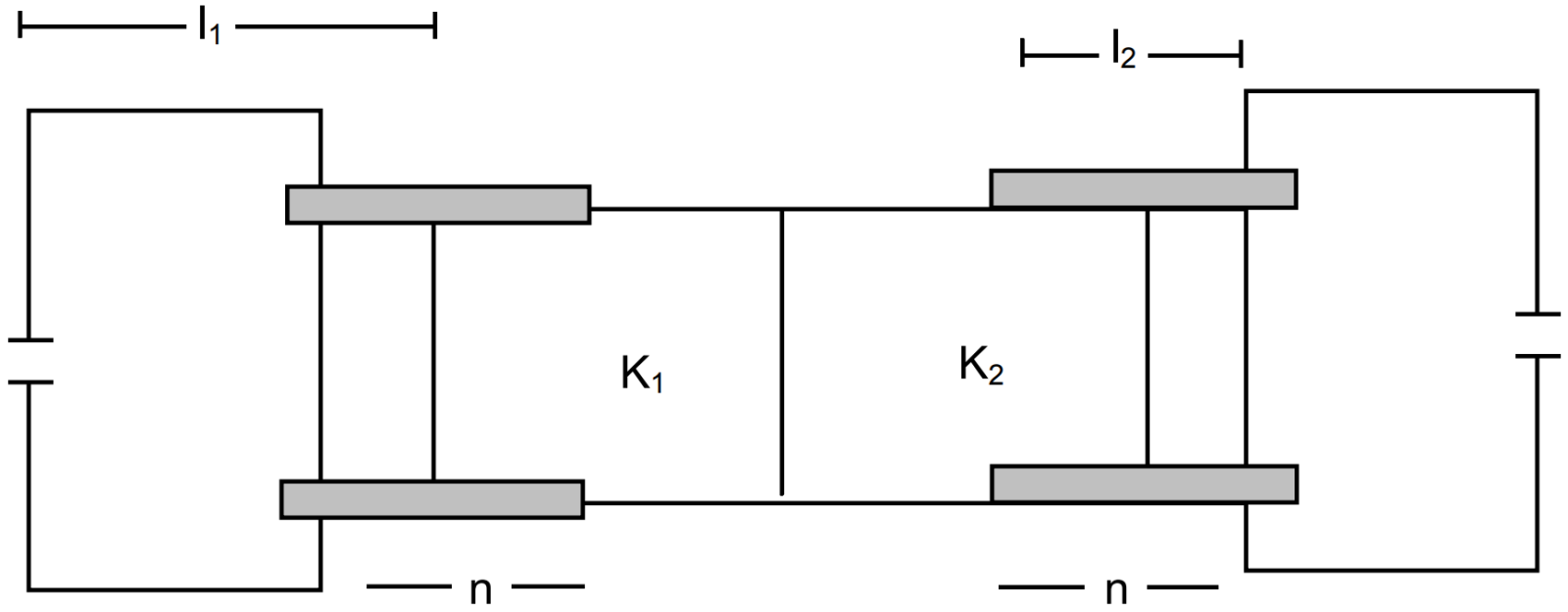
Figure shows two parallel plate capacitors with fixed plates and connected to two batteries. The separation between the plates is the same for the two capacitors. The plates are rectangular in shape with width b and lengths $l_1$ and $l_2$ The left half of the dielectric slab has a dielectric constant $K_1$ and the right half $K_2$. Neglecting any friction, find the ratio of the emf of the left. battery to that of the right battery for which the dielectric slab may remain in equilibrium.
Answer


Consider the left side
The plate area of the part with the dielectric is by its capacitance $\text{C}_1=\frac{\text{K}_1\epsilon_0\text{bx}}{\text{d}}$ and with out dielectric $\text{C}_2=\frac{\epsilon_0\text{b}(\text{L}_1-\text{x})}{\text{d}}$
These are connected in parallel
$\text{C}=\text{C}_1+\text{C}_2$
$=\frac{\epsilon_0\text{b}}{\text{d}}[\text{L}_1+\text{x}(\text{k}_1-1)]$
Let the potential $V_1$
$\text{U}=\Big(\frac{1}{2}\Big)\text{CV}_1^2=\frac{\epsilon_0\text{bv}_1^2}{2\text{d}}[\text{L}_1+\text{x}(\text{k}-1)]\ \dots(1)$
Suppose dielectric slab is attracted by electric field and an external force $F$ consider the part dx which makes inside further, As the potential difference remains constant at $V.$
The charge supply, $dq = (dc)v$ to the capacitor.
The work done by the battery is $dw_b = v.dq = (dc)v^2​​​​​​​$​​​​​​​
The external force $F$ does a work dwe $= (–f.dx)$ during a small displacement.
The total work done in the capacitor is $dw_b + dw_e = (dc)v^2 - fdx$
This should be equal to the increase dv in the stored energy.
Thus $\Big(\frac{1}{2}\Big)(\text{dk})\text{v}^2=(\text{dc})\text{v}^2-\text{fdx}$
$\text{f}=\frac{1}{2}\text{v}^2\frac{\text{dc}}{\text{dx}}$
from equation $(1)$
$\text{F}=\frac{\epsilon_0\text{bv}^2}{2\text{d}}(\text{k}_1-1)$
$\Rightarrow\text{V}_1^2=\frac{\text{F}\times2\text{d}}{\epsilon_0\text{b}(\text{k}_1-1)}$
$\Rightarrow\text{V}_1=\sqrt{\frac{\text{F}\times2\text{d}}{\epsilon_0\text{b}(\text{k}_1-1)}}$
For the right side, $\text{V}_2=\sqrt{\frac{\text{F}\times2\text{d}}{\epsilon_0\text{b}(\text{k}_2-1)}}$
$\frac{\text{V}_1}{\text{V}_2}=\frac{\sqrt{\frac{\text{F}\times2\text{d}}{\epsilon_0\text{b}(\text{k}_1-1)}}}{\sqrt{\frac{\text{F}\times2\text{d}}{\epsilon_0\text{b}(\text{k}_2-1)}}}$
$\frac{\text{V}_1}{\text{V}_2}=\frac{\sqrt{\text{k}_2-1}}{\sqrt{\text{k}_1-1}}$
$\therefore$ The ratio of the emf of the left battery to the right battery $=\frac{\sqrt{\text{k}_2-1}}{\sqrt{\text{k}_1-1}}$

Need a full question paper?

Generate a complete, print-ready paper with questions like this in minutes — across 16+ boards, with answer keys.

Start Generating Free

Similar questions

A person with a normal near point $(25 \ cm)$ using a compound microscope with objective of focal length $8.0\ mm$ and an eyepiece of focal length $2.5 \ cm$ can bring an object placed at $9.0\ mm$ from the objective in sharp focus. What is the separation between the two lenses? Calculate the magnifying power of the microscope.
Calculate and compare the energy released by $a ($ fusion of $1.0 \ kg$ of hydrogen deep within Sun and $b)$ the fission of $1.0 \ kg$ of $^{235}\text{U}$ in a fission reactor.
A $12pF$ capacitor is connected to a $50V$ battery. How much electrostatic energy is stored in the capacitor?
  1. Draw a ray diagram to show the image formation by a combination of two thin convex lenses in contact. Obtain the expression for the power of this combination in terms of the focal lengths of the lenses.
  2. A ray of light passing from air through an equilateral glass prism undergoes minimum deviation when the angle of incidence is $\frac{3}{4}^{th}$ of the angle of prism. Calculate the speed of light in the prism.
A $100$ turn closely wound circular coil of radius $10 \ cm$ carries a current of $3.2 A. \ (a)$ What is the field at the centre of the coil? $(b)$ What is the magnetic moment of this coil?
The coil is placed in a vertical plane and is free to rotate about a horizontal axis which coincides with its diameter. A uniform magnetic field of $2 T$ in the horizontal direction exists such that initially the axis of the coil is in the direction of the field. The coil rotates through an angle of $90^{\circ}$ under the influence of the magnetic field. $(c)$ What are the magnitudes of the torques on the coil in the initial and final position?
$(d)$ What is the angular speed acquired by the coil when it has rotated by $90^{\circ}$ ? The moment of inertia of the coil is $0.1 \ kg m ^2$.
A magnetic field $B$ is confined to a region $ r \leq$ a and points out of the paper $($the $z-$ axis$), r = 0$ being the centre of the circular region. $A$ charged ring $ ($charge $= Q)$ of radius $b, b > a$ and mass m lies in the $x-y$ plane with its centre at the origin. The ring is free to rotate and is at rest. The magnetic field is brought to zero in time $\triangle t$. Find the angular velocity $\omega$ of the ring after the field vanishes.
A square plate of edge d and a circular disc of diameter d are placed touching each other at the midpoint of an edge of the plate as shown in figure. Locate the centre of mass of the combination, assuming same mass per unit area for the two plates.
Two point charges of $+5 \times 10^{-19}C$ and $+20 \times 10^{-19}C$ are separated by a distance of $2m.$ Find the point on the line joining them at which electric field intensity is zero.
The $\text{K}_\alpha$ and $\text{K}_\beta$ X-rays of molybdenum have wavelengths 0.71A and 0.63A respectively. Find the wavelength of $\text{L}_\alpha$ X-ray of molybdenum.
Obtain an expression for motional electromotive force.