Question
Fill in the blanks:
An example of a function which is continuous everywhere but fails to be differentiable exactly at two points is __________.
Answer

An example of a function which is continuous everywhere but fails to be differentiable exactly at two points is x = 0 and x = 1.
Solution:
|x| + |x - 1| is continuous everywhere but fails to be differentiable exactly at points
x = 0 and x = 1.
So, there can be more such examples of functions.

Need a full question paper?

Generate a complete, print-ready paper with questions like this in minutes — across 16+ boards, with answer keys.

Start Generating Free

Similar questions

Fill in the blanks:
If $A$ is invertible matrix of order $3 \times 3,$ then $|A^{-1}|$ _______ .
If $A =\left[\begin{array}{cc}3 & -5 \\ 2 & 0\end{array}\right]$ and $B =\left[\begin{array}{cc}1 & 17 \\ 0 & -10\end{array}\right]$, then $| AB |=$ ________ .
The value of $\int_2^3 x^2 d x=$ _____________
Fill in the blank.
If A is symmetric matrix, then B′AB is _________.
The position vectors of two points A and B are $\overrightarrow{\text{OA}}=2\hat{\text{i}}-\hat{\text{j}}-\hat{\text{k}}$ and $\overrightarrow{\text{OB}}=2\hat{\text{i}}-\hat{\text{j}}-2\hat{\text{k}},$ respectively. The position vector of a point P which divides the line segment joining A and B in the ratio 2 : 1 is ___________.
Fill in the blanks.
In a LPP, the linear inequalities or restrictions on the variables are called _________.
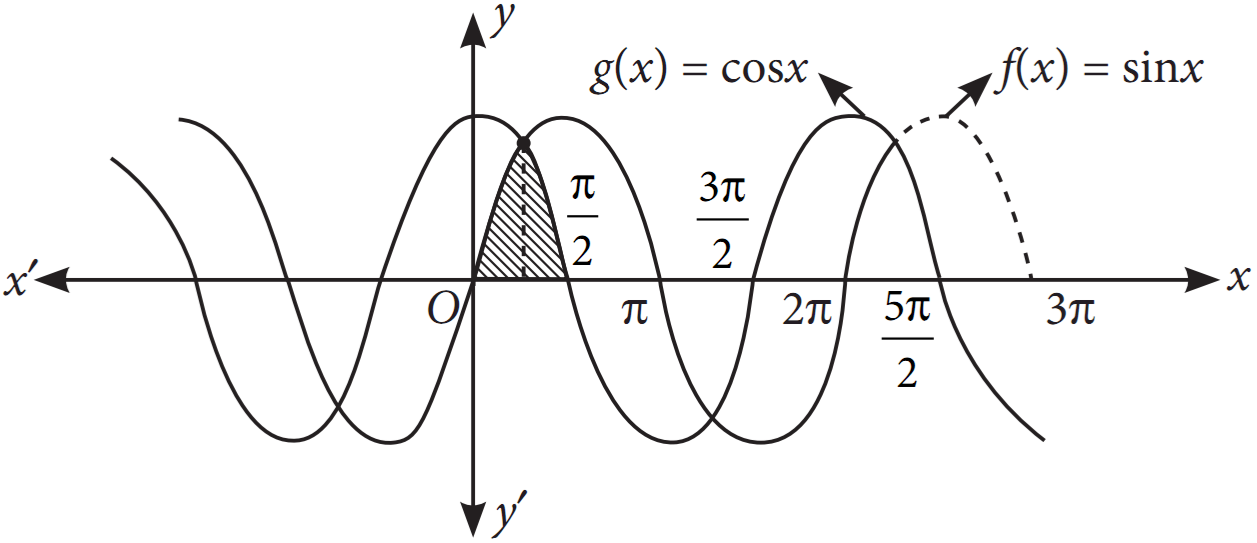
Graphs of two function $\text{f}(\text{x})=\text{sin}\text{ x}$ and $\text{(g)}\text{x}=\text{cos}\text{ x}$ is given below:

Based on the above information, answer the following questions.
  1. In $(0, \pi)$, the curves $\text{f}(\text{x})=\text{sin}\text{ x}$ and $\text{g}\text{ (x)}=\text{cos}\text{ x}$ at $\text{x}=$ 
    1. $\frac{\pi}{2}$
    2. $\frac{\pi}{3}$
    3. $\frac{\pi}{4}$
    4. ${\pi}$
  2. Value of $\int\limits_{0}^{\frac{\pi}{4}}\text{sin}\text{ x}\text{ dx}$ is.
    1. $1-\frac{1}{\sqrt{2}}$
    2. $1+\frac{1}{\sqrt{2}}$
    3. $2-\frac{1}{\sqrt{2}}$
    4. $2+\frac{1}{\sqrt{2}}$
  1. Value of $\int\limits_\frac{\pi}{4}^{\frac{\pi}{2}}\text{cos}\text{ x}\text{ dx}$ is.
    1. $1+\frac{1}{\sqrt{2}}$
    2. $1-\frac{1}{\sqrt{2}}$
    3. $2-\sqrt{2}$
    4. $2+\sqrt{2}$
  2. Value of $\int\limits_{0}^{\pi}\text{sin}\text{ x}\text{ dx}$ is.
  1. 0
  2. 1
  3. 2
  4. -2
  1. Value of $\int\limits_{0}^\frac{\pi}{2}\text{sin}\text{ x}\text{ dx}$ is.
  1. 0
  2. 1
  3. 3
  4. 4
Differentiation of $x^2$ w.r.t. $x^3$ is $=$ _________ .
Fill in the blanks:
The sum of the products of elements of any row with the co$-$factors of corresponding elements is equal to $..............$
Fill in the blanks:
If $\text{f(x)}=|\cos\text{x}-\sin\text{x}|,$ then $\text{f}'\Big(\frac{\pi}{3}\Big)=$ _______.