Question
Fill in the blanks:
The least value of the function $\text{f(x)}=\text{ax}+\frac{\text{b}}{\text{a}}(\text{a}>0,\text{b}>0,\text{x}>0)$ is ______.
Answer

The least value of the function $\text{f(x)}=\text{ax}+\frac{\text{b}}{\text{a}}(\text{a}>0,\text{b}>0,\text{x}>0)$ is $2\sqrt{\text{ab}}$
Solution:
$\text{f(x)}=\text{ax}+\frac{\text{b}}{\text{x}^2}$
$\text{f(x)}=0$
$\Rightarrow\ \text{a}=\frac{\text{b}}{\text{x}^2}$ or $\text{x}=\sqrt{\frac{\text{b}}{\text{a}}}\ \ (\text{as x}>0)$
Now, $\text{f}''(\text{x})=\frac{2\text{b}}{\text{x}^3}>0$ for $\text{x}=\sqrt{\frac{\text{b}}{\text{a}}}$
Thus least value of f(x) is $\text{f}\Big(\sqrt{\frac{\text{b}}{\text{a}}}\Big)=\text{a}\cdot\sqrt{\frac{\text{b}}{\text{a}}}+\frac{\text{b}}{\sqrt{\frac{\text{b}}{\text{a}}}}$ $=\sqrt{\text{ab}}+\sqrt{\text{ab}}=2\sqrt{\text{ab}}$

Need a full question paper?

Generate a complete, print-ready paper with questions like this in minutes — across 16+ boards, with answer keys.

Start Generating Free

Similar questions

The value of $\sin ^{-1}\left(\cos \frac{33 \pi}{5}\right)$ is. ________
If $A =\left[\begin{array}{cc}x & 1 \\ -1 & -x\end{array}\right]$, satisfy the equation $A ^2=0$, then $x$ $=$ __________ .
Fill in the blanks.
The direction cosines of the vector $2\hat{\text{i}}+2\hat{\text{j}}-\hat{\text{k}}$ are ________.
If $A =\left[\begin{array}{ccc}0 & a & 1 \\ -1 & b & 1 \\ -1 & c & 0\end{array}\right]$ has a skew symmetric matrix, then value of $(a+b+c)^2$ ________
The degree of the differential equation $\frac{d^3 y}{d x^3}+2\left(\frac{d^2 y}{d x^2}\right)^2-\frac{d y}{d x}+y=0$ will be _____________ .
Fill in the blank.
If A and B are symmetric matrices, then:
  1. AB – BA is a _________.
  2. BA – 2AB is a _________.
If E and F are independent events then $P ( E \cap F )=$ ___________ .
Fill in the blank.
If $\text{f}(\text{x})=[4-(\text{x}-7)^3],$ then $f^{-1}(x) =$ _______.
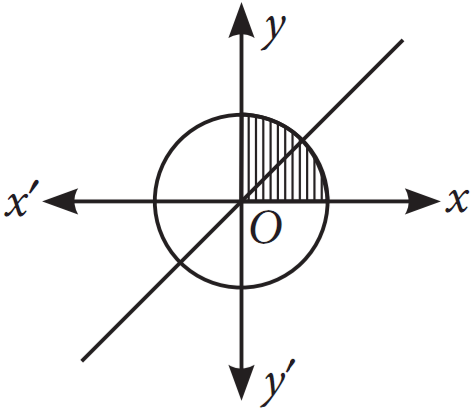
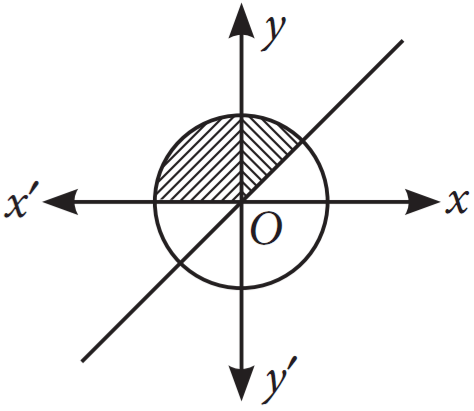
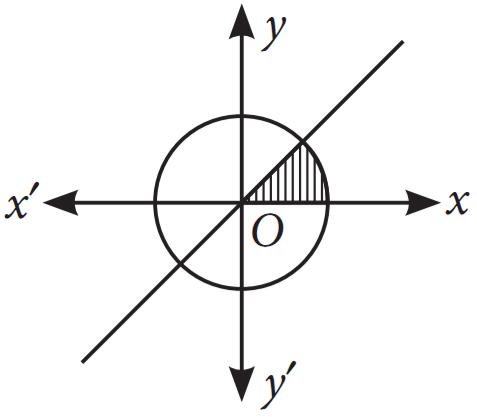
Consider the curve $x^2+y^2=16$ and line $y = x$ in the first quadrant. Based on the above information, answer the following questions.
  1. Point of intersection of both the given curves is.
  1. $(0, 4)$
  2. $(0, 2\sqrt{2})$
  3. $(2\sqrt{ 2},2\sqrt{2})$
  4. $(2,\sqrt{2},4)$
  1. Which of the following shaded portion represent the area bounded by given two curves?
  1. None of these
  1. The value of the integral $\int\limits_{0}^{2\sqrt{2}}\text{x}\text{dx}$ is.
  1. $0$
  2. $1$
  3. $2$
  4. $4$
  1. The value of the integral $\int\limits_{2\sqrt{2}}^{0}\sqrt{16-\text{x}^2}\text{ dx}$ is.
  1. $2(\pi-2)$
  2. $2(\pi-8)$
  3. $4(\pi-2)$
  4. $4(\pi+2)$
  1. Area bounded by the two given curves is.
  1. $3\pi\text{ sq.units}$
  2. $\frac{\pi}{2}\text{ sq.units}$
  3. $\pi\text{ sq.units}$
  4. $2\pi\text{ sq.units}$
If $P ( B )=0.5$ and $P ( A \cap B )=0.32$ then the value of $P ( A \mid B )$ will be ____________ .