MCQ
Final product $'C'$ is ?

  • B

  • C

  • D

Answer

Correct option: A.

a

Need a full question paper?

Generate a complete, print-ready paper with questions like this in minutes — across 16+ boards, with answer keys.

Start Generating Free

Similar questions

For the reaction 

$CO(g) + H_2O(g)  \rightleftharpoons  CO_2(g) + H_2(g)$, at a given temperature, the equilibrium amount of $CO_2(g)$ can be increased by

Which of the following is not a general characteristic of equilibria involving physical processes?
Match List - $I$ with List - $II$

List - $I$

(Pair of Compounds)

List - $II$ (Isomerism)

$A$n-propanol and

Isopropanol

$(I)$ Metamerism

$B$Methoxypropane and

ethoxyethane

$(II)$ Chain Isomerism

$C$Propanone and

propanal

$(III)$ Position Isomerism

$D$Neopentane and

Isopentane

$(IV)$ Functional Isomerism

Choose the correct answer from the options given below: 
The compound $\begin{array}{*{20}{c}}
  {C{H_{3\,\,}}\,\,\,\,\,\,\,} \\ 
  {|\,\,\,\,\,\,\,\,\,\,\,\,\,\,\,\,} \\ 
  {C{H_3} - C = CH - C{H_3}} 
\end{array}$ on reaction with $NaI{O_4}$ in the presence of $KMn{O_4}$ gives
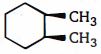
Which of the following describes the best relationship between the methyl groups  in the chair conformation of the substance shown below ?
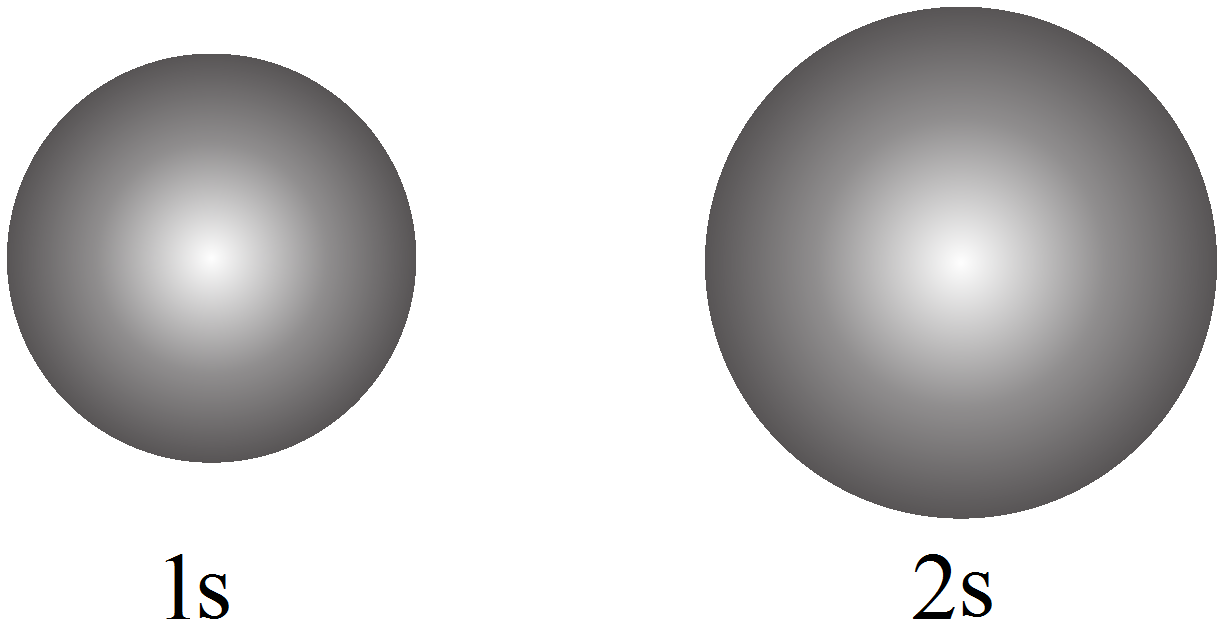
The probability density plots of $1s$ and $2s$ orbitals are given in figure.

The density of dots in a region represents the probability density of finding electrons in the region.
On the basis of above diagram which of the following statements is incorrect?
The enthalpies of the elements in their standard states are assumed to be
An equilibrium mixture of the reaction $2{H_2}S_{(g)}$ $\rightleftharpoons$ $2{H_2}_{(g)} + {S_2}_{(g)}$ had $0.5$ $mole$ ${H_2}S$, $0.10$ $mole$ ${H_2}$ and $0.4$ $mole$ ${S_2}$ in one litre vessel. The value of equilibrium constant $(K)$ in mole litre$^{-1}$ is
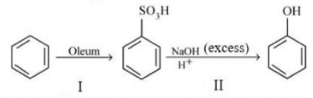
In the following reaction

The $\%$ yield for reaction $I$ is $60 \%$ and that of reaction II is $50 \%$. The overall yield of the complete reaction is $..........\%$ [nearest integer]
For melting of $3 $ moles of water at ${0\,^o}C$ the $\Delta {G^o}$ is