Question
Find a point on the x-axis which is equidistant from the points $(7, 6)$ and $(-3, 4).$

Answer

Let $A (7,6)$ and $B (-3,4)$ be the given points.
Let $P(x, 0)$ be the point on $x$-axis such that $P A=P B$
$PA = PB$
$PA^2 = PB^2$
$(x - 7)^2 + (0 - 6)^2 = (x + 3)^2 + (0 - 4)^2$
$\Rightarrow x^2 + 49 - 14x + 36 = x^2 + 9 + 6x + 16$
$\Rightarrow x^2 - 14x - x^2 - 6x = 9 + 16 - 36 - 49$
$\Rightarrow -20x = -60$
$\Rightarrow x = 3$
$\therefore$ The point on x-axis is $(3, 0).$

Need a full question paper?

Generate a complete, print-ready paper with questions like this in minutes — across 16+ boards, with answer keys.
Start Generating Free

Similar questions

Solve the following equations by using the method of completing the square:
$x^2 - 4x + 1 = 0$
A wall 24m, 0.4m thick and 6m high is constructed with the bricks each of dimensions $25\ cm x 16\ cm x 10\ cm$. If the mortar occupies $\Big(\frac{1}{10}\Big)$ of the volume of the wall, then find the number of bricks used in constructing the wall.
In an isosceles triangle $ABC$, if $AB = AC = 13\ cm$ and the altitude from $A$ on $BC$ is $5cm$, find $BC.$
A box contains 90 discs which are numbered from 1 to 90. If one disc is drawn at random from the box, find the probability that it bears:
  1. A two-digit number.
  2. A perfect square number.
  3. A number divisible by 5.
How many terms of the A.P. $9, 17, 25, .....$ must be taken so that sum is 636?
Determine the $AP$ whose fourth term is $18$ and the difference of the ninth term from the fifteenth term is $30$ .
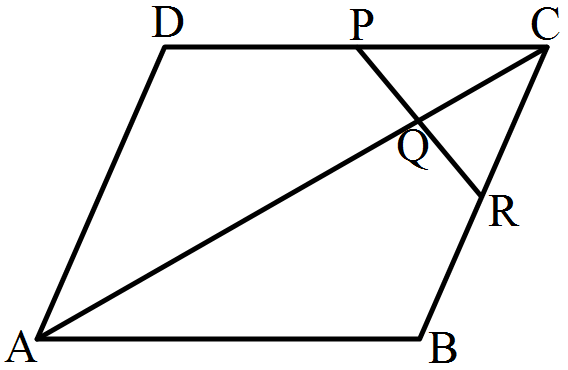
ABCD is a parallelogram in which P is the midpoint of DC and Q is a point on AC such that $\text{CQ}=\frac{1}{4}\text{AC}.$ If PQ produced meets BC at R, prove that R is the midpoint of BC.
Find the sum of first n terms of an AP whose nth term is (5 - 6n). Hence, find the sum of its first 20 terms.
The diameter of a metallic sphere is equal to $9\ cm$. It is melted and drawn into a long wire of diameter 2mm having uniform cross-section. Find the length of the wire.
A circular field has a perimeter of $650\ m$. A square plot having its vertices on the circumference of the field is marked in the field. Calculate the area of the square plot.