Question
Find a vector of magnitude 49, which is perpendicular to both the vectors $2\hat{\text{i}}+3\hat{\text{j}}+6\hat{\text{k}}$ and $3\hat{\text{i}}-6\hat{\text{j}}+2\hat{\text{k}}.$

Answer

Let, $\vec{\text{a}}=2\hat{\text{i}}+3\hat{\text{j}}+6\hat{\text{k}},\vec{\text{b}}=3\hat{\text{i}}-6\hat{\text{j}}+2\hat{\text{k}}$
If $\vec{\text{a}}=\text{a}_1\hat{\text{i}}+\text{b}_1\hat{\text{j}}+\text{c}_1\hat{\text{k}}$ and
$\vec{\text{b}}=\text{a}_2\hat{\text{i}}+\text{b}_2\hat{\text{j}}+\text{c}_2\hat{\text{k}},$ then,
$\vec{\text{a}}\times\vec{\text{b}}=\begin{vmatrix}\hat{\text{i}}&\hat{\text{j}}&\hat{\text{k}}\\\text{a}_1&\text{b}_1&\text{c}_1\\\text{a}_2&\text{b}_2&\text{c}_2 \end{vmatrix}$
$=\begin{vmatrix}\hat{\text{i}}&\hat{\text{j}}&\hat{\text{k}}\\2&3&6\\3&-6&2 \end{vmatrix}$
$=\hat{\text{i}}(6+36)-\hat{\text{j}}(4-18)+\hat{\text{k}}(-12-9)$
$=42\hat{\text{i}}+14\hat{\text{j}}-21\hat{\text{k}}$
$=7\big(6\hat{\text{i}}+2\hat{\text{j}}-3\hat{\text{k}}\big)$
$\big|\vec{\text{a}}\times\vec{\text{b}}\big|=7\sqrt{(6)^2+(2)^2(-3)^2}$
$=7\sqrt{36+4+9}$
$\big|\vec{\text{a}}\times\vec{\text{b}}\big|=7\sqrt{49}$
$\big|\vec{\text{a}}\times\vec{\text{b}}\big|=7\times7$
$\big|\vec{\text{a}}\times\vec{\text{b}}\big|=49$

Need a full question paper?

Generate a complete, print-ready paper with questions like this in minutes — across 16+ boards, with answer keys.

Start Generating Free

Similar questions

The volume of a sphere is increasing at 3 cubic centimeter per second. Find the rate of increase of the radius, when the radius is 2cms.
If R and S are transitive relations on a set A, then prove that $\text{R}\cup\text{S}$ may not be a transitive relation on A.
Determine that value of the constant 'k' so that function $\text{f(x)}=\begin{cases}\frac{\text{kx}}{|\text{x}|},&\text{if }\text{ x}<0\\3,&\text{if }\text{ x}\geq0\end{cases}$ is continuous at x = 0.
Find the equation of the line passing through the point $(3,1,2)$ and perpendicular to the lines $\frac{x-1}{1}=\frac{y-2}{2}=\frac{z-3}{3}$ and $\frac{x}{-3}=\frac{y}{2}=\frac{z}{5}$.
If $\text{A}=\begin{bmatrix}1&2\\0&3 \end{bmatrix}$ is written as B + C, where B is a symmetric matrix and C is a skew- symmetric matrix, then B is equal to.
Find the angle between the plane:
x + y - 2z = 3 and 2x - 2y + z = 5
Diffrentiate the following w.r.t.x

$\log \left(\sqrt{\left.\frac{1+\cos \left(\frac{5 x}{2}\right)}{1-\cos \left(\frac{5 x}{2}\right)}\right)}\right.$
Find vector equation of line passing through the point whose position vector is $3 \hat{i}-4 \hat{j}+\hat{k}$ and parallel to the vector $2 \hat{i}+\hat{j}-3 \hat{k}$. Also write the equation in Cartesian form.
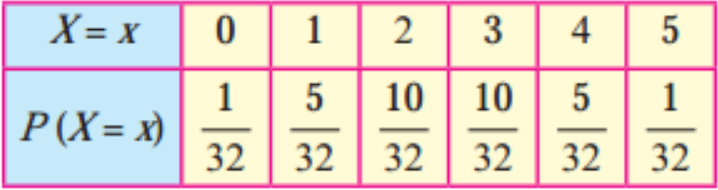
Find the expected value, variance, and standard deviation of the random variable whose p.m.f’s are given below:

Image

If $\text{y}=\sqrt{\tan\text{x}+\sqrt{\tan\text{x}+\sqrt{\tan\text{x}+\ .... \text{to }\infty}}}$ prove that $\frac{\text{dy}}{\text{dx}}=\frac{\sec^2\text{x}}{2\text{y}-1}$