MCQ
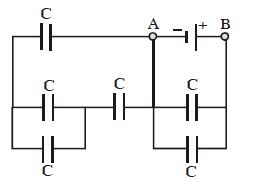
Find equivalent capacitance between $A$ and $B$
  • A
    $3\,\,C$
  • B
    $5\,\,C$
  • C
    $4\,\,C$
  • $2\,\,C$

Answer

Correct option: D.
$2\,\,C$
d
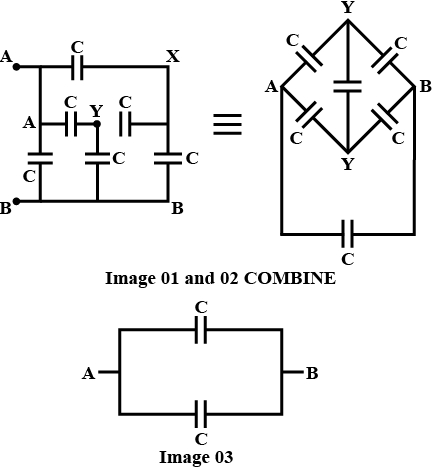
For IMAGE $O1$ AND $O2:$

[Loops $A X B Y$ forms wheat stone bridge]

so, effective capacitance will be for the bridge $C$

In IMAGE $O3$ the parallel combination

$C^{\prime}=C+C=2 C$
Need a full question paper?

Generate a complete, print-ready paper with questions like this in minutes — across 16+ boards, with answer keys.

Start Generating Free

Similar questions

Assertion : The setting sun appears to be red.

Reason : Scattering of light is directly proportional to the wavelength.
The path of a refracted ray of light in a prism is parallel to the base of the prism only when the
The length of a potentiometer wire is $l$. $A$ cell of $\mathrm{emf}$ $E$ is balanced at a length $l/3$ from the positive end of the wire. If the length of the wire is increased by $l/2$. At what distance will the same cell give a balance point.
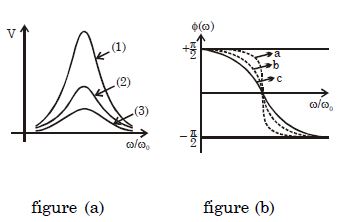
Figure $(a)$  shows plot of voltage across the capacitor as a function of the driving frequency for a sinusoidally driven electromagnetic oscillator $LCR$ circuit. Figure $(b)$ shows phase angle $\phi$ (phase difference between voltage and current) vs $\omega/\omega_0$ graph for same circuit, for three different quality factor graph $1, 2, 3$ of figure $(a)$ and each one can be  matched by one of graphs $a, b, c$ also of figure $(b)$ :-
From Maxwell’s hypothesis, a charging electric field gives rise to:
Dipole moment depends on $........$?
The force exerted by a magnetic field on a wire having length $L$ and current $I$ is perpendicular to the wire and given as $\left| F \right| = IL\left| B \right|$ . An experimental plot shows $(\vec F)$ as function of $L$ . The plot is a straight line with a slope $S = \left( {10 \pm 1} \right) \times {10^{ - 5}}\ AT$. The current in the wire is $\left( {15 \pm 1} \right)\ mA$ . The percentage error in $B$ is
Match the nuclear processes given in column $I$ with the appropriate option$(s)$ in column $II$
column $I$ column $II$
$(A.)$Nuclear fusion $(P.)$ Absorption of thermal neutrons by ${ }_{92}^{213} U$
$(B.)$Fission in a nuclear reactor $(Q.)$ ${ }_{27}^{60} Co$ nucleus
$(C.)$ $\beta$-decay $(R.)$ Energy production in stars via hydrogen conversion to helium
$(D.)$ $\gamma$-ray emission $(S.)$ Heavy water
  $(T.)$ Neutrino emission
In a hydrogen atom, an electron moves in a circular orbit of radius $5.2 \times {10^{ - 11}}\,m$ and produces a magnetic induction of $12.56\, T$ at its nucleus. The current produced by the motion of the electron will be (Given ${\mu _0} = 4\pi \times {10^{ - 7}}\,Wb/A - m)$
An atomic mass unit $($amu$)$ will be equal to :