Question
Find following product:
$\frac{1}{4}\text{xy}×\frac{2}{3}\text{x}^2\text{yz}^2$

Answer

To multiply algebraic expressions, we can use commutative and associative laws along with the law of indices, $a^m \times a^n=a^{m+n}$.
We have:
$\frac{1}{4}\text{xy}×\frac{2}{3}\text{x}^2\text{yz}^2$
$=\big(\frac{1}{4}×\frac{2}{3}\big)×\big(\text{x}×\text{x}^2)×(\text{y}×\text{y})×\text{z}^2$
$=\big(\frac{1}{4}×\frac{2}{3}\big)×\big(\text{x}^{1+2}\big)×\big(\text{y}^{1+1}\big)×\text{z}^2$
$=\frac{1}{6}\text{x}^3\text{y}^2\text{z}^2$
Thus, the answer is $=\frac{1}{6}\text{x}^3\text{y}^2\text{z}^2$

Need a full question paper?

Generate a complete, print-ready paper with questions like this in minutes — across 16+ boards, with answer keys.
Start Generating Free

Similar questions

Represent the following numbers on the number line.
-3
The value of a machine depreciates at the rate of 10% per annum. What will be its value 2 years hence, if the present value is Rs. 100000? Also, find the total depreciation during this period.
Prepare a frequency table of the following scores obtained by 50 students in a test:
42, 51, 21, 42, 37, 37, 42, 49, 38, 52, 7, 33, 17, 44, 39, 7, 14, 27, 39, 42, 42, 62, 37, 39, 67, 51, 53, 53, 59, 41, 29, 38, 27, 31, 64, 19, 53, 51, 22, 61, 42, 39, 59, 47, 33, 34, 16, 37, 57, 43.
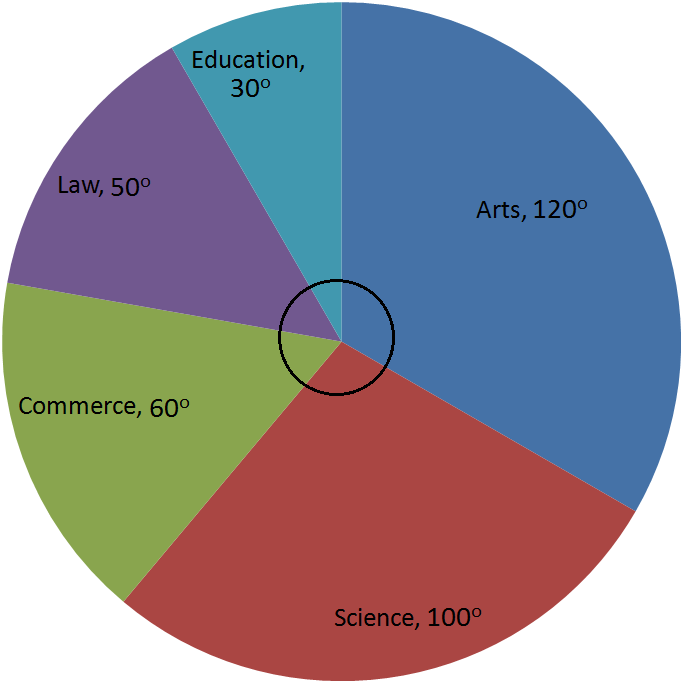
The following pie-chart shows the number of students admitted in different faculties of a college. If 1000 students are admitted in Science answer the following:
  1. What is the total number of students?
  2. What is the ratio of students in science and arts?
Find the compound interest if the amount of a certain principal after two years is Rs 4036.80 at the rate of 16 p.c.p.a.
A shopkeeper gives 11% discount on a television set, hence the cost price of it is Rs 22,250. Then find the marked price of the television set.
Observe the following pattern:
$1^3=1$
$1^3+2^3=(1+2)^2$
$1^3+2^3+3^3=(1+2+3)^2$
Write the next three rows and calculate the value of $1^3+2^3+3^3+\ldots+9^3+10^3$ by the above pattern.
Evaluate following when x = 2, y = −1.
$(2\text{xy})×\big(\frac{\text{x}^2\text{y}}{4}\big)×\big(\text{x}^2\big)×\big(\text{y}^2\big)$
A box contains 19 balls bearing numbers 1, 2, 3, ..., 19 respectively. A ball is drawn at random from the box. Find the probability that the number on the ball is:
  1. A prime number.
  2. An even number.
  3. A number divisible by 3.
Three numbers are in the ratio $1: 2: 3$. The sum of their cubes is 98784 . Find the numbers.