Question
$\text{Find} \int \frac{\sqrt{x}}{\sqrt{\text{a}^{3}} - \text{x}^{3}}\text{dx}.$

Answer

$\text{I} = \int \frac{\sqrt{x}}{\sqrt{\text{a}^{3}} - \text{x}^{3}}\text{dx}$
$\text{Put x}^{3/2} = \text{t}\Rightarrow\frac{3}{2}.\text{x}^{1/2}\text{dx = dt or}\sqrt{\text{x }} dx= \frac{3}{2}\text{dt}$
$\text{I} = \frac{2}{3}\int\frac{\text{dt}}{\sqrt{\text{(a}^{3/2})^{2} - \text{t}^{2}}}$
$= \frac{2}{3}.\sin^{-1}\bigg(\frac{\text{t}}{\text{a}^{3/2}}\bigg)+\text{C}$
$= \frac{2}{3} \sin^{-1}\bigg(\frac{\text{x}^{3/2}}{\text{a}^{3/2}}\bigg)+ \text{C}$

Need a full question paper?

Generate a complete, print-ready paper with questions like this in minutes — across 16+ boards, with answer keys.
Start Generating Free

Similar questions

Differentiate the following functions with respect to x:
$\text{e}^{\text{ax}}\sec\text{x}\tan2\text{x}$
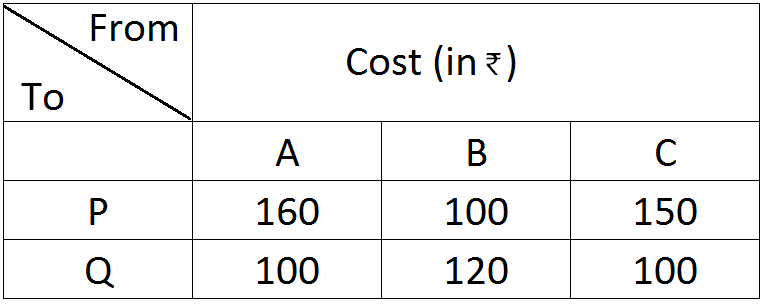
There are two factories located one at place P and the other at place Q. From these locations, a certain commodity is to be delivered to each of the three depots situated at A, B and C. The weekly requirements of the depots are respectively 5, 5 and 4 units of the commodity while the production capacity of the factories at P and Q are respectively 8 and 6 units. The cost of transportation per unit is given below:
How many units should be transported from each factory to each depot in order that the transportation cost is minimum. What will be the minimum transportation cost?
A dice rolled two times and sum of appeared number found 7 . Find the conditional probability of getting 3 at least one time.
Solve the following systems of linear equations by cramer's rule:
2x + 3y = 10,
x + 6y = 4
Find the equations of the tangent and the normal to the following curves at the indicated points.
$\text{x}=\text{at}^2,\text{y}=2\text{at at}\text{ t}=1$
$\text{If}\cos\text{y}=\text{x}\cos(\text{a}+\text{y}),\ \text{with}\cos\text{a}\neq\pm1,\ \text{prove that}\frac{\text{dy}}{\text{dx}}=\frac{\cos^2(\text{a}+\text{y})}{\sin\text{a}}$ 
Solve the following systems of linear equations by cramer's rule:
x + 2y = 1,
3x + y = 4
If $\text{f}\text{(x)}=\begin{cases}\frac{1-\cos\text{kx}}{\text{x}\sin\text{x}}, & \text{x} \neq 0\\\frac{1}{2}, & \text{x}= 0\end{cases}$ is continuous at x = 0. find k.
Find the equation of a plane which is at a distance of $3\sqrt{3}\text{ units}$ from the origin and the normal to which is equally inclined to the coordinate axes.
Find the points o local maxima or local minima, if any, of the following functions, using the first derivatives test. Also, find the local maximum or local minimum values, as the case may be:
$\text{f}(\text{x})=\sin2\text{x}-{\text{x}},-\frac{\pi}{2}\leq\text{x}\leq\frac{\pi}{2}$