Question
Find mean, variance and S.D. of the following data.
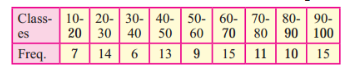
Image

Answer


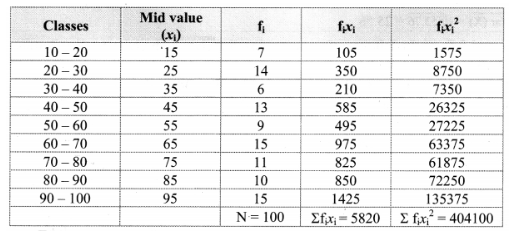
Image

$\bar{x}=\frac{\sum f_i x_1}{ N }=\frac{5820}{100}=58.2$

$\operatorname{Var}( X )=\sigma_x^2=\frac{\sum f _{ i } x_{ i }^2}{ N }-(\bar{x})^2$

$\begin{aligned} & =\frac{404100}{100}-(58.2)^2 \\ & =4041-3387.24\end{aligned}$

$=653.76$

S.D. $=\sigma_x=\sqrt{\operatorname{Var}(X)}=\sqrt{653.76}=25.56$

Alternate Method:

Let $u =\frac{ x - A }{ h }=\frac{ x -55}{10}$

Calculation of variance of u:
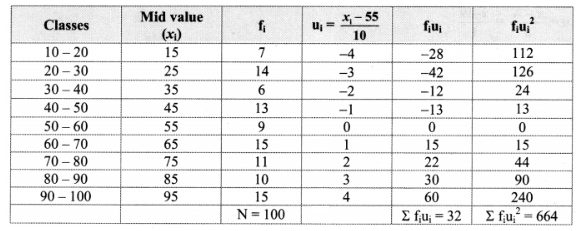

Image

$\overline{ u }=\frac{\sum f _{ f } u _i}{ N }=\frac{32}{100}=0.32$

$\begin{aligned} \bar{x} & =\overline{ u } \times h + A \\ & =0.32 \times 10+55\end{aligned}$

$=58.2$

$\operatorname{Var}( u )=\sigma_{ u }{ }^2=\frac{\sum f _i u _i{ }^2}{ N }-(\overline{ u })^2$

$\begin{aligned} & =\frac{664}{100}-(0.32)^2 \\ & =6.64-0.1024 \\ & =6.5376\end{aligned}$

$\begin{aligned} \operatorname{Var}(X) & =h^2 \operatorname{Var}(u) \\ & =(10)^2 \times 6.5376 \\ & =100 \times 6.5376 \\ & =653.76\end{aligned}$

S.D. $=\sigma_x=\sqrt{\operatorname{Var}(X)}=\sqrt{653.76}=25.56$

Need a full question paper?

Generate a complete, print-ready paper with questions like this in minutes — across 16+ boards, with answer keys.

Start Generating Free

Similar questions

Find the equation of the straight line perpendicular to $2x - 3y = 5$ and cutting off an intercept $1$ on the positive direction of the $x-$axis.
Find the coordinates of the foot of the perpendicular from the point (-1, 3) to the line 3x- 4y - 16 = 0.
If $\cot \theta=\frac{3}{4}$ and $\pi<\theta<\frac{3 \pi}{2}$, then find the value of $4 \operatorname{cosec} \theta+5 \cos \theta$.
Prove the following by the principle of mathematical induction:
$\frac{1}{2}+\frac{1}{4}+\frac{1}{8}+...+\frac{1}{2^\text{n}}=1-\frac{1}{2^\text{n}}$
Find the derivatives of the following w.r.t. x. at the points indicated against them by using the method of the first principle:
$\cos x$ at $x=\frac{5 \pi}{4}$
Sum the following series to n terms:
$\frac{1}{1.6}+\frac{1}{6.11}+\frac{1}{11.16}+\frac{1}{16.21}+\ .....\ +\frac{1}{(5\text{n}-4)(5\text{n}+1)}$
If $A=\left[\begin{array}{ll}3 & -4 \\ 1 & -1\end{array}\right]$, prove that $A^n=\left[\begin{array}{cc}1+2 n & -4 n \\ n & 1-2 n\end{array}\right]$, for all $n \in \mathbf{N}$.
Find the co-ordinates of the orthocentre of the triangle whose vertices are A(2, – 2), B(l, 1) and C(-1,0).
Find $a$ and $b$ if the following function is continuous at the point or on the interval indicated against them:
$
\begin{aligned}
f(x) & =a x^2+b x+1, & & \text { for }|2 x-3| \geq 2 \\
& =3 x+2, & & \text { for } \frac{1}{2}\end{aligned}
$
The equations of perpendicular bisectors of the sides $AB$ and $AC$ of a triangle $ABC$ are $x - y + 5 = 0$ and $x + 2y = 0$ respectively. If the point $A$ is $(1, -2),$ find the equation of the line $BC.$