Question
Find out magnetic force on parallel current carrying conductors and also state their special conditions.
Answer

SELF

Need a full question paper?

Generate a complete, print-ready paper with questions like this in minutes — across 16+ boards, with answer keys.

Start Generating Free

Similar questions

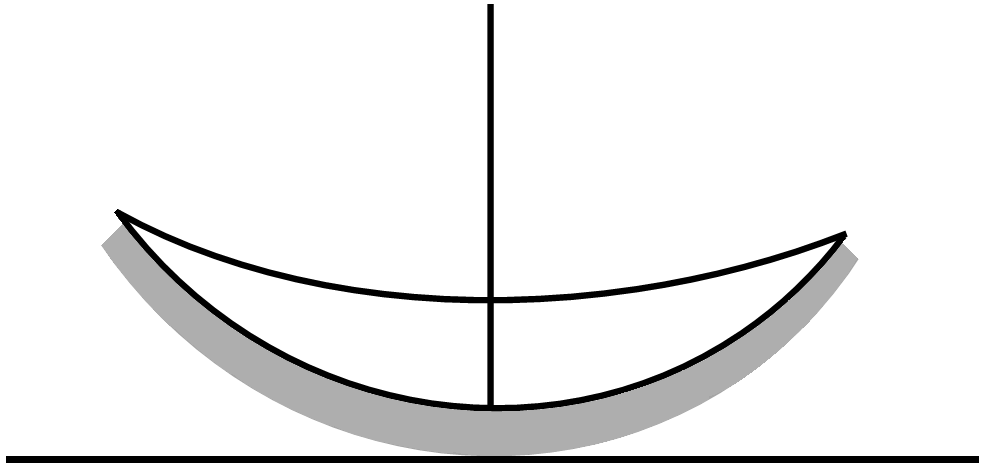
The convex surface of a thin concavo-convex lens of glass of refractive index 1.5 has a radius of curvature 20cm. The concave surface has a radius of curvature 60cm. The convex side is silvered and placed on a horizontal surface as shown in figure.
  1. Where should a pin be placed on the axis so that its image is formed at the same place?
  2. If the concave part is filled with water $\Big(\mu=\frac{4}{3}\Big),$ find the distance through which the pin should be moved so that the image of the pin again coincides with the pin.
There are two sources of light, each emitting with a power of 100W. One emits X-rays of wavelength 1nm and the other visible light at 500nm. Find the ratio of number of photons of X-rays to the photons of visible light of the given wavelength?

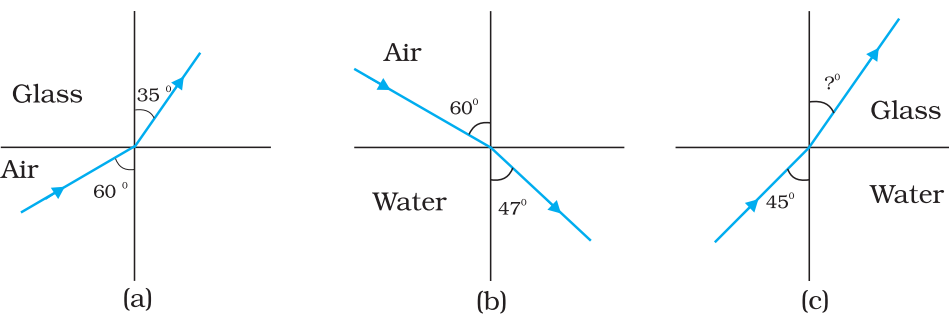
(a) and (b) show refraction of a ray in air incident at 60° with the normal to a glass-air and water-air interface, respectively. Predict the angle of refraction in glass when the angle of incidence in water is 45º with the normal to a water - glass interface.
Three bulbs, each with a resistance of $180\Omega,$ are connected in parallel to an ideal battery of emf 60V. Find the current delivered by the battery when.
(a) all the bulbs are switched on, (b) two of the bulbs are switched on and (c) only one bulb is switched on.
A thin lens made of a material of refractive index $\mu_2$ has a medium of refractive index $\mu_1$ on one side and a medium of refractive index $\mu_3$ on the other side. The lens is biconvex and the two radii of curvature have equal magnitude R. A beam of light travelling parallel to the principal axis is incident on the lens. Where will the image be formed if the beam is incident from:
  1. The medium $\mu_1$
  2. From the medium $\mu_3?$
Define induction coefficient. Explain the phenomenon of mutual inductance with the help of an experiment. Obtain an expression for mutual inductance coefficient of two solenoids and prove that $M=\sqrt{L_1 L_2}$.
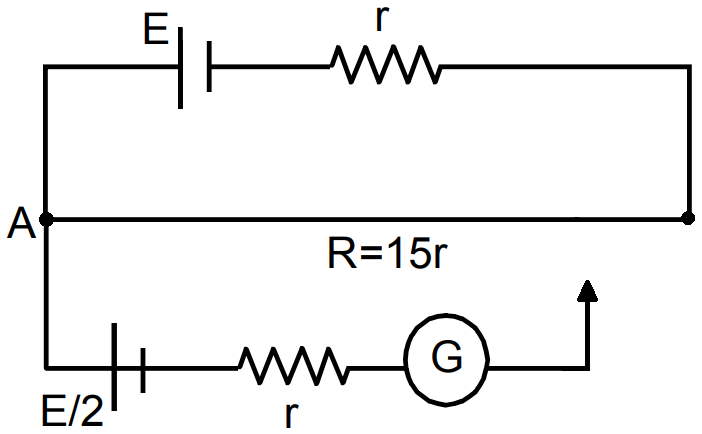
Consider the potentiometer circuit as arranged in the figure. The potentiometer wire is 600cm long. (a) At what distance from the point A should the jockey touch the wire to get zero deflection in the galvanometer? (b) If the jockey touches the wire at a distance of 560cm from A, what will be the current in the galvanometer?
An aluminium can of cylindrical shape contains $500 \mathrm{~cm}^3$ of water. The area of the inner cross section of the can is $125 \mathrm{~cm}^2$. All measurements refer to $10^{\circ} \mathrm{C}$. Find the rise in the water level if the temperature increases to $80^{\circ} \mathrm{C}$. The coefficient of linear expansion of aluminium $=23 \times 10^{-6}{ }^{\circ} \mathrm{C}^{-1}$ and the average coefficient of volume expansion of water $=3.2 \times 10^{-4}{ }^{\circ} \mathrm{C}^{-1}$ respectively.
When an electron goes from the valence band to the conduction band in silicon, its energy is increased by 1.1eV. The average energy exchanged in a thermal collision is of the order of kT which is only 0.026eV at room temperature. How is a thermal collision able to take some of the electrons from the valence band to the conduction band?
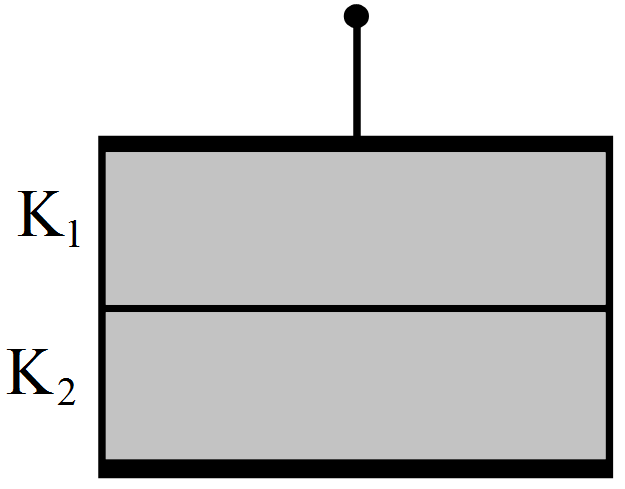
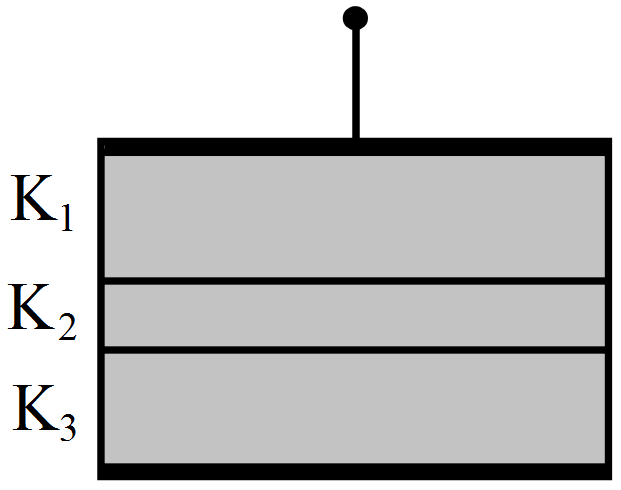
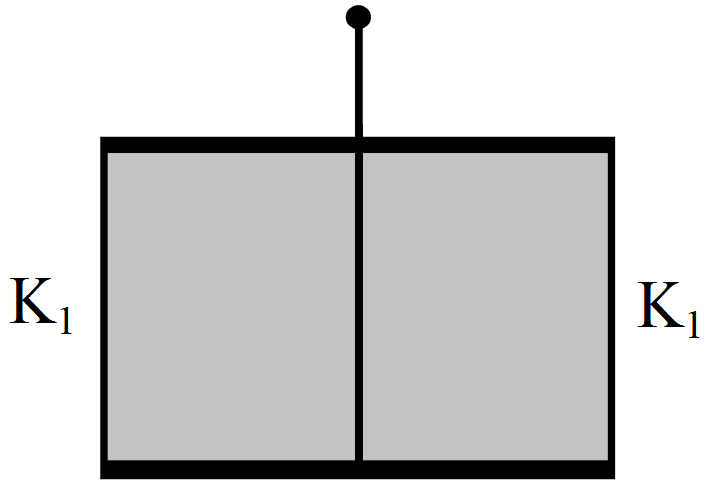
Find the capacitances of the capacitors shown in figure. The plate area is A and the separation between the plates is d. Different dielectric slabs in a particular part of the figure are of the same thickness and the entire gap between the plates is filled with the dielectric slabs.