MCQ
Find out the incorrect statement
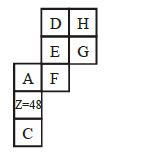
  • A
    The nature of oxide $A$ and $E$ element is amphoteric
  • B
    Element $E$ and $F$ has difference in $Z_{eff}$ is $1.5$
  • Oxide of element $G$ and $H$ is acidic in higher $O.S.$
  • D
    Element $H$ forms neutral oxide in lower oxidation state which is formed when formic acid is react with dil $H_2SO_4$
Answer

Correct option: C.
Oxide of element $G$ and $H$ is acidic in higher $O.S.$
c
As charges of the ions increases or their sizes decreases the lattice energy increases resulting in higher melting point and greater hardness.

Amongst sodium halides $NaF$ has the maximum lattice energy so it has the highest melting point. As $F$-has the smallest size.

Need a full question paper?

Generate a complete, print-ready paper with questions like this in minutes — across 16+ boards, with answer keys.

Start Generating Free

Similar questions

Identify correct statements from below:

$A$. The chromate ion is square planar.

$B$. Dichromates are generally prepared from chromates.

$C$. The green manganate ion is diamagnetic.

$D$. Dark green coloured $\mathrm{K}_2 \mathrm{MnO}_4$ disproportionates in a neutral or acidic medium to give permanganate.

$E$. With increasing oxidation number of transition metal, ionic character of the oxides decreases.

Choose the correct answer from the options given below:

Which of the following have the same number of unpaired electrons in $‘d’$ orbitals
Element $x$ is strongly electropositive and $y$ is strongly electronegative. Both element are univalent, the compounds formed from their combination will be
An aqueous solution of $NaCl$ shows the depression of freezing point of water equal to $0.372\,K$. The boiling point of $BaCl_2$ solution of same molality will be  .........$^oC$ .$[K_f \,(H_2O)= 1.86\,K\,kg\,mol^{-1}$ ; $K_b\,(H_2O) = 0.52\,K\,kg\,mol^{-1} ]$
The formation of the oxide ion $O^{2-}(g)$ requires first an exothermic and then  an endothermic step as shown below

$O(g) + e^- \to O^-(g);  \Delta H = - 142 \,kJ \,mol^{-1}$

$O^-(g) + e \to O^{2-} (g); \Delta H = 844\, kJ \,mol^{-1}$

This is because

Given $l/a = 0.5\,c{m^{ - 1}},\,R = 50\,ohm,\,N = 1.0$. The equivalent conductance of the electrolytic cell is ................ ${\rm{Oh}}{{\rm{m}}^{ - 1}}{\mkern 1mu} {\rm{c}}{{\rm{m}}^2}{\rm{gm}}\,{\rm{e}}{{\rm{q}}^{ - 1}}$
Which of the following is non-polar
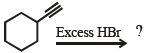
Identify the major product of the following reaction
Which of the following equations is a balanced one ?
Compare $\pi -$ bond strength between $B$ and $N$ given in two compounds

$(I)$  $\begin{array}{*{20}{c}}
  {{{(C{H_3})}_3}Si - NB{H_2}} \\ 
  {\,\,\,\,\,\,\,\,\,\,\,\,\,\,\,\,\,\,|} \\ 
  {\,\,\,\,\,\,\,\,\,\,\,\,\,\,\,\,\,\,\,\,\,\,\,\,\,\,\,\,\,\,\,\,\,\,Si{{(C{H_3})}_3}} 
\end{array}$         $(II)$   $\begin{array}{*{20}{c}}
  {{{(C{H_3})}_3}C - NB{H_2}} \\ 
  {\,\,\,\,\,\,\,\,\,\,\,\,\,\,\,\,\,|} \\ 
  {\,\,\,\,\,\,\,\,\,\,\,\,\,\,\,\,\,\,\,\,\,\,\,\,\,\,\,\,\,\,\,\,\,\,\,C{{(C{H_3})}_3}} 
\end{array}$