Question
Find $\frac{\text{dy}}{\text{dx}}$ in the following cases:
$(x + y)^2 = 2axy$

Answer

We Have,$ (x + y)^2 = 2axy$
Differentiating with respect to x, we get,
$\Rightarrow\frac{\text{d}}{\text{dx}}\big(\text{x}+\text{y}\big)^2=\frac{\text{d}}{\text{dx}}\big(2\text{axy}\big)$
$\Rightarrow2(\text{x}+\text{y})\frac{\text{d}}{\text{dx}}(\text{x}+\text{y})=2\text{a}\Big[\text{x}\frac{\text{dy}}{\text{dx}}+\text{y}\frac{\text{d}}{\text{dx}}(\text{x})\Big]$
$\Rightarrow2(\text{x}+\text{y})\Big[1+\frac{\text{dy}}{\text{dx}}\Big]=2\text{a}\Big[\text{x}\frac{\text{dy}}{\text{dx}}+\text{y}(1)\Big]$
$\Rightarrow2(\text{x}+\text{y})+2(\text{x}+\text{y})\frac{\text{dy}}{\text{dx}}=2\text{a}\text{x}\frac{\text{dy}}{\text{dx}}+2\text{ay}$
$\Rightarrow\frac{\text{dy}}{\text{dx}}\big[2(\text{x}+\text{y})-2\text{a}\text{x}\big]=2\text{ay}-2(\text{x}+\text{y})$
$\Rightarrow\frac{\text{dy}}{\text{dx}}=\frac{2[\text{ay}-\text{x}-\text{y}]}{2[\text{x}+\text{y}-\text{a}\text{x}]}$
$\Rightarrow\frac{\text{dy}}{\text{dx}}=\Big(\frac{\text{ay}-\text{x}-\text{y}}{\text{x}+\text{y}-\text{a}\text{x}}\Big)$

Need a full question paper?

Generate a complete, print-ready paper with questions like this in minutes — across 16+ boards, with answer keys.
Start Generating Free

Similar questions

Evaluate the following integrals:$\int\limits^{\frac{\pi}{4}}_{-\frac{\pi}{4}}\frac{\cos^{2}\text{x}}{1+\text{e}^{\text{x}}}\text{ dx}$
Evalute the following integrals:
$\int\frac{\sin(\text{x}-\alpha)}{\sin(\text{x}+\alpha)}\text{dx}$
Evaluate the following integrals:$\int_{0}^\limits{\frac{\pi}{4}}\big(\text{a}^2\cos^2\text{x}+\text{b}^2\sin^2\text{x}\big)\text{dx}$
Evaluate the following integrals:
$\int\frac{\text{x}^3}{(\text{x}^2+1)^3}\text{dx}$
Show that $\text{AB}\neq\text{BA}$ in the following cases:
$\text{A}=\begin{bmatrix}1&3&-1\\2&-1&-1\\3&0&-1\end{bmatrix}$ and $\text{B}=\begin{bmatrix}-2&3&-1\\-1&2&-1\\-6&9&-4\end{bmatrix}$
Find the equation of the plane passing through the point (-1, 3, 2) and perpendicular to each of the planes x + 2y + 3z = 5 and 3x + 3y + z = 0.
Classify the following functions as injection, surjection or bijection:
$f : Z \rightarrow Z$ given by $f(x) = x^3$
Differentiate $\sin^{-1}\Big(4\text{x}\sqrt{1-4\text{x}^2}\Big)$ with respect to $\sqrt{1-4\text{x}^2},$ if:
$\text{x}\in\Big(-\frac{1}{2\sqrt{2}},\frac{1}{\sqrt{2\sqrt{2}}}\Big)$
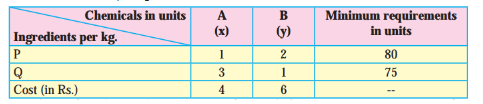
A factory produced two types of chemicals A and B. The following table gives the units of ingredients P and Q (per kg) of chemicals A and B as well as minimum requirements of P and Q and also cost per kg. chemicals A and B :

Image

Find the number of units of chemicals A and B should be produced so as to minimize the cost.

Find the value of x for which the matrix product
$\begin{bmatrix}2&0&7\\0&1&0\\1&-2&1\end{bmatrix}\begin{bmatrix}-\text{x}&14\text{x}&7\text{x}\\0&1&0\\\text{x}&-4\text{x}&-2\text{x}\end{bmatrix}$ equal an identity matrix.