Question
Find the angle between the given planes.
$\vec{\text{r}}\cdot(2\hat{\text{i}}-3\hat{\text{j}}+4\hat{\text{k}})=1$ and $\vec{\text{r}}\cdot(-\hat{\text{i}}+\hat{\text{j}})=4$
Answer

We know that the angle between the planes $\vec{\text{r}}\cdot\vec{\text{n}}_1=\text{d}_1,\vec{\text{ r}}\cdot\vec{\text{n}}_2=\text{d}_2$ is given by
$\cos\theta=\frac{\vec{\text{n}}_1\cdot\vec{\text{n}}_2}{|\vec{\text{n}}_1||\vec{\text{n}}_2|}$
Here, $\vec{\text{n}}_1=2\hat{\text{i}}-3\hat{\text{j}}+4\hat{\text{k}}$
$\vec{\text{n}}_2=-\hat{\text{i}}+\hat{\text{j}}+0\hat{\text{k}}$
So, $\cos\theta=\frac{(2\hat{\text{i}}-3\hat{\text{j}}+4\hat{\text{k}})\cdot(-\hat{\text{i}}+\vec{\text{j}}+0\hat{\text{k}})}{\big|2\hat{\text{i}}-3\hat{\text{j}}+4{\hat{\text{k}}\big|}\big|\hat{\text{i}}-3\hat{\text{j}}+4\hat{\text{k}}\big|}$
$=\frac{-2-3}{\sqrt{4+9+16}\sqrt{1+1+0}}$
$=\frac{-5}{\sqrt{29}\sqrt{2}}$
$=\frac{-5}{\sqrt{58}}$
$\theta=\cos^{-1}\Big(\frac{-5}{\sqrt{58}}\Big)$ 

Need a full question paper?

Generate a complete, print-ready paper with questions like this in minutes — across 16+ boards, with answer keys.

Start Generating Free

Similar questions

Integrate the function in Exercise:$\frac{\sin^{8}-\cos^{8}\text{x}}{1-2\sin^{2}\text{x}\cos^{2}\text{x}}$
Check whether the relation R defined on the set A = {1, 2, 3, 4, 5, 6} as R = {(a, b): b = a + 1} is reflexive, symmetric or transitive.
Evaluate the following intregals:
$\int\frac{1}{\cos\text{x}(\sin\text{x}+2\cos\text{x})}\ \text{dx}$
Show that the following planes are at right angles.
$\vec{\text{r}}\cdot(2\hat{\text{i}}-\hat{\text{j}}+\hat{\text{k}})=5$ and $\vec{\text{r}}\cdot(-\hat{\text{i}}-\hat{\text{j}}+\hat{\text{k}})=3$
Evalute the following integrals:
$\int\frac{\cos\text{x}}{\cos(\text{x}-\text{a})}\text{dx}$
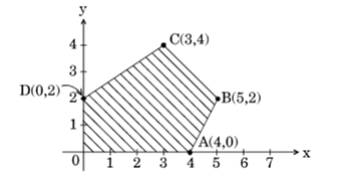
The corner points of the feasible region determined by the system of linear inequations are as shown below :
Image

Answer each of the following:
i. Let $z = 13x - 15y $ be the objective function. Find the maximum and minimum values of $z$ and also the
corresponding points at which the maximum and minimum values occur.
ii. Let $z = kx + y $ be the objective function. Find $k,$ if the value of $z$ at $A$ is same as the value of $z$ at $B$.
Integrate the rational function $\frac{1}{{{x^2} - 9}}$
If $\text{y}=\sin\text{x}$ and x changes from $\frac{\pi}{2}$ to $\frac{22}{14}$, what is the approximate change in y?
Using the properties of determinants: $\begin{vmatrix}0&\text{xy}^2&\text{xz}^2\\\text{x}^2\text{y}&0&\text{yz}^2\\\text{x}^2\text{z}&\text{zy}^2&0\end{vmatrix}$
If f(x) is an odd function, then write whether f'(x) is even of odd.