Question
Find the angle between the plane:
2x - 3y + 4z = 1 and -x + y = 4

Answer

We know that the angle between the planes,
$\text{a}_1\text{x}+\text{b}_1\text{y}+\text{c}_1\text{z}+\text{d}_1=0$ and $\text{a}_2\text{x}+\text{b}_2\text{y}+\text{c}_2\text{z}+\text{d}_2=0$ is given by
$\cos\theta=\frac{\text{a}_1\text{a}_2+\text{b}_1\text{b}_2+\text{c}_1\text{c}_2}{\sqrt{\text{a}_1^2+\text{b}_1^2+\text{c}_1^2}\sqrt{\text{a}_2^2+\text{b}_2^2+\text{c}^2_2}}$
So, the angle between 2x - 3y + 4z = 1 and -x + y + 0z = 4 is given by
$\cos\theta=\frac{(2)(-1)+(-3)(1)+(4)(0)}{\sqrt{2^2+(-3)^2+4^2}\sqrt{(-1)^2+1^2+0^2}}$
$=\frac{-2-3+0}{\sqrt{4+9+16}\sqrt{1+1+0}}$
$=\frac{-5}{\sqrt{29}\sqrt{2}}=\frac{-5}{\sqrt{58}}$
$\theta=\cos^{-1}\Big(\frac{-5}{\sqrt{58}}\Big)$

Need a full question paper?

Generate a complete, print-ready paper with questions like this in minutes — across 16+ boards, with answer keys.
Start Generating Free

Similar questions

If a vector$​​\vec{\text{a}}$ is perpendicular to two non-collinear vectors $\vec{\text{b}}$ and $\vec{\text{c}},$ then show that $​​\vec{\text{a}}$ is perpendicular to every vector in the plane of $\vec{\text{b}}$ and $\vec{\text{c}}.$
Find the angle between the following pairs of lines:
  1. $\vec{\text{r}}=3\hat{\text{i}}+\hat{\text{j}}-2\hat{\text{k}}+\lambda\Big(\hat{\text{i}}-\hat{\text{j}}-2\hat{\text{k}}\Big)\ \text{and}$
$\vec{\text{r}}=2\hat{\text{i}}-\hat{\text{j}}-56\hat{\text{k}}+\mu\Big(3\hat{\text{i}}-5\hat{\text{j}}-4\hat{\text{k}}\Big)$
Find the least value of a such that the function f given by $f(x) = x^2 + ax + 1$ strictly increasing on $(1, 2).$
Using determinants show that the following points are collinear:
$(1, -1), (2, 1)$ and $(4, 5)$
Solve the differential equation $\bigg[\frac{\text{e}^{-2\sqrt{\text{x}}}}{\sqrt{\text{x}}}-\frac{\text{y}}{\sqrt{\text{x}}}\bigg]\frac{\text{dx}}{\text{dy}}=1(\text{x}\neq0).$
Evaluate the following integrals:
$\int\frac{1}{\sqrt{1-\text{x}^2}(\sin^{-1}\text{x})^2}\text{dx}$
Let A be the set of all human beings in a town at a particular time. Determine whether the following relations are reflexive, symmetric and transitive:
R = {(x, y): x is father of and y}
Let $A = {1, 2, 3},$ and let $R_2 = {(2, 2), (3, 1), (1, 3)}$. Find whether or not the relations $R_2$ on$ A$ is:
  1. Reflexive.
  2. Symmetric.
  3. Transitive.
Find the equation of the plane passing through the following points:
(2, 1, 0), (3, -2, -2) and (3, 1, 7)
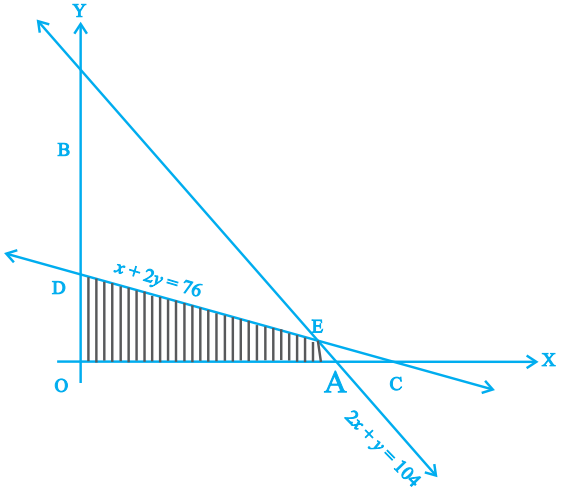
Determine the maximum value of Z = 3x + 4y if the feasible region (shaded) for a LPP is shown in.