Question
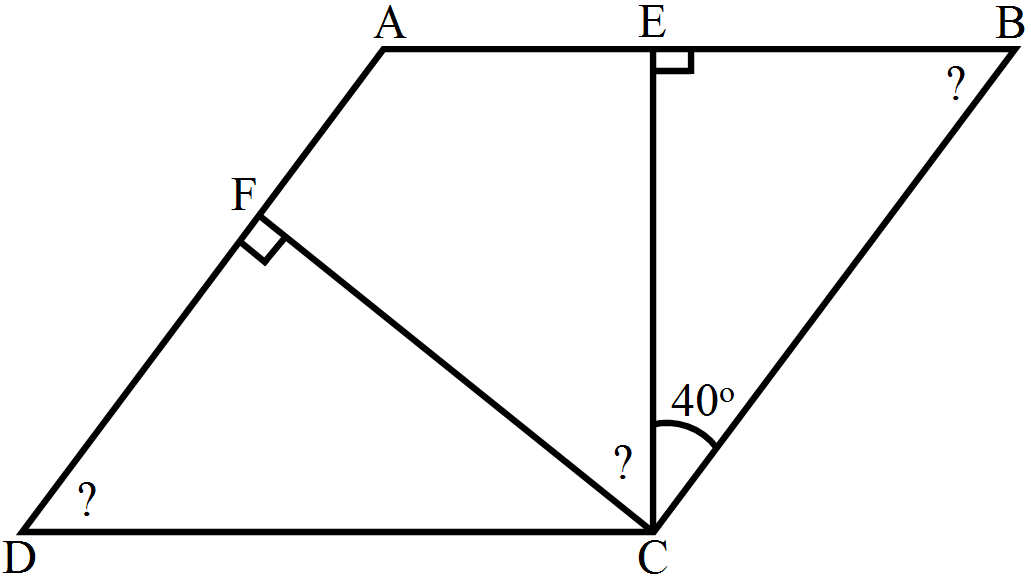
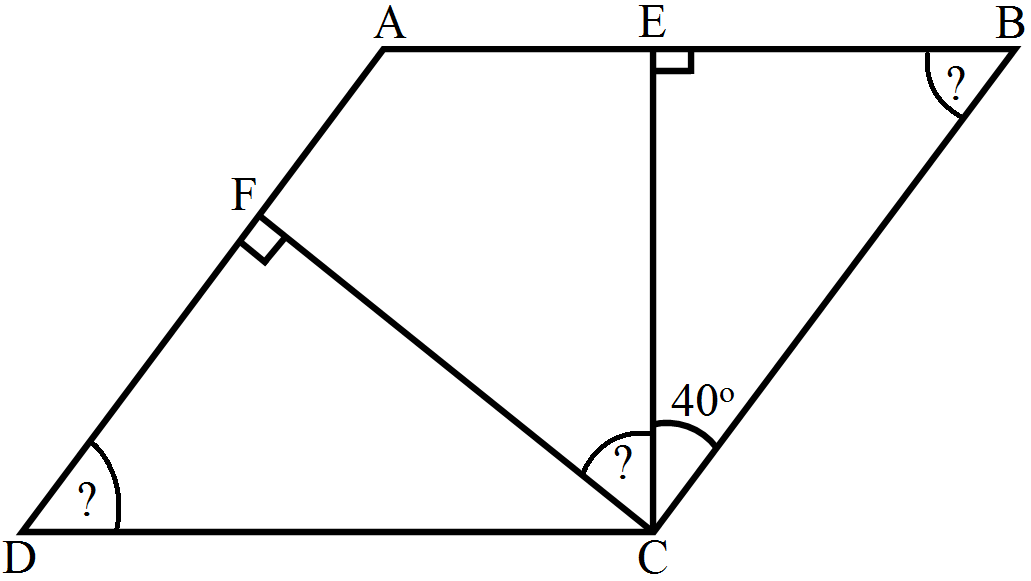
Find the angles marked with a question mark shown in the figure.
Answer


In parallelogram ABCD,
CE ⊥ AB and CF ⊥ AD
$\angle\text{BCE}=40^\circ$
In $\triangle\text{BCE}$,
$\angle\text{BCE}+\angle\text{CEB}+\angle\text{EBC}=180^\circ$ (Sum of angles of a triangle)
$\Rightarrow40^\circ +90^\circ+\angle\text{EBC}=180^\circ$
$\Rightarrow130^\circ+\angle\text{EBC}=180^\circ$
$\Rightarrow\angle\text{EBC}=180^\circ-130^\circ$
$\Rightarrow\angle\text{EBC}=50^\circ$
or $\angle\text{B}=50^\circ$
But $\angle\text{D}=\angle\text{B}$ (Opposite angles)
$\angle\text{D}=50^\circ$ or $\angle\text{ADC}=50^\circ$
Similarly in $\triangle\text{DCF}$,
$\angle\text{DCF}+\angle\text{CFD}+\angle\text{FDC}=180^\circ$
$\Rightarrow\angle\text{DCF}+90^\circ+50^\circ=180^\circ$
$\Rightarrow\angle\text{DCF}+140^\circ=180^\circ$
$\Rightarrow\angle\text{DCF}=180^\circ-140^\circ$
$\Rightarrow\angle\text{DCF}=40^\circ$
But $\angle\text{C}+\angle\text{B}=180^\circ$ (Sum of adjacent angles)
$\Rightarrow\angle\text{BCE}+\angle\text{ECF}+\angle\text{DCF}+\angle\text{A}=180^\circ$
$\Rightarrow40^\circ+\angle\text{ECF}+40^\circ+50^\circ=180^\circ$
$\Rightarrow\angle\text{ECF}+130^\circ=180^\circ$
$\Rightarrow\angle\text{ECF}=180^\circ-130^\circ$
$\Rightarrow\angle\text{ECF}=50^\circ$

Need a full question paper?

Generate a complete, print-ready paper with questions like this in minutes — across 16+ boards, with answer keys.
Start Generating Free

Similar questions

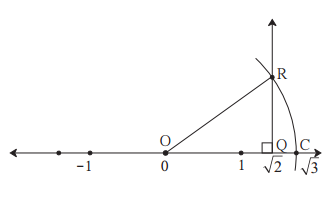
The number √2 is shown on a number line. Steps are given to show √3 on the number line using √2. Fill in the boxes properly and complete the activity.
Image
The point Q on the number line shows the number ……….
A line perpendicular to the number line is drawn through the point Q. Point R is at unit distance from Q on the line.
Right angled ∆OQR is obtained by drawing seg OR.
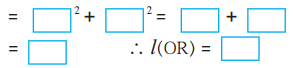
l(OQ) = √2, l(QR) = 1
∴By Pythagoras theorem,
[l(OR)]² = [l(OQ)]² + [l(QR)]²
Image

Draw an arc with centre O and radius OR. Mark the point of intersection of the line and the arc as C. The point C shows the number √3
Find the cube root of the following rational numbers:
$\frac{-19683}{24689}$
The following table shows the percentage of students who dropped out of school after completing high school.
Age (in Year)
8
9
10
11
12
13
14
15
16
17
18
Boys
72%
75%
78%
81%
84%
88%
92%
95%
98%
99%
100%
Girls
77%
81%
84%
88%
91%
95%
98%
99%
99.5%
100%
100%
Now, use the graph to answer the following question:
  1. In which year both boys and the girls achieve their maximum height?
  2. Who grows faster at puberty (14 years to 16 years of age).
Verify associativity of addition of rational numbers i.e., (x + y) + z = x + (y + z), when:
$\text{x}=\frac{1}{2},\text{y}=\frac{2}{3},\text{z}=-\frac{1}{5}$
Construct a quadrilateral PQRS, in which $\angle\text{PQR}=45^\circ,$ $\angle\text{QRS}=90^\circ,$ QR = 5cm, PQ = 9cm and Rs = 7cm.
The following table gives the information regarding length of a side of a square and its area:
Length of a side (in cm): 1 2 3 4 5
Area of square (in $cm^2$): 1 4 9 16 25
Draw a graph to illustrate this information.
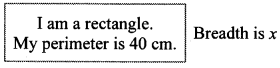
Write correct numbers in the boxes given length is 3 times the breadth
Image
Perimeter of the rectangle = 40
2(__x + __x) = 40
2 × __ x = 40
__ x = 40
x = __
∴ Breadth of rectangle = __ cm and Length of rectangle = __ cm
Construct a quadrilateral ABCD, in which AB = 6cm, BC = 4cm, CD = 4cm, $\angle\text{B}=95^\circ$ and $\angle\text{C}=90^\circ.$
Draw an isosceles triangle. Locate its centroid, orthocentre, circumcentre and incentre. Verify that they are collinear.
Which of the following numbers are perfect squares?
  1. 484
  2. 625
  3. 576
  4. 941
  5. 961
  6. 2500