Question
Find the angular velocity for an object to experience weightlessness at the equator of earth. Under this condition, also find the duration of a day.

Answer

Due to the rotation $\text{g}'=\text{g}\Big(1-\frac{\text{R}\omega^2}{\text{g}}\cos^2\theta\Big)$ where $\theta$ is the latitude. For weightlessness, g' = 0. At the equator, $\theta=0^\circ$ $\therefore1-\frac{\text{R}\omega^2}{\text{g}}\cos^20^\circ=0$ $\text{or }\omega=\sqrt{\frac{\text{g}}{\text{R}}}$ $\Rightarrow\omega=\sqrt{\frac{10}{6400\times10^3}}=\frac{1}{800}$ $\omega=\frac{2\pi}{\text{T}}$ $\Rightarrow=\frac{2\text{x}}{\omega}=\frac{2\times3.14}{\frac{1}{800}}$ $=5024\text{sec.}$

Need a full question paper?

Generate a complete, print-ready paper with questions like this in minutes — across 16+ boards, with answer keys.
Start Generating Free

Similar questions

What is the pressure inside the drop of mercury of radius 3.00 mm at room temperature? Surface tension of mercury at that temperature $\left(20^{\circ} C \right)$ is $4.65 \times 10^{-1} Nm ^{-1}$. The atmospheric pressure is $1.01 \times 10^5 Pa$. Also give the excess pressure inside the drop.
Consider the fusion in helium plasma. Find the temperature at which the average thermal energy 1.5kT equals the Coulomb potential energy at 2fm.
The time of flight of a projectile is $T$ and horizontal range is $R$. What will be the projectile angle?Or The time of flight is $T$ and horizontal range is $R$ of a projectile. Prove that the angle of projection of a projectile is $\theta=\tan ^{-1}\left(\frac{g T^2}{2 R}\right)$.
The density of water at $0^{\circ} \mathrm{C}$ is $0.998 \mathrm{~g} \mathrm{~cm}^{-3}$ and at $4^{\circ} \mathrm{C}$ is $1000 \mathrm{~g} \mathrm{~cm}^{-3}$. Calculate the average coefficient of volume expansion of water in the temperature range 0 to $4^{\circ} \mathrm{C}$.
Given that the amplitude of the scattered light is:
  1. Directly proportional to that of incident light.
  2. Directly proportional to the volume of the scattering dust particle.
  3. Inversely proportional to its distance from the scattering particle.
  4. Dependent upon the wavelength $(\lambda)$ of the light. Show that the intensity of scattered light varies as $1$.
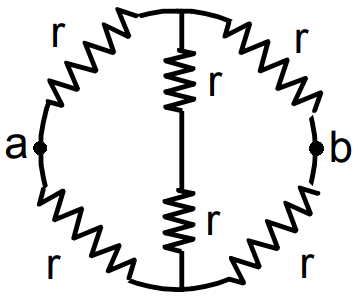
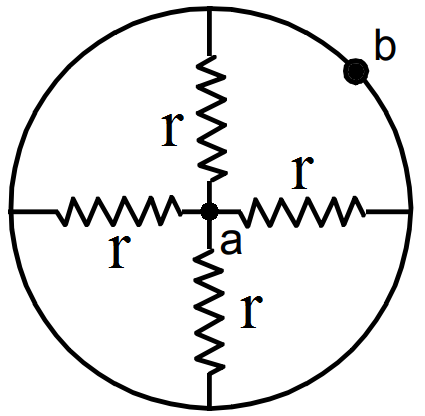
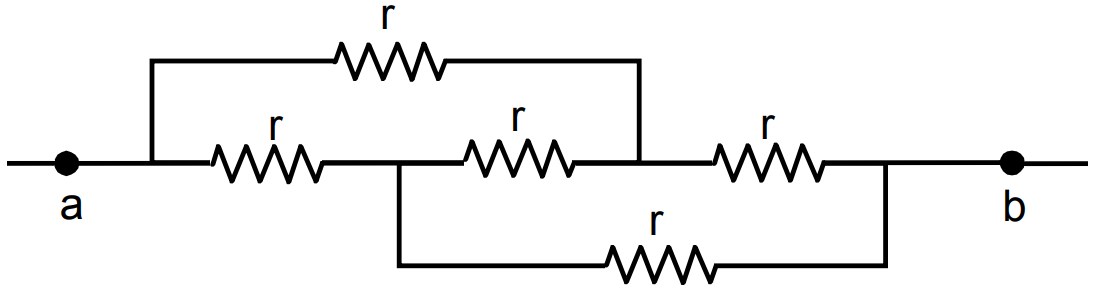
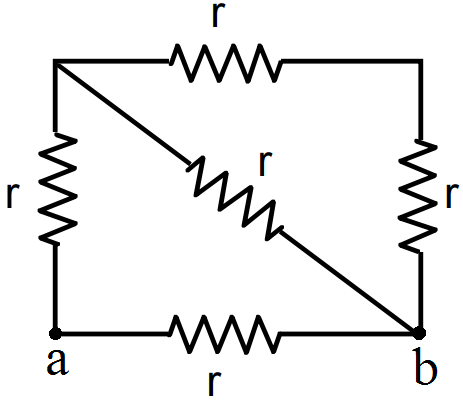
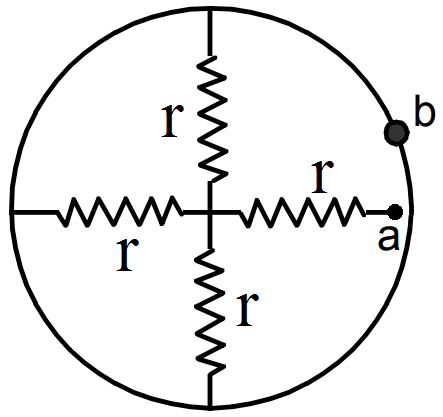
Find the equivalent resistances of the networks shown in the figure. between the points $a$ and $b.$
  1.  
  1.  
  1.  
  1.  
  1.  
State the law of conservation of momentum. Establish the same for a 'n' body system.
Prove that for an adiabatic process $\text{PV}^\gamma=\text{constant},$ where the symbols have their usual meanings.
The radius of a planet is three times the radius of the Earth but the density of both is same. If $v_p$ on $v_e$ are the escape velocities on the planet and the earth then prove that $v_P=3 v_e$.
A converging lens and a diverging mirror are placed at a separation of 15cm. The focal length of the lens is 25cm and that of the mirror is 40cm. Where should a point source be placed between the lens and the mirror so that the light, after getting reflected by the mirror and then getting transmitted by the lens, comes out parallel to the principal axis?