Question
Find the area bounded by curves $\left\{(\text{x, y}):\text{y}\geq\text{x}^2 \text{ and y}=|\text{x}|\right\}.$

Answer

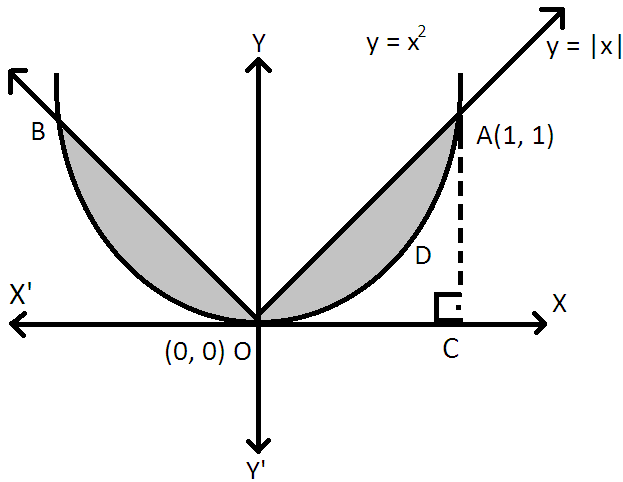
The area bounded by the curves, $\left\{(\text{x, y}):\text{y}\geq\text{x}^2 \text{ and y}=|\text{x}|\right\},$ is represented by the shaded region as

It can be observed that the required area is symmetrical about y-axis.
Required area = 2[Area(OCAO) - Area(OCADO)]
$=2\Bigg[\int\limits^1_0\text{x dx}-\int\limits^1_0\text{x}^2\text{dx}\Bigg]$
$=2\bigg[\Big[\frac{\text{x}^2}{2}\Big]^1_0-\Big[\frac{\text{x}^3}{3}\Big]^1_0\bigg]$
$=2\Big[\frac12-\frac13\Big]$
$=2\Big[\frac16\Big]=\frac13\text{units}$

Need a full question paper?

Generate a complete, print-ready paper with questions like this in minutes — across 16+ boards, with answer keys.
Start Generating Free

Similar questions

Show that the differential equation $\frac{d y}{d x}-\frac{y}{x}+cosec \left(\frac{y}{x}\right)=0$ is homogenous and find the particular solution, given that $y = 0$ when $x = 1$.
By computing the shortest distance determine whether the following pairs of lines intersect or not:3
$\frac{\text{x}-5}{4}=\frac{\text{y}-7}{-5}=\frac{\text{z}+3}{-5}$ and $\frac{\text{x}-8}{7}=\frac{\text{y}-7}{1}=\frac{\text{z}-5}{3}$
Solve the following systems of linear equations by cramer's rule:
x + 2y = 1,
3x + y = 4
Find the foot of perpendicular from the point (2, 3, 4) to the line $\frac{4-\text{x}}{2}=\frac{\text{y}}{6}=\frac{1-\text{z}}{3}.$ Also, find the perpendicular distance from the given point to the line.
Find the value of $\lambda$ so that the following vectors are coplanar:
$\vec{\text{a}}=\hat{\text{i}}+3\hat{\text{j}},\vec{\text{b}}=5\hat{\text{k}},\vec{\text{c}}=\lambda\hat{\text{i}}-\hat{\text{j}}$
Solve the following system of equations by matrix method:
$2x + 6y = 2$
$3x - z = -8$
$2x - y + z = -3$
Find the particular solution of $\text{e}^{\frac{\text{dy}}{\text{dx}}}=\text{x}+1,$ that $\text{y}=3,$ when $\text{x}=0.$
Differentiate the following functions with respect to x:
$\frac{\text{e}^{2\text{x}}+\text{e}^{-2\text{x}}}{\text{e}^{2\text{x}}-\text{e}^{-2\text{x}}}$
If $\text{x}=\text{a}(\cos\text{t}+\text{t}\sin\text{t})\ \text{and}\ \text{y}=\text{a}(\sin\text{t}-\text{t}\cos\text{t}),$ find the value of $\frac{\text{d}^2\text{y}}{\text{dx}^2}\ \text{at}\ \text{t}=\frac{\pi}{4}.$
Show that x = 2 is a root of the equation $\begin{vmatrix}\text{x}&-6&-1\\2&-3\text{x}&\text{x}-3\\-3&2\text{x}&\text{x}+2\end{vmatrix}=0$ and solve it completely.