Question
Find the area of $\triangle\text{ABC}$ whose vertices are:
$A(10, -6), B(2, 5)$ and $C(-1, 3)$

Answer

$A(10, -6), B(2, 5)$ and $C(-1, -3)$ are the vertices of $\triangle\text{ABC}.$
Then, $(x_1 = 10, y_1= -6), (x_2 = 2, y_2 = 5)$ and $(x_3 = -1, y_3 = 3)$
Area of triangle ABC
$=\frac{1}{2}\big\{\text{x}_1(\text{y}_2-\text{y}_3)+\text{x}_2(\text{y}_3-\text{y}_1)+\text{x}_3(\text{y}_1-\text{y}_2)\big\}$
$=\frac{1}{2}\big\{10(5-3)+2(3-(-6))+(-1)(-6-5)\big\}$
$=\frac{1}{2}\big\{10(2)+2(9)-1(-11)\big\}$
$=\frac{1}{2}\big\{20+18+11\big\}$
$=\frac{1}{2}(49)$
$=24.5\ \text{sq}.\text{units}$

Need a full question paper?

Generate a complete, print-ready paper with questions like this in minutes — across 16+ boards, with answer keys.
Start Generating Free

Similar questions

Prove that:
$\cot\theta\tan(90^\circ-\theta)-\sec(90^\circ-\theta)\text{cosec }\theta\\+\sqrt{3}\tan12^\circ\tan60^\circ\tan78^\circ=2$
A bag contains 6 red, 8 black and 4 white balls. A ball is drawn at random. What is the probability that ball drawn is not black?
Form a quadratic equation such that one of its roots is 5. Form a quadratic equation for it and write. ( For the formation of word problem you can use quantities like age, rupees or natural numbers.) (sample solution for the above example is given below students can take another number to form another example)
The sum of digits of a two number is 15. The number obtained by reversing the order of digits of the given number exceeds the given number by 9. Find the given number.
how many two-digit numbers are divisible by 5?
Activity :- Two-digit numbers divisible by 5 are, 10,15,20........95.
Here, d=5, therefore this sequence is an A.P.
Here a=10, d=5, Tn=95, n=?
$t _{ n }$= a+(n-1____)
____= 10+(n-1)×5
____= (n-1)×5
____= (n-1)
therefore n=____
there are ____two-digit numbers divisible by 5.
Find the least number which when divided by 20, 25, 35 and 40 leaves remainders 14, 19, 29 and 34 respectively.
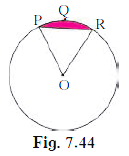
In the figure 7.44, O is the centre of the circle. M (arc PQR) = 60° OP = 10 cm.
Find the area of the shaded region. (π = 3.14, √3 = 1.73)
For what value of k does the system of equations:
$x + 2y = 3, 5x + ky + 7 = 0$
have;
  1. A unique solution,
  2. No solution?
Also, show that there is no value of k for which the given system of equations has infinite number of solutions:
The following is the cummulative frequency distribution (of less than type) of $1000$ persons each of age $20$ years and above. Determine the mean age.
Age below (in year):
$30$
$40$
$50$
$60$
$70$
Number of persons:
$100$
$220$
$350$
$750$
$950$