Question
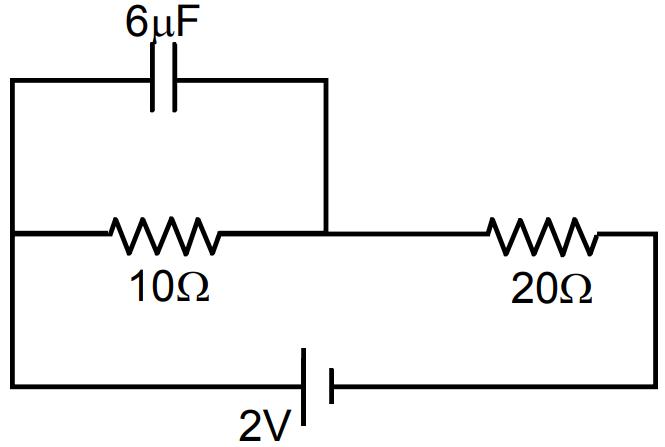
Find the charge on the capacitor shown in figure.

Answer

In steady stage condition no current flows through the capacitor. $\text{R}_\text{eff}=10+20=30\Omega$
$\text{i}=\frac{2}{30}=\frac{1}{15}\text{A}$
Voltage drop across $10\Omega$ resistor = i × R$=\frac{1}{15}\times10=\frac{10}{15}=\frac{2}{3}\text{V}$
Charge stored on the capacitor (Q) = CV$=6\times10^{-6}\times\frac{2}{3}=4\times10^{-6}\text{C}=4\mu\text{C}.$

Need a full question paper?

Generate a complete, print-ready paper with questions like this in minutes — across 16+ boards, with answer keys.
Start Generating Free

Similar questions

Write the expression for the magnetic moment ($\overrightarrow{\text{m}}$) due to a planar square loop of side ‘l’ carrying a steady current I in a vector form. In the given figure this loop is placed in a horizontal plane near a long straight conductor carrying a steady current $I_1$ at a distance l as shown. Give reasons to explain that the loop will experience a net force but no torque. Write the expression for this force acting on the loop.
Two charged conducting spheres of radii a and b are connected to each other by a wire. What is the ratio of electric fields at the surfaces of the two spheres? Use the result obtained to explain why charge density on the sharp and pointed ends of a conductor is higher than on its flatter portions.
  1. Find the value of the phase difference between the current and the voltage in the series LCR circuit shown below. Which one leads in phase: current or voltage?
  2. Without making any other change, find the value of the additional capacitor $C_1,$ to be connected in parallel with the capacitor C, in order to make the power factor of the circuit unity.
Consider the situation of the previous problem. A particle having charge q and mass m is projected from the point Q in a direction going into the plane of the diagram. It is found to describe a circle of radius r between the two plates. Find the speed of the charged particle.
The band gap between the valence and the conduction bands in zinc oxide (ZnO) is 3.2eV. Suppose an electron in the conduction band combines with a hole in the valence band and the excess energy is released in the form of electromagnetic radiation. Find the maximum wavelength that can be emitted in this process.
Draw the circuit diagram of a full wave rectifier and explain its working. Also, give the input and output waveforms.
Find the speed of the electron in the ground state of a hydrogen atom. The description of ground state is given in the previous problem.
Draw a circuit diagram of a C.E. transistor amplifier. Briefly, explain its working and write the expression for (i) current gain, (ii) voltage gain of the amplifier.
A circular ring of radius r made of a nonconducting material is placed with its axis parallel to a uniform electric field. The ring is rotated about a diameter through 180°. Does the flux of electric field change? If yes, does it decrease or increase?
Can normal force do a nonzero work on an object. If yes, give an example. If no, give reason.