MCQ
Find the cofactor of element $-3$ in the determinant $\triangle=\begin{bmatrix}1&4&4\\-3&5&9\\2&1&2\end{bmatrix}$ is:
  • $-4$
  • B
    $4$
  • C
    $-5$
  • D
    $-3$

Answer

Correct option: A.
$-4$
The minor of element $-3$ is given by
$\text{M}_{21}=\begin{bmatrix}4&4\\1&2\end{bmatrix}=4(2)-4=4\ ($Obtained by eliminating $\text{R}_2$ and $\text{C}_1)$
$\therefore\text{A}_{21}=(-1)^{2+1} \text{M}_{21}=(-1)^3 4=-4.$

Need a full question paper?

Generate a complete, print-ready paper with questions like this in minutes — across 16+ boards, with answer keys.
Start Generating Free

Similar questions

The value of  $\mathop {n \to \infty }\limits^{\lim } \frac{1}{n}\sin \left( {\frac{1}{n}} \right){\left( {\cos \left( {\frac{1}{n}} \right)} \right)^2} $ $+ \frac{1}{n}\sin \left( {\frac{2}{n}} \right){\left( {\cos \left( {\frac{2}{n}} \right)} \right)^2} + \frac{1}{n}\sin \left( {\frac{3}{n}} \right){\left( {\cos \left( {\frac{3}{n}} \right)} \right)^2} +$ $ ..... + \frac{1}{n}(\sin 1){(\cos 1)^2}$ is 
If $[t]$ denotes the greatest integer $\leq 1$, then the value of $\frac{3(e-1)^2}{e} \int \limits_1^2 x^2 e^{[x]+\left[x^3\right]} d x$ is :
Consider the following statements:
  1. $\tan^{-1} 1+ \tan^{-1} (0.5) = \dfrac {\pi}2$
  2. $\sin^{-1}{\cfrac{1}{3} }+ \cos^{-1}{\cfrac{1}{3}} =\cfrac{\pi}{2}$
Which of the above statements is/are correct ?
Primitive of $\frac{{3{x^{4\,}} - 1}}{{{{({x^4} + x + 1)}^2}}}$ w.r.t.  $x$ is :
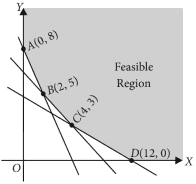
Feasible region for an L.P.P. is shown shaded in the following figure. Minimum of $Z=5 x+3 y$ occurs at the point point
Image
If $\left| {\,\begin{array}{*{20}{c}}{{{(b + c)}^2}}&{{a^2}}&{{a^2}}\\{{b^2}}&{{{(c + a)}^2}}&{{b^2}}\\{{c^2}}&{{c^2}}&{{{(a + b)}^2}}\end{array}\,} \right| = k\,abc{(a + b + c)^3}$, then the value of $k$ is
Choose the correct answer from the given four option. The degree of the differential equation $\frac{\text{d}^2\text{y}}{\text{d}\text{x}^2}+\Big(\frac{\text{d}\text{y}}{\text{d}\text{x}}\Big)^3+6\text{y}^5=0$ is :
In a binomial distribution $B(n\,\,,\,p =$  $\frac{1}{4}$) ,if the probability of at least one success is greater than or equal to$ \frac{9}{{10}}$ then $n$ greater than :
The graph of the inequality $2 x+3 y>6$ is
Let $a-2 b+c=1$

If $f(x)=\left|\begin{array}{lll}{x+a} & {x+2} & {x+1} \\ {x+b} & {x+3} & {x+2} \\ {x+c} & {x+4} & {x+3}\end{array}\right|,$ then