Question
Find the cube of the following binomial expressions: $2\text{x}+\frac{3}{\text{x}}$

Answer

Given, $2\text{x}+\frac{3}{\text{x}}$ The above equation is in the form of $(a + b)^3= a^3 + b^3 + 3ab(a + b)$
we know that $\text{a}=2\text{x},\text{b}=\frac{3}{\text{x}}$ By using $(a + b)^3$
formula $=8\text{x}^3+\frac{27}{\text{x}^3}+\frac{18\text{x}}{\text{x}}\Big(\frac{2}{\text{x}}+\frac{3}{\text{x}}\Big)$
$=8\text{x}^3+\frac{27}{\text{x}^3}+\frac{18\text{x}}{\text{x}}\Big(2{\text{x}}+\frac{3}{\text{x}}\Big)$
$=8\text{x}^3+\frac{27}{\text{x}^3}+\Big({18}\times2{\text{x}}\Big)+\Big(18\times\frac{3}{\text{x}}\Big)$
$=\Big(8\text{x}^3+\frac{27}{\text{x}^3}+36\times\frac{54}{\text{x}}\Big)$
Hence The cube of $\Big(2\text{x}+\frac{3}{\text{x}}\Big)^3=\Big(8\text{x}^3+\frac{27}{\text{x}^3}+36\times\frac{54}{\text{x}}\Big)$

Need a full question paper?

Generate a complete, print-ready paper with questions like this in minutes — across 16+ boards, with answer keys.
Start Generating Free

Similar questions

An equilateral triangle of side 9cm is inscribed in a circle. Find the radius of the circle.
$A B C D$ is a parallelogram. $P$ is the mid-point of $A B$. $B D$ and $C P$ intersect at $Q$ such that $C Q: Q P=3: 1$. If $\operatorname{ar}(\triangle PBQ )=10\ cm^2$, find the area of parallelogram $ABCD$ .
$ABC$ is a triangle and through $A, B, C$ lines are drawn parallel to $BC, CA$ and $AB$ respectively intersecting at $P, Q$ and $R.$ Prove that the perimeter of $\triangle\text{PQR}$ is double the perimeter of $\triangle\text{ABC}.$
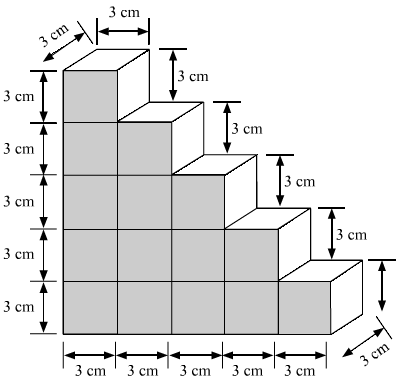
A child playing with building blocks, which are of the shape of the cubes, has built a structure as shown in Figure. If the edge of each cube is $3\ cm$, find the volume of the structure built by the child.
If $V$ is the volume of a cuboid of dimensions $a, b, c$ and $S$ is its surface area, then prove that:
$\frac{1}{\text{V}}=\frac{2}{\text{S}}\Big(\frac{1}{\text{a}}+\frac{1}{\text{b}}+\frac{1}{\text{c}}\Big)$
Why do we group data?
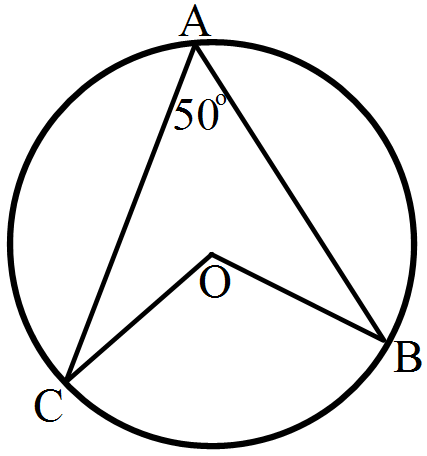
In figure, $O$ is the centre of the circle. If $\angle\text{APB}=50^\circ,$ find $\angle\text{AOB}$ and $\angle\text{OAB}.$
Simplify: $\frac{4+\sqrt{5}}{4-\sqrt{5}}+\frac{4-\sqrt{5}}{4+\sqrt{5}}$
In the given figure, $ABCD$ is a rectangle in which diagonal $AC$ is produced to $E$. If $\angle\text{ECD}=146^\circ,$ find $\angle\text{AOB}.$
If the bisectors of two adjacent angles A and B of a quadrilateral ABCD intersect at a point O such that $\angle\text{C}+\angle\text{D}=\text{k}\angle\text{AOB},$ then find the value of k.