Question
✓
Answer
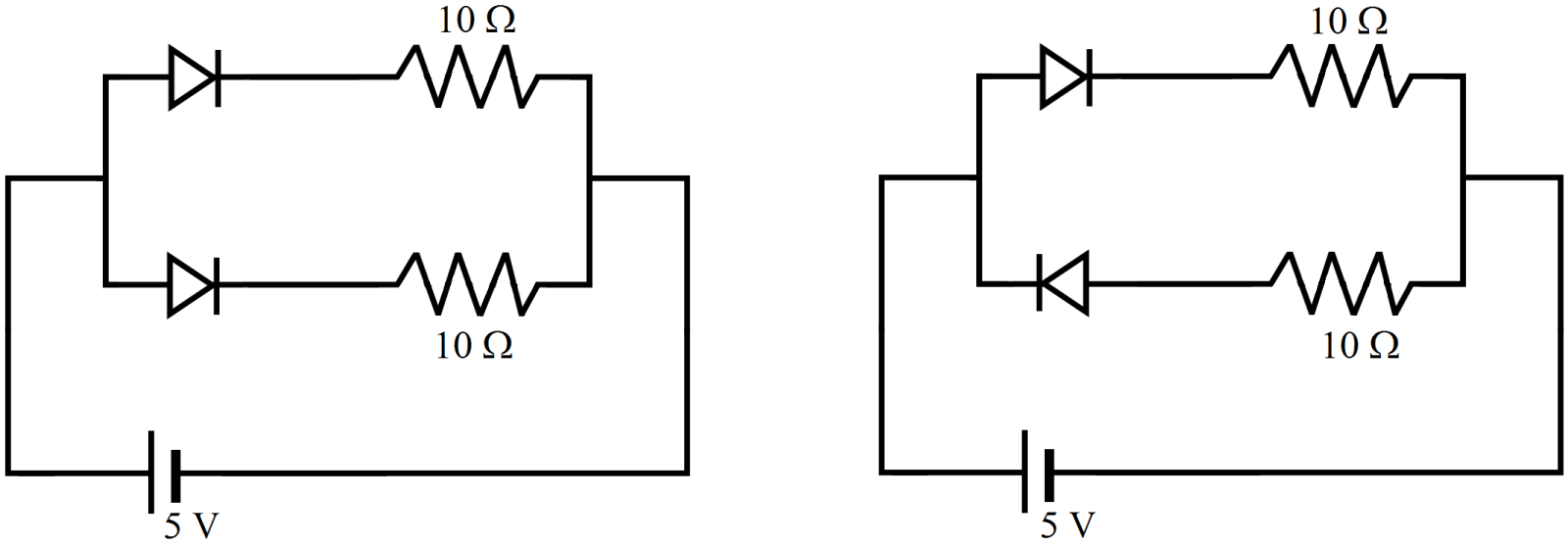
Both diodes are forward biased. Thus the net diode resistance is 0.
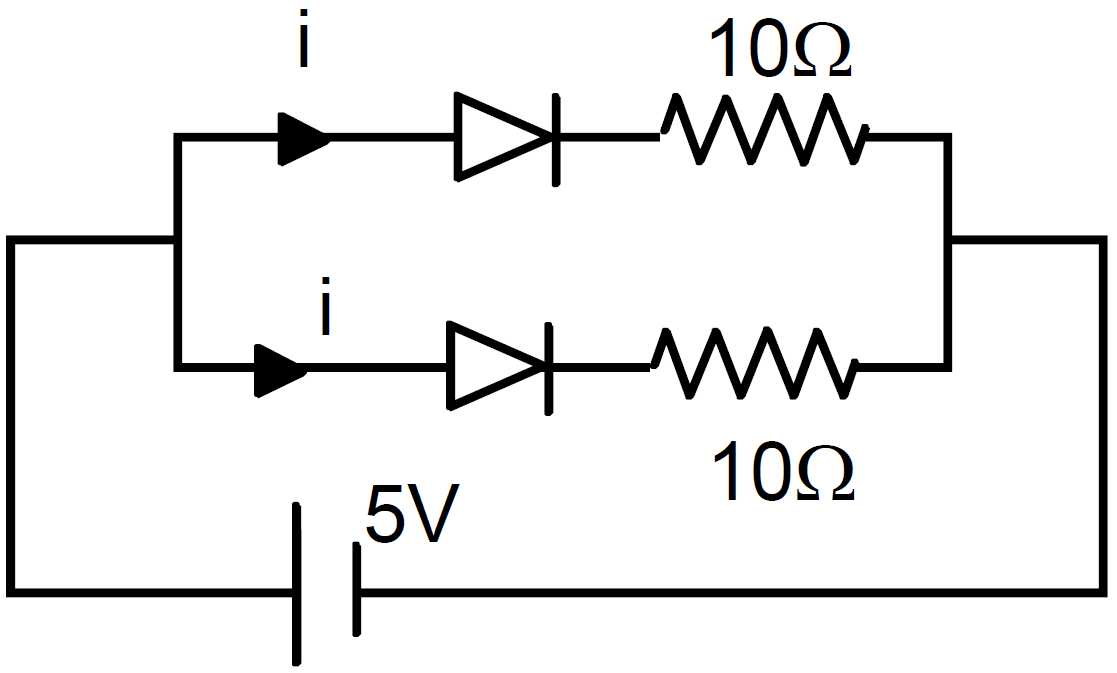
$\text{i}=\frac{5}{\frac{10\times10}{10+10}}=\frac{5}{5}=1\text{A}$
One diode is forward biased and other is reverse biased.
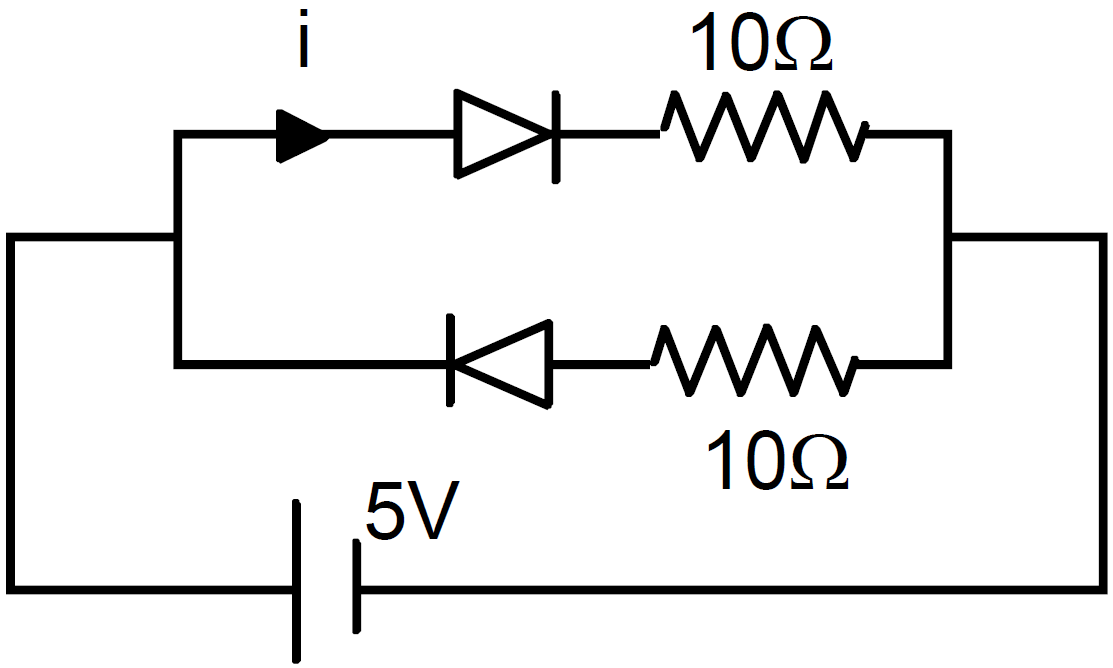
$\text{i}=\frac{\text{V}}{\text{R}_\text{net}}=\frac{5}{10+0}=\frac{1}{2}=0.5\text{A}$
$\text{i}=\frac{5}{\frac{10\times10}{10+10}}=\frac{5}{5}=1\text{A}$
One diode is forward biased and other is reverse biased.
$\text{i}=\frac{\text{V}}{\text{R}_\text{net}}=\frac{5}{10+0}=\frac{1}{2}=0.5\text{A}$
Need a full question paper?
Generate a complete, print-ready paper with questions like this in minutes — across 16+ boards, with answer keys.
Explore more
More "5 Marks Questions" from Semiconductor Electronic: Material, Devices And Simple Circuits→Semiconductor Electronic: Material, Devices And Simple Circuits — all question types→Physics STD 12 Science question papers→Gujarat Board STD 12 Science question papers→Gujarat Board question paper generator→
Similar questions
White coherent light (400nm - 700nm) is sent through the slits of a Young's double slit experiment (figure.) The separation between the slits is 0.5mm and the screen is 50cm away from the slits. There is a hole in the screen at a point 1.0mm away (along the width of the fringes) from the central line.
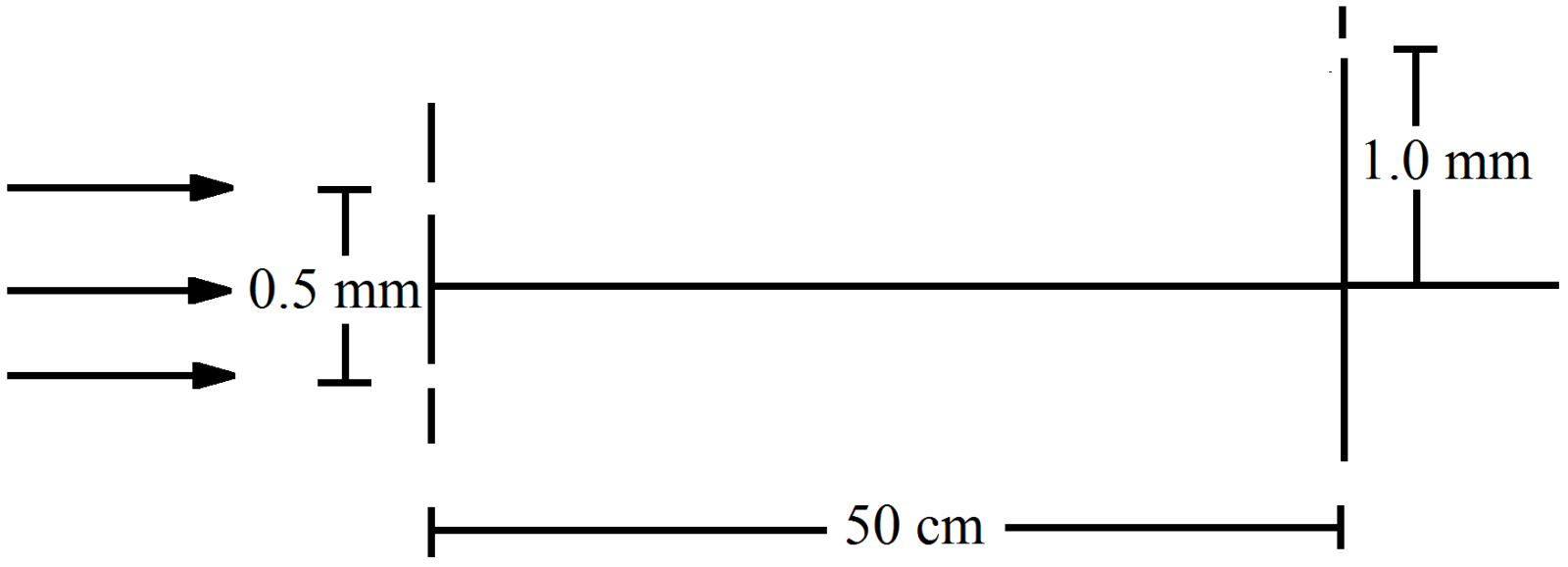
- Which wavelength (s) will be absent in the light coming from the hole?
- which wavelength (s) will have a strong intensity?
Solve the previous problem if the coefficient of restitution is e. Use $\theta=45^\circ,\ \text{e}=\frac{3}{4}$ and h = 5m
→A rectangular loop of sides 25cm and 10cm carrying a current of 15A is placed with its longer side parallel to a long straight conductor 2.0cm apart carrying a current of 25A (fig). What is the net force on the loop?
- An electron moves along a circle of radius 1m in a perpendicular magnetic field of strength 0.50T. What would be its speed? Is it reasonable?
- If a proton moves along a circle of the same radius in the same magnetic field, what would be its speed?
A thin paper of thickness 0.02mm having a refractive index 1.45 is pasted across one of the slits in a Young's double slit experiment. The paper transmits $\frac{4}{9}$ of the light energy falling on it.
→- Find the ratio of the maximum intensity to the minimum intensity in the fringe pattern.
- How many fringes will cross through the centre if an identical paper piece is pasted on the other slit also? The wavelength of the light used is 600nm.
Two particles A and B, each carrying a charge Q, are held fixed with a separation d between them. A particle C having mass m and charge q is kept at the middle point of the line AB.
- If it is displaced through a distance x perpendicular to AB, what would be the electric force experienced by it.
- Assuming x << d, show that this force is proportional to x.
- Under what conditions will the particle C execute simple harmonic motion if it is released after such a small displacement?
A uniform ladder of length 10.0m and mass 16.0kg is resting against a vertical wall making an angle of 37° with it. The vertical wall is frictionless but the ground is rough. An electrician weighing 60.0kg climbs up the ladder. If he stays on the ladder at a point 8.00m from the lower end, what will be the normal force and the force of friction on the ladder by the ground? What should be the minimum coefficient of friction for the elctrician to work safely?
Define resolving power of a compound microscope. How does the resolving power of a compound microscope change when:
- Refractive index of medium between the object and objective lens increases.
- Wavelength of radiation used is increased?