Question
Find the dimensions of:
  1. Linear momentum.
  2. Frequency.
  3. Pressure.

Answer

  1. Linear momentum: $\text{mv}=[\text{MLT}^{-1}]$
  2. Frequency: $\frac{1}{\text{T}}=[\text{M}^0\text{L}^0\text{T}^{-1}]$
  3. Pressure: $\frac{\text{Force}}{\text{Area}}=\frac{[\text{MLT}^{-2}]}{\text{[L}^2]}=[\text{ML}^{-1}\text{T}^{-2}]$

Need a full question paper?

Generate a complete, print-ready paper with questions like this in minutes — across 16+ boards, with answer keys.
Start Generating Free

Similar questions

Answer the following:
a. Magnetic field lines can be entirely confined within the core of a toroid, but not within a straight solenoid. Why?
b. Does a bar magnet exert a torque on itself due to its own field? Justify your answer.
c. When an electron revolves around a nucleus, obtain the expression for the magnetic moment associated with it.
Answer the following: A man fixes outside his house one evening a two metre high insulating slab carrying on its top a large aluminium sheet of area $1m^2$. Will he get an electric shock if he touches the metal sheet next morning?
Is it necessary to have two waves of equal intensity to study interference pattern? Will there be an effect on clarity if the waves have unequal intensity?
A hydrogen atom contains one proton and one electron. It may be assumed that the electron revolves in a circle of radius 0.53 angstrom (1 angstrom $= 10^{-10}m$ and is abbreviated as A) with the proton at the centre. The hydrogen atom is said to be in the ground state in this case. Find the magnitude of the electric force between the proton and the electron of a hydrogen atom in its ground state.
An infinite line charge produces a field of $9 × 10^4$ N/C at a distance of 2 cm. Calculate the linear charge density.
Plot a graph showing variation of de-Broglie wavelength $\lambda$ versus $\frac{1}{\sqrt{V}} ,$ where V is accelerating potential for two particles A and B carrying same charge but of masses $m_1, m_2\left(m_1>m_2\right)$. Which one of the two represents a particle of smaller mass and why?
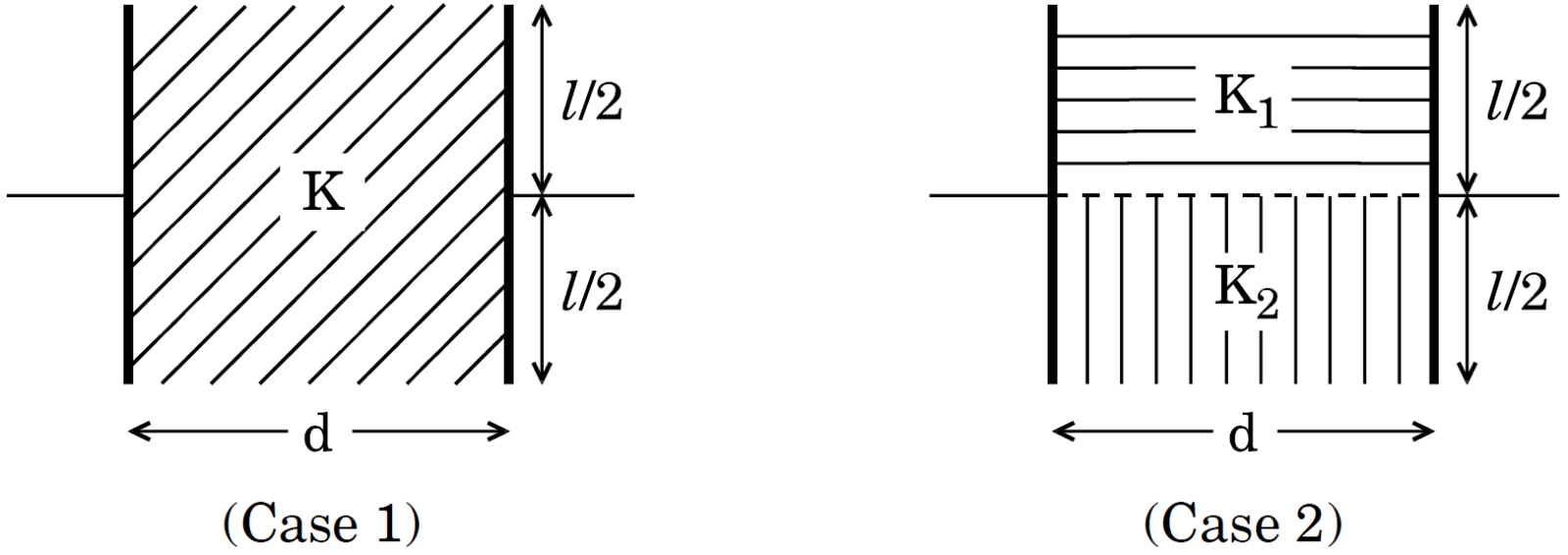
The space between the plates of a parallel plate capacitor is completely filled in two ways. In the first case, it is filled with a slab of dielectric constant K. In the second case, it is filled with two slabs of equal thickness and dielectric constants $\mathrm{K}_1$ and $\mathrm{K}_2$ respectively as shown in the figure. The capacitance of the capacitor is same in the two cases. Obtain the relationship between $\mathrm{K}, \mathrm{K}_1$ and $\mathrm{K}_2$.
Answer the following questions regarding earth’s magnetism:
The earth's field, it is claimed, roughly approximates the field due to a dipole of magnetic moment $8 \times 10^{22} \mathrm{~J} \mathrm{~T}^{-1}$ located at its centre. Check the order of magnitude of this number in some way.
Answer the following questions:
Why is choke coil needed in the use of fluorescent tubes with acmains? Why can we not use an ordinary resistor instead of the choke coil?
Show that the interior of a conductor can have no excess charge in the static situation.