Question
Find the intensity at a point on a screen in Young’s double slit experiment where the interfering waves of equal intensity have a path difference of (i) $\lambda/4$, and (ii) $\lambda/3$.

Answer

Path difference 𝜆/4 ⟹ phase difference 𝜋/2
Path difference 𝜆/3 ⟹ phase difference (2𝜋/3)
$I=4I_0\cos^2\Big(\frac{\theta}{2}\Big)$
  1. $I_1=4I_0\times\frac{1}{2}=2I_0$
  2. $I_2=4I_0\times\frac{1}{4}=I_0$

Need a full question paper?

Generate a complete, print-ready paper with questions like this in minutes — across 16+ boards, with answer keys.
Start Generating Free

Similar questions

If we cover the lower half of the reflecting surface of a concave mirror with some opaque (nonreflective) material, then what effect will this have on the image formed by the mirror of an object situated in front of the mirror?
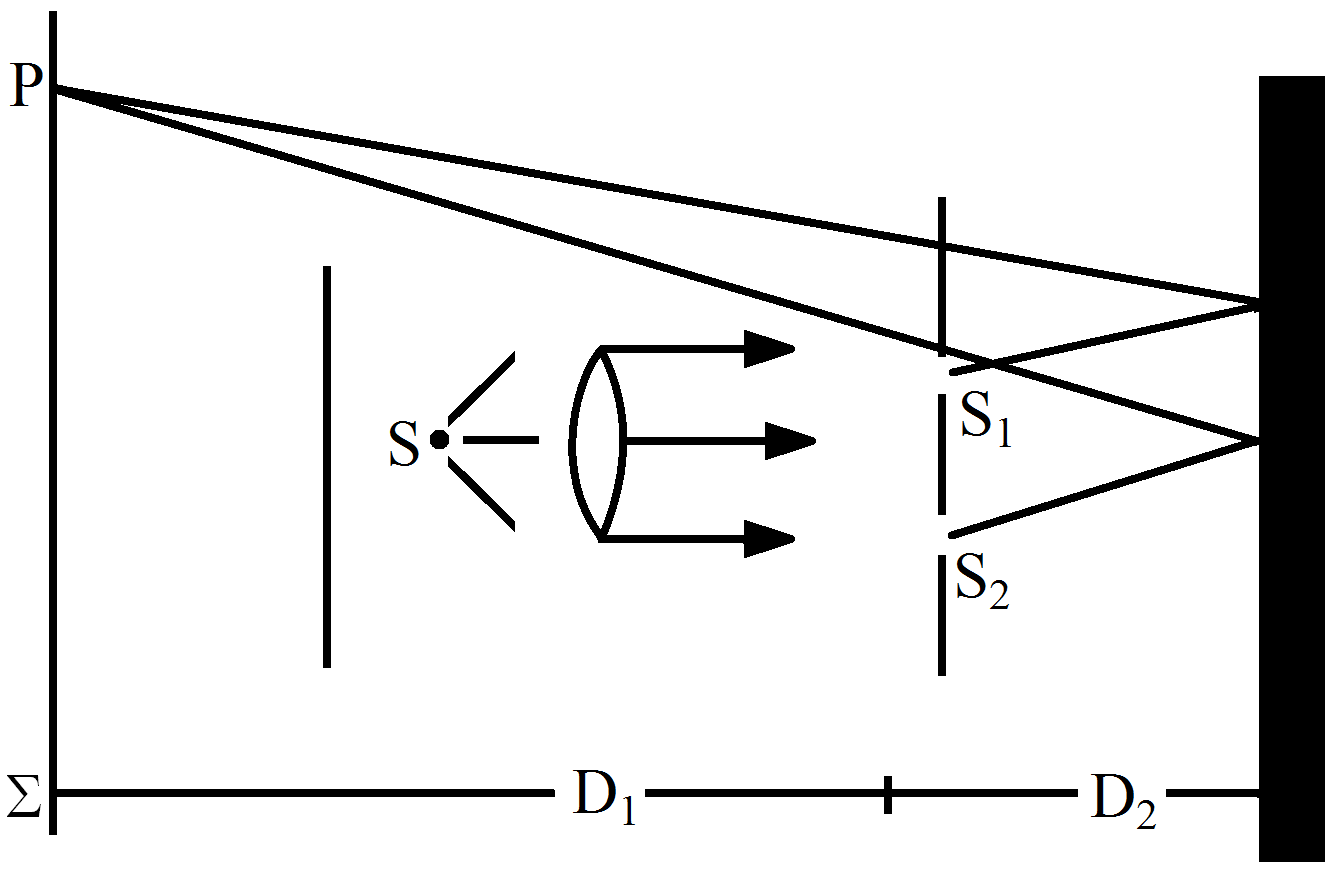
A double slit S1 - S2 is illuminated by a coherent light of wavelength $\lambda$. The slits are separated by a distance d. A plane mirror is placed in front of the double slit at a distance D1 from it and a screen $\sum$ is placed behind the double slit at a distance D2 from it (figure 17-E2). The screen E receives only the light reflected by the mirror. Find the fringe-width of the interference pattern on the screen.

The mass of a H-atom is less than the sum of the masses of a proton and electron. Why is this?
Answer the following questions:
Why is choke coil needed in the use of fluorescent tubes with acmains? Why can we not use an ordinary resistor instead of the choke coil?
Give the sign convection for electric or magnetic field leaving and entering the plane of the paper.
How the speed of revolving electron in stable orbit is related to principal quantum number?
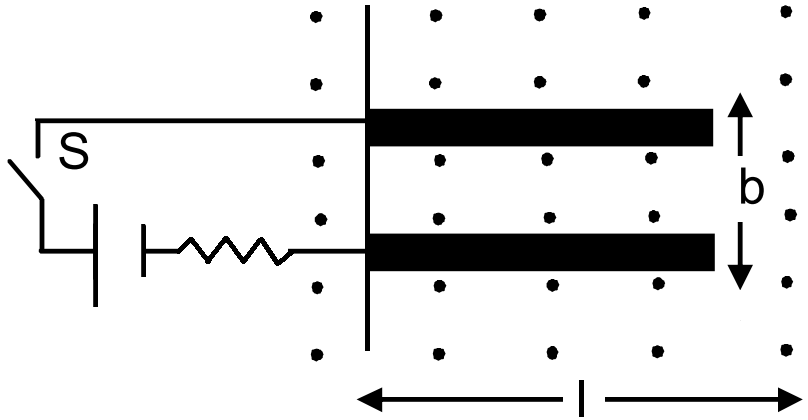
Two metal strips, each of length l, are clamped parallel to each other on a horizontal floor with a separation b between them. A wire of mass m lies on them perpendicularly, as shown in A vertically-upward magnetic field of strength B exists in the space. The metal strips are smooth but the coefficient of friction between the wire and the floor is $\mu.$ A current i is established when the switch S is closed at the instant t = 0. Discuss the motion of the wire after the switch is closed. How far away from the strips will the wire reach?

Write the relation for the forces $\overrightarrow{F}$ acting on a charge carrier q moving with a velocity $\overrightarrow{V}$  through a magnetic field $\overrightarrow{B}$  in vector notation. Using this relation, deduce the conditions under which this force will be (1) maximum (2) minimum.
(a) Calculate the potential at a point $P$ located at a distance of 9 cm due to the charge $4 \times 10^{-7} C$.(b) Now, find the work done in bringing the charge $2 \times 10^{-9} C$ from infinity to point P . Does the answer depend on the path along which the charge is brought?
Explain destructive interference using proper (appropriate) example.