Question
Find the inverse of the following matrices by using elementry row transformation:
$\begin{bmatrix}3 & 10 \\ 2 & 7 \end{bmatrix}$

Answer

$\text{A}=\begin{bmatrix}3 & 10 \\ 2 & 7 \end{bmatrix}$
Now, A = IA
$\begin{bmatrix}3 & 10 \\ 2 & 7 \end{bmatrix}=\begin{bmatrix}1 & 0 \\ 0 & 1 \end{bmatrix}\text{A}$
$\text{Applying R}_1\rightarrow\frac{1}{3}\text{ R}_1$
$\begin{bmatrix} 1 & \frac{10}{7} \\ 2 & 7 \end{bmatrix}=\begin{bmatrix} \frac{1}{3} & 0 \\ 0 & 1 \end{bmatrix}\text{A}$
Applying $R_2 \rightarrow R_2 - 2R_1$
$\begin{bmatrix} 1 & \frac{10}{3} \\ 0 & \frac{1}{3} \end{bmatrix}=\begin{bmatrix}\frac{1}{3} & 0 \\ \frac{-2}{3} & 1 \end{bmatrix}\text{A}$
Applying $R_2 \rightarrow 3R_2$
$\begin{bmatrix}1 & \frac{10}{3} \\ 0 & \frac{1}{3} \end{bmatrix}=\begin{bmatrix}\frac{1}{3} & 0 \\ -2 & 3 \end{bmatrix}\text{A}$
$\text{Applying R}_1\rightarrow\text{R}_1-\frac{10}{3}\text{ R}_3$
$\begin{bmatrix} 1 & 0 \\ 0 & 1 \end{bmatrix}=\begin{bmatrix} 7 & -10 \\ -2 & 3 \end{bmatrix}\text{A}$
I = BA
Hence, B is the inverse of A.

Need a full question paper?

Generate a complete, print-ready paper with questions like this in minutes — across 16+ boards, with answer keys.
Start Generating Free

Similar questions

A diet for a sick person must contain at least 4000 units of vitamins, 50 units of minerals and 1400 of calories. Two foods A and B, are available at a cost of Rs 4 and Rs 3 per unit respectively. If one unit of A contains 200 units of vitamin, 1 unit of mineral and 40 calories and one unit of food B contains 100 units of vitamin, 2 units of minerals and 40 calories, find what combination of foods should be used to have the least cost?
If $\text{f}\text{(x)}=\begin{cases}\frac{1-\cos\text{kx}}{\text{x}\sin\text{x}}, & \text{x} \neq 0\\\frac{1}{2}, & \text{x}= 0\end{cases}$ is continuous at x = 0. find k.
State when the line $\vec{\text{r}}=\vec{\text{a}}+\lambda\vec{\text{b}}$ is parallel to the plane $\vec{\text{r}}\cdot\vec{\text{n}}=\text{d}.$ Show that the line $\vec{\text{r}}=\hat{\text{i}}+\hat{\text{j}}+\lambda(3\hat{\text{i}}-\hat{\text{j}}+2\hat{\text{k}})$ is parallel to the plane $\vec{\text{r}}\cdot(2\hat{\text{i}}+\hat{\text{k}})=3.$ Also, find the distance between the line and the plane.
Show that the relative error in computing the volume of a sphere, due to an error in measuring the radius, is approximately equal to three times the relative error in the radius.
Solve the matrix equations:
$\begin{bmatrix}\text{x}&1\end{bmatrix}\begin{bmatrix}1&0\\-2&-3\end{bmatrix}\begin{bmatrix}\text{x}\\5\end{bmatrix}=0$
Solve the following differential equation:$\frac{\text{dy}}{\text{dx}}+2\text{y}=6\text{e}^{\text{x}}$
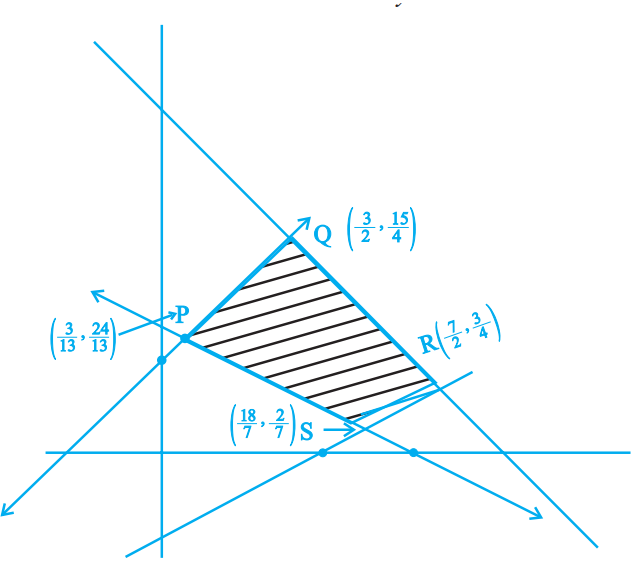
In the feasible region (shaded) for a LPP is shown. Determine the maximum and minimum value of Z = x + 2y.
Evaluate the following integrals:
$\int\sqrt{2\text{x}-\text{x}^2}\text{dx}$
Prove by vector method that the sum of the squares of the diagonals of a parallelogram is equal to the sum squares of its sides.
Evaluate the following integrals:$\int\frac{\text{x}-3}{\text{x}^2+2\text{x}-4}\text{ dx}$