Question
Find the L.C.M. of the following numbers using prime factorisation method :
36, 54, 81

Answer

324

Need a full question paper?

Generate a complete, print-ready paper with questions like this in minutes — across 16+ boards, with answer keys.
Start Generating Free

Similar questions

Solve : $3 \frac{2}{5}= x -2 \frac{1}{3}$
Solve the following equation : $2 z -2 \frac{1}{2}=3 \frac{1}{3}$
Two angles of a quadrilateral are of measures $75^{\circ}$ and $117^{\circ}$ respectively and the other two angles are equal. Find the measure of each of the equal angles.
Solve the following equation: 7x - 2 = 4x + 7
Three angles of a quadrilateral are equal and the fourth angle measures $120^{\circ}$. What is the measure of each of the equal angles?
A train covers $51$ km in $3$ hours. Calculate its speed. How far does the train go in $30$ minutes?
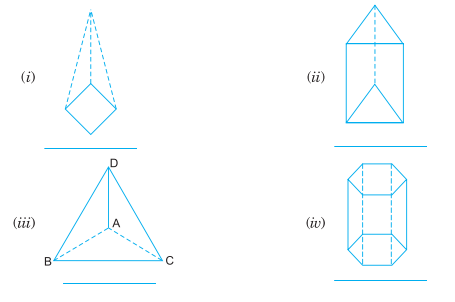
Write the name of each shape given below :
Image
A piece of cloth is $5$ metre long. After washing, it shrinks by $\frac{1}{25}$ of its length. What is the length of the cloth after washing?
We need to have atleast three parameters to construct a triangle. But still there are certain limitations. The angle sum property of a triangle and the sum of any two sides of a triangle being always greater than the third side, play an important role in judging whether a triangle can be constructed or not.
Q.1. If the lengths of two sides of a triangle are 14 cm and 18 cm, then the length of the third side can be :
(a) 32 cm$\quad$(b) 5 cm$\quad$(c) 4 cm$\quad$(d) 3 cm
Q.2. In which of the following cases is the construction of $\triangle ABC$ possible?
(a) $AB =3 cm, BC =5 cm, AC =8 cm$
(b) $AB =4 cm, BC =5 cm, AC =10 cm$
(c) $AB =5 cm, BC =6 cm, AC =7 cm$
(d) None of these
Q.3. In which of the following cases is the construction of $\triangle ABC$ possible?
(a) $\angle A =50^{\circ}, \angle B =60^{\circ}, \angle C =80^{\circ}$
(b) $\angle A =40^{\circ}, \angle B =50^{\circ}, \angle C =60^{\circ}$
(c) $\angle A =55^{\circ}, \angle B =55^{\circ}, \angle C =55^{\circ}$
(d) $\angle A =35^{\circ}, \angle B =45^{\circ}, \angle C =100^{\circ}$
Q.4. In which of the following cases is the construction of $\triangle ABC$ possible?
(a) $AB =5 cm, BC =6 cm, \angle C =40^{\circ}$
(b) $AB =6 cm, BC =8 cm, \angle B =50^{\circ}$
(c) $AB =4 cm, BC =7 cm, \angle A =60^{\circ}$
(d) None of these
Simplify : $1 \frac{1}{3} \div \frac{3}{7}$ of $2 \frac{5}{8}+1 \frac{1}{9}$