Question
Find the linear inequations for which the solution set is the shaded region given in Fig.
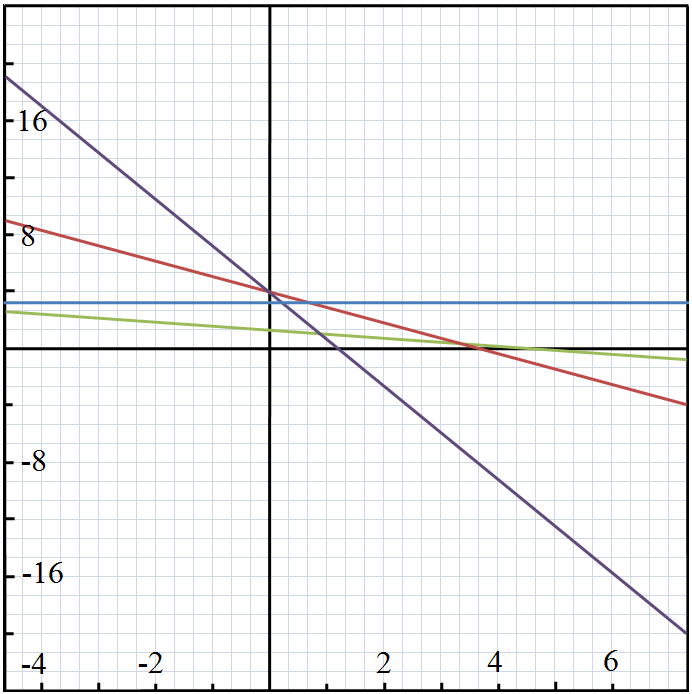
Consider the line x + y = 4. We observe that the shaded region and the origin are on the same side of the line x + y = 4 and (0, 0) satisfies the linear inequation $\text{x}+\text{y}\leq4.$ So, we must have one inequations as $\text{x}+\text{y}\leq4.$
Consider the line y = 3. We observe that the shaded region and the origin are on the same side of the line y = 3 and (0, 0) satisfies the linear inequation $\text{y}\leq3$ so, the second inequations is $\text{y}\leq3.$
Consider the line x = 3.
We observe that the shaded region and the origin are on the same side of the line x = 3 and (0, 0) satisfies the linear inequation $\text{x}\leq3$ so, the third inequations is $\text{x}\leq3$
Consider the line x + 5y = 4. We observe that the shaded region and the origin are on the opposite sides of the line x + 5y = 4 and (0, 0) does not satisfy the inequation $\text{x} + 5\text{y} \geq 4.$ so, the fourth inequations is $\text{x} + 5\text{y} \geq 4.$
Finaly, consider the line 6x + 2y = 8. We observe that the shaded region and the origin are on the opposite sides of the 6x + 2y = 8 and(0, 0) does not satisfy the inequation 6x + 2y = 8.
so the fifth inequations is 6x + 2y = 8,
we also, notice that the shaded region is above x-axis and is on the right side of y-axis. So, we must have $\text{x}\geq0$ and $\text{y}\geq0$
Thus, the linear inequations corresponding to the given solution set are
$\text{x}+\text{y}\leq4,\text{y}\leq3,\text{x}\,\leq3\text{x}+5\text{y}\geq4,,6\text{x}+2\text{y}\geq8,\text{x}\geq0,\text{y}\leq0$
Generate a complete, print-ready paper with questions like this in minutes — across 16+ boards, with answer keys.
parallel to x-axis