Question
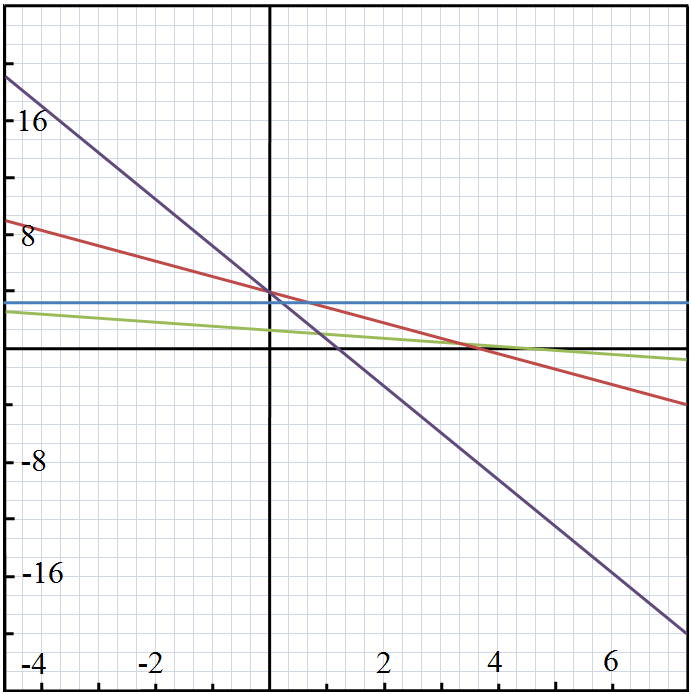
Find the linear inequations for which the solution set is the shaded region given in Fig.

Answer


Consider the line x + y = 4. We observe that the shaded region and the origin are on the same side of the line x + y = 4 and (0, 0) satisfies the linear inequation $\text{x}+\text{y}\leq4.$ So, we must have one inequations as $\text{x}+\text{y}\leq4.$

Consider the line y = 3. We observe that the shaded region and the origin are on the same side of the line y = 3 and (0, 0) satisfies the linear inequation $\text{y}\leq3$ so, the second inequations is $\text{y}\leq3.$

Consider the line x = 3.

We observe that the shaded region and the origin are on the same side of the line x = 3 and (0, 0) satisfies the linear inequation $\text{x}\leq3$ so, the third inequations is $\text{x}\leq3$

Consider the line x + 5y = 4. We observe that the shaded region and the origin are on the opposite sides of the line x + 5y = 4 and (0, 0) does not satisfy the inequation $\text{x} + 5\text{y} \geq 4.$ so, the fourth inequations is $\text{x} + 5\text{y} \geq 4.$

Finaly, consider the line 6x + 2y = 8. We observe that the shaded region and the origin are on the opposite sides of the 6x + 2y = 8 and(0, 0) does not satisfy the inequation 6x + 2y = 8.

so the fifth inequations is 6x + 2y = 8,

we also, notice that the shaded region is above x-axis and is on the right side of y-axis. So, we must have $\text{x}\geq0$ and $\text{y}\geq0$

Thus, the linear inequations corresponding to the given solution set are

$\text{x}+\text{y}\leq4,\text{y}\leq3,\text{x}\,\leq3\text{x}+5\text{y}\geq4,,6\text{x}+2\text{y}\geq8,\text{x}\geq0,\text{y}\leq0$

Need a full question paper?

Generate a complete, print-ready paper with questions like this in minutes — across 16+ boards, with answer keys.

Start Generating Free

Similar questions

Prove the following by the principle of mathematical induction:
$1 + 3 + 3^2 + ... + 3^{\text{n}-1}=\frac{3^\text{n}-1}{2}$
Find the middle term $($terms$)$ in the expansion of:
$\Big(3\text{x}-\frac{\text{x}^3}{6}\Big)^{9}$
If ${^\text{28}}\text{C}_{2\text{r}}:{^\text{24}}\text{C}_{\text{2r-4}},=225:11,$ Find r.
The vertices of a triangle ABC are A(0, 0), B(2, -1) and C(9, 2). Find cos B.
If $\sin\text{x}+\cos\text{x}=0$ and x lies in the fourth quadrant, find $\sin \text{x } $and $\cos\text{x}.$
Two dice are thrown. The events A, B, C, D, E and F are described as follows: A = Getting an even number on the first die.
B = Getting an odd number on the first die.
C = Getting at most 5 as a sum of the numbers on the two dice.
D = Getting the sum of the numbers on the dice greater than 5 but less than 10.
E = Getting at least 10 as the sum of the numbers on the dice.
F = Getting an odd number on one of the dice.
Describe the following events: A and B, B or C, B and C, A and E, A or F, A and F.
Evaluate the following limit:
$\lim\limits_{\text{x}\rightarrow-1}\frac{\text{x}^2-\text{x}-2}{\big(\text{x}^2+\text{x}\big)+\sin(\text{x}+1)}$
Prove that:
$\frac{\sin\text{A}+\sin\text3{A}}{\cos\text{A}-\cos3\text{A}}=\cot\text{A}$
If $\sin(\alpha+\beta)=1$ and $\sin(\alpha-\beta)=\frac{1}{2}$ where $0\leq\alpha,\beta\leq\frac{\pi}{2}$ than find the values of $\tan(\alpha+2\beta)$and $\tan(2\alpha+\beta).$
The mid-points of the sides of a triangle are (5, 7, 11), (0, 8, 5) and (2, 3, -1). Find its vertices.