Question
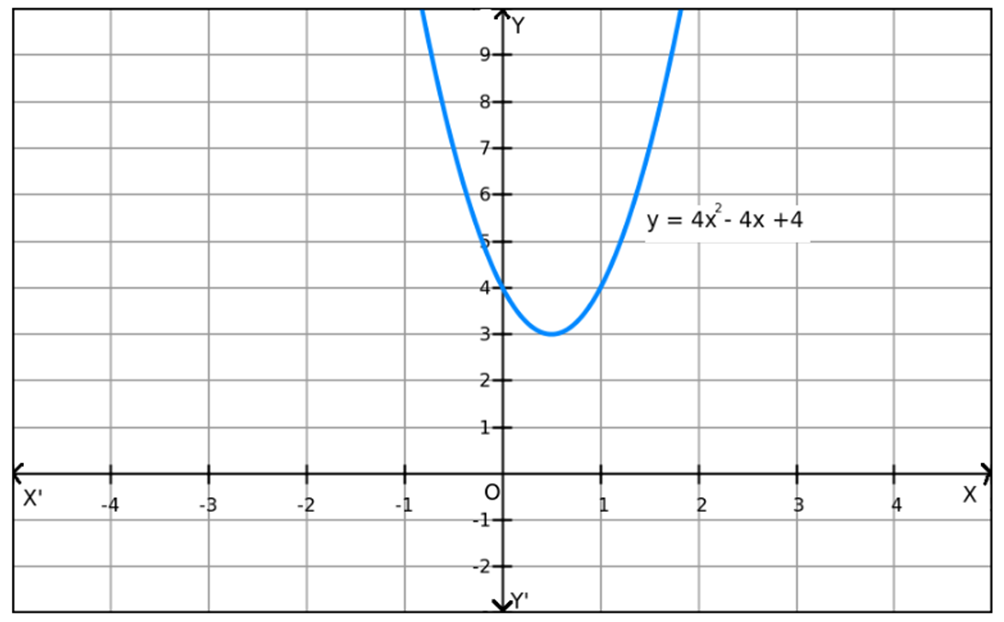
Find the maximum and the minimum values, if any, without using derivatives of the following functions: $f(x) = 4x^{2 }- 4x + 4$ on $R.$
Answer

$\text{f}(\text{x})=4\text{x}^{2}-4\text{x}+4$ on $R$
$=4\text{x}^{2}-4\text{x}+1+3$
$=(2\text{x})^{2}+3$
$ \therefore(2\text{x}-1)^{2}\geq0$
$\Rightarrow(2\text{x}-1)^{2}+3\geq3$
$\Rightarrow\text{f}(\text{x})\geq\text{f}\Big(\frac{1}{2}\Big)$

Thus, the minimum value of $f(x)$ is $3$ at $\text{x}=\frac{1}{2}$ 
since, $f(x)$ can be made as large as. Therefore maximum value does not exist. 

Need a full question paper?

Generate a complete, print-ready paper with questions like this in minutes — across 16+ boards, with answer keys.

Start Generating Free

Similar questions

For each of the differential equation given in find the general solution:
$\text{x}\frac{\text{dy}}{\text{dx}}+2\text{y}=\text{x}^2\log\text{x}$
Prove that:
$\begin{vmatrix}1&\text{b}+\text{c}&\text{b}^2+\text{c}^2\\1&\text{c}+\text{a}&\text{c}^2+\text{a}^2\\1&\text{a}+\text{b}&\text{a}^2+\text{b}^2 \end{vmatrix}=(\text{a}+\text{b})(\text{b}-\text{c})(\text{c}-\text{a})$
A diet for a sick person must contain at least $4000$ units of vitamins, $50$ units of minerals and $1400$ of calories. Two foods $A$ and $B,$ are available at a cost of $Rs. 4$ and $Rs. 3$ per unit respectively. If one unit of $A$contains $200$ units of vitamin, $1$ unit of mineral and $40$ calories and one unit of food $B$ contains $100$ units of vitamin, $2$ units of minerals and $40$ calories, find what combination of foods should be used to have the least cost?
If a young man drives his vehicle at 25 km/hr, he has to spend Rs. 2 per km on petrol. If he drives it at a faster speed of 40 km/hr, the petrol cost increases to Rs. 5 per km. He has Rs. 100 to spend on petrol and travel within one hour. Express this as an LPP and solve the same.
Maximise Z = 3x + 4y
subject to the constraints: $\text{x}+\text{y}\leq4,\text{x}\geq0,\ \text{y}\geq0.$
Show that the four points A, B, C and D with the position vectors $\vec{\text{a}},\ \vec{\text{b}},\ \vec{\text{c}}$ and $\vec{\text{d}}$ respectively are coplanar if and only if $3\vec{\text{a}}-2\vec{\text{b}}+\vec{\text{c}}-2\vec{\text{d}}=\vec0$.
Evaluate: $\int\limits^{\frac{\pi}{2}}_{0}\frac{\sin^{2}x}{\sin x + \cos x}dx$
Find the equation of the plane which bisects the line segment joining the points (-1, 2, 3) and (3, -5, 6) at right angles.
Maximum $Z = 10x + 6y$
Subject to
$3\text{x}+\text{y}\leq12$
$2\text{x}+5\text{y}\leq34$
$\text{x},\text{y}\geq0$
If $(\text{x}-\text{y})\text{e}^{\frac{\text{x}}{\text{x}-\text{y}}}=\text{a},$ prove that $\text{y}\frac{\text{dy}}{\text{dx}}+\text{x}=2\text{y}$