Question
Find the maximum wavelength of electromagnetic radiation which can create a hole-electron pair in germanium. The band gap in germanium is 0.65eV.

Answer

Given,
Band gap of germanium, E = 0.65eV
Wavelength of the incident radiation, $\lambda=?$
For the electron‒hole pair creation, the energy of the incident radiation should be at least equal to the band gap of the material.
So,
$\text{E}=\frac{\text{hc}}{\lambda}$
$\Rightarrow\lambda=\frac{\text{hc}}{\text{E}}=\frac{1242\text{eV}-\text{nm}}{0.65\text{eV}}$
$\Rightarrow\lambda=1910.7\times10^{-9}\text{m}$
$\Rightarrow\lambda=1.9\times10^{-5}\text{m}$

Need a full question paper?

Generate a complete, print-ready paper with questions like this in minutes — across 16+ boards, with answer keys.
Start Generating Free

Similar questions

A person wears glasses of power -2.5D. Is the person farsighted or nearsighted? What is the far point of the person without the glasses?
The magnetic field inside a tightly wound, long solenoid is $\text{B}=\mu_0\text{ni}.$ It suggests that the field does not depend on the total length of the solenoid, and hence if we add more loops at the ends of a solenoid the field should not increase. Explain qualitatively why the extra-added loops do not have a considerable effect on the field inside the solenoid.
Give the characteristics of an electric field.
An aeroplane travels over a rectangular field 100m × 50m, parallel to its length. What should be the speed of the plane so that the field becomes square in the plane frame?
Define the SI unit of the magnetic field.
Because of the friction between the water in oceans with the earth's surface, the rotational kinetic energy of the earth is continuously decreasing. If the earth's angular speed decreases by 0.0016rad/ day in 100 years, find the average torque of the friction on the earth. Radius of the earth is 6400km and its mass is $6.0 × 10^{24}$kg.
Explain the lateral shift for a ray refracted from a glass slab with parallel sides.
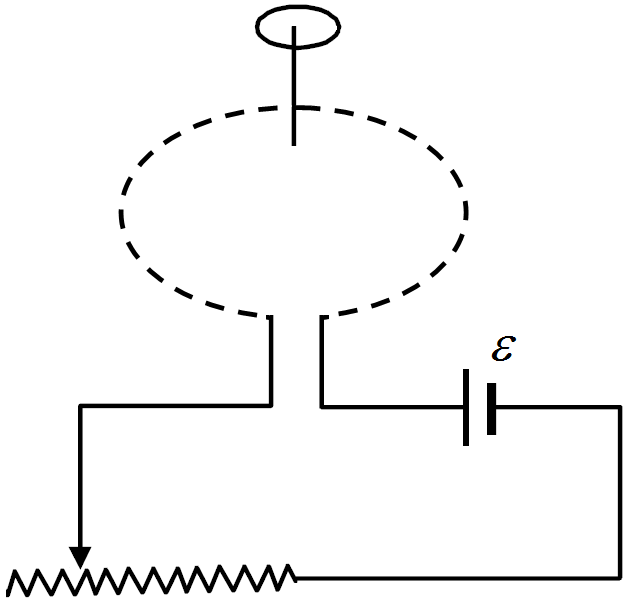
Find the mutual inductance between the circular coil and the loop shown in figure.
Does the polarising angle for any transparent medium depend on the wavelength of light?
Can you have $\overrightarrow{\text{A}}\times\overrightarrow{\text{B}}=\overrightarrow{\text{A}}\cdot\overrightarrow{\text{B}}$ with $\text{A}\neq0$ and $\text{B}\neq0?$ What if one of the two vectors is zero?