Question
Find the perimeter of the rectangle whose length is $40\ cm$ and a diagonal is $41\ cm.$
Answer


Given,
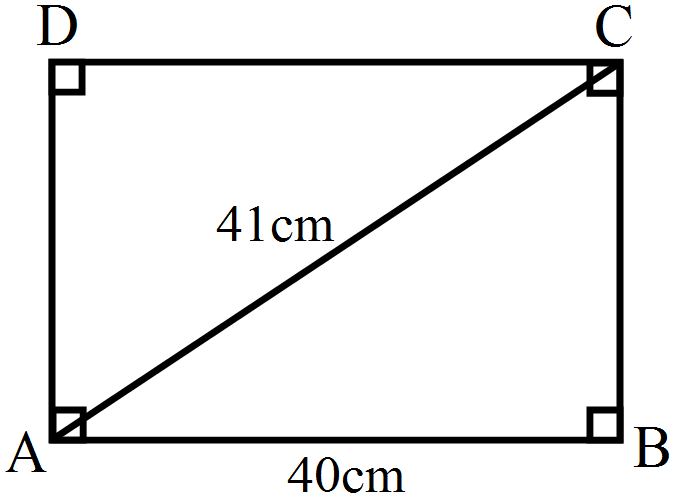
$A B C D$ is a rectangle and $A C$ is its diagonal.
$\mathrm{AB}=40 \mathrm{~cm} \text { and } \mathrm{AC}=41 \mathrm{~cm}$
Now in right $\triangle \mathrm{ABC}$
$A C^2=A B^2+B C^2(B y \text { Pythagoras Theorom) }$
$\Rightarrow(41)^2=(40)^2+B C^2$
$\Rightarrow 1681=1600+B C^2$
$\Rightarrow B C^2=1681-1600$
$\Rightarrow B C^2=81$
$\Rightarrow B C^2=(9)^2$
$B C=9 \mathrm{~cm}$
Now perimeter of rectangle $A B C D=2(A B+B C)=2(40+9)=2 \times 49=98 \mathrm{~cm}$.

Need a full question paper?

Generate a complete, print-ready paper with questions like this in minutes — across 16+ boards, with answer keys.

Start Generating Free

Similar questions

If the mean of the following data is $15$, find $p$.
x:
$5$
$10$
$15$
$20$
$25$
f:
$6$
$p$
$6$
$10$
$5$
The ratio of the radii of two circles is $4 : 5.$ Find the ratio of their areas.
A unit test paper contains 20 questions. If 5 marks are awarded for every correct answer, 2 marks are deducted for every wrong answer and 1 mark is deducted for every unanswered question. If Romit got 12 correct answers, 5 wrong answers and left 3 questions unanswered. What is his score?
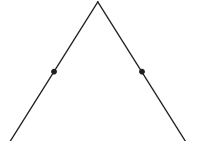
Use support lines in the given figure to construct a pointed arch. Make different arches by changing the radius of the arcs.
Image
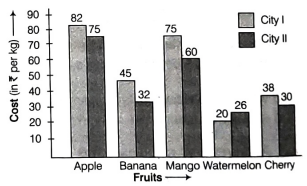
Study the double bar graph given below and answer the questions that follow
Image
(i) What information does the above double graph depict?
(ii) Name the fruits for which cost of 1 kg is greater in City I as compared to City II.
(iii) What is the difference of rates for apples in both the cities?
(iv) Find the ratio of the cost of mangoes per kg in City! to the cost of mangoes per kg in City II.
Find the mode and median of the data: 13, 16, 12, 14, 19, 12, 14, 13, 14. By using the empirical relation also find the mean.
Draw a line $AB$ and draw another line $CD$ parallel to $AB$ at a distance of $3.5\ cm$ from it.
Arrange the following rational numbers in ascending order: $\frac{-3}{4},\frac{5}{-12},\frac{-7}{16},\frac{9}{-24}$
Draw a line $PQ$. Draw another line parallel to $PQ$ at a distance of $3\ cm$ from it.
Draw $\triangle\text{DEF}$ such that $DE= DF= 4\ cm$ and $EF = 6\ cm$. Measure $\angle\text{E}$ and $\angle\text{F}.$