Question
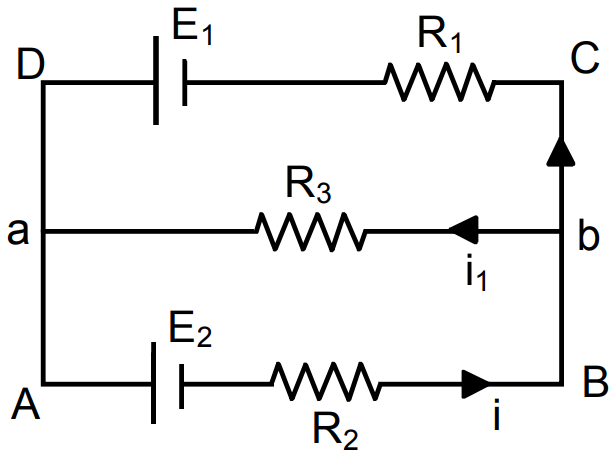
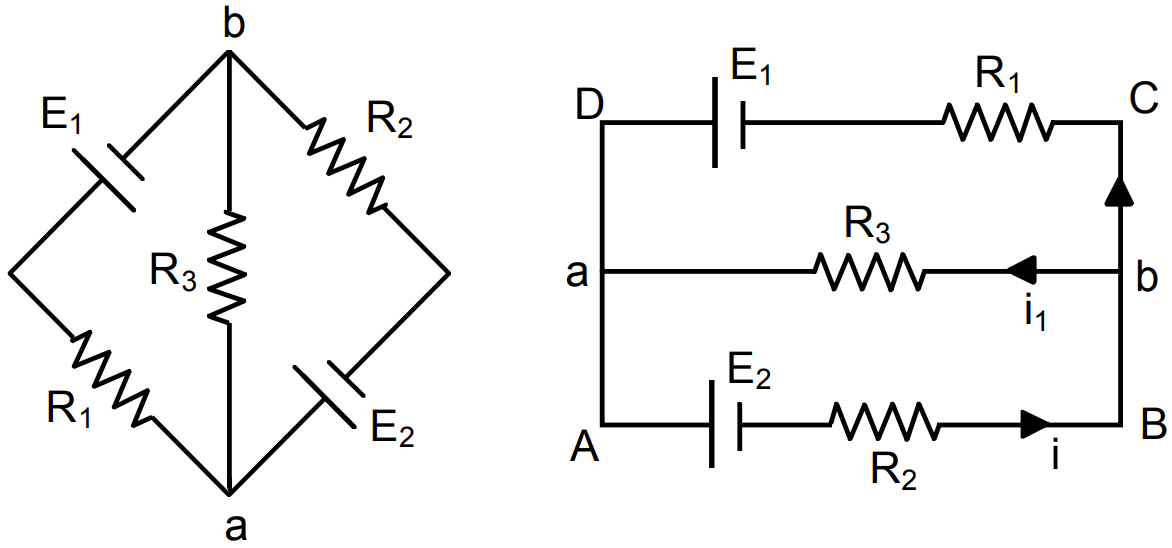
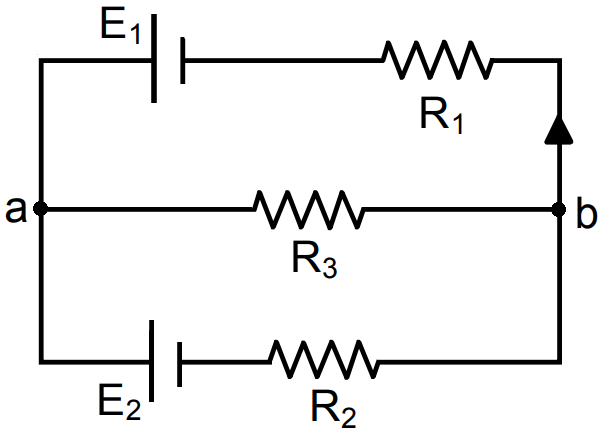
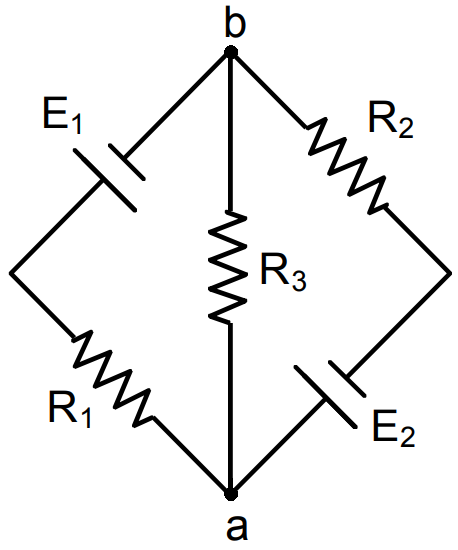
Find the potential difference $V_a - V_b $ in the circuits shown in figure.
Answer

  1. In circuit, AB ba A


$\text{E}_2+\text{iR}_2+\text{i}_1\text{R}_3=0$

In circuit, $\text{i}_1\text{R}_3+\text{E}_1-(\text{i}-\text{i}_1)\text{R}_1=0$

$\Rightarrow\text{i}_1\text{R}_3+\text{E}_1-\text{iR}_1+\text{i}_1\text{R}_1=0$

$[\text{iR}_2+\text{i}_1\text{R}_3\ \ \ \ \ \ \ \ \ \ \ \ \ \ \ \ \ \ \ \ \ \ =-\text{E}_2]\text{R}_1\\ [\text{iR}_2-\text{i}_1(\text{R}_1+\text{R}_3)\ \ \ \ \ \ \ \ \ =\text{E}_1]\text{R}_2\\\underline{\ \ \ \ \ \ \ \ \ \ \ \ \ \ \ \ \ \ \ \ \ \ \ \ \ \ \ \ \ \ \ \ \ \ \ \ \ \ \ \ \ \ \ \ \ \ \ \ \ \ \ \ \ \ \ \ \ }\\\text{iR}_2\text{R}_1+\text{i}_1\text{R}_3\text{R}_1\ \ \ \ \ \ \ \ \ \ \ \ \ =-\text{E}_2\text{R}_1\\\text{iR}_2\text{R}_1-\text{i}_1\text{R}_2(\text{R}_1+\text{R}_3)=\ \ \ \text{E}_1\text{R}_2\\\underline{ \ \ \ \ \ \ \ \ \ \ \ \ \ \ \ \ \ \ \ \ \ \ \ \ \ \ \ \ \ \ \ \ \ \ \ \ \ \ \ \ \ \ \ \ \ \ \ \ \ \ \ \ \ \ \ \ \ }$

$\text{iR}_3\text{R}_1+\text{i}_1\text{R}_2\text{R}_1+\text{i}_1\text{R}_2\text{R}_3=\text{E}_1\text{R}_2-\text{E}_1\text{R}_1$

$\Rightarrow\text{i}_1(\text{R}_3\text{R}_1+\text{R}_2\text{R}_1+\text{R}_2\text{R}_3)=\text{E}_1\text{R}_2-\text{E}_2\text{R}_1$

$\Rightarrow\text{i}_1=\frac{\text{E}_1\text{R}_2-\text{E}_2\text{R}_1}{\text{R}_3\text{R}_1+\text{R}_2\text{R}_1+\text{R}_2\text{R}_3}$

$\Rightarrow\frac{\text{E}_1\text{R}_2\text{R}_3-\text{E}_2\text{R}_1\text{R}_3}{\text{R}_3\text{R}_1+\text{R}_2\text{R}_1+\text{R}_2\text{R}_3}=\Bigg(\frac{\frac{\text{E}_1}{\text{R}_1}-\frac{\text{E}_2}{\text{R}_2}}{\frac{1}{\text{R}_2}+\frac{1}{\text{R}_1}+\frac{1}{\text{R}_3}}\Bigg)$
  1. $\therefore$ Same as a

Need a full question paper?

Generate a complete, print-ready paper with questions like this in minutes — across 16+ boards, with answer keys.

Start Generating Free

Similar questions

Suppose an attractive nuclear force acts between two protons which may be written as $\text{F}=\text{Ce}^{-\text{kr}}/\text{r}^2.$
  1. Write down the dimensional formulae and appropriate SI units of C and k.
  2. Suppose that k = 1 fermi$^{-1}$ and that the repulsive electric force between the protons is just balanced by the attractive nuclear force when the separation is 5 fermi. Find the value of C.
If several forces act on a particle, the total torque on the particle may be obtained by first finding the resultant force and then taking torque of this resultant. Prove this. Is this result valid for the forces acting on different particles of a body in such a way that their lines of action intersect at a common point?
  1. A rod of length l is moved horizontally with a uniform velocity ‘v’ in a direction perpendicular to its length through a region in which a uniform magnetic field is acting vertically downward. Derive the expression for the emf induced across the ends of the rod.
  2. How does one understand this motional emf by invoking the Lorentz force acting on the free charge carriers of the conductor? Explain.
Draw V – I characteristics of a p–n junction diode. Answer the following questions, giving reasons:
  1. Why is the current under reverse bias almost independent of the applied potential up to a critical voltage?
  2. Why does the reverse current show a sudden increase at the critical voltage?
Name any semiconductor device which operates under the reverse bias in the breakdown region.
A circular loop of radius 20cm carries a current of 10A. An electron crosses the plane of the loop with a speed of $2.0 \times 10^6m/s$. The direction of motion makes an angle of 30° with the axis of the circle and passes through its centre. Find the magnitude of the magnetic force on the electron at the instant it crosses the plane.
The following data was recorded for values of object distance and the corresponding values of image distance in the experiment on study of real image formation by a convex lens of power +5D. One of these observations is incorrect. Identify this observation and give reason for your choice:
S .No
Object distance (cm)
Image distance (cm)
1
25
97
2
30
61
3
35
37
4
45
35
5
50
32
6
55
30
The nucleus $^{23}_{10}\text{Ne}$ decays by $\beta$ emission. Write down the $\beta$-decay equation and determine the maximum kinetic energy of the electrons emitted. Given that:
$\text{m}(^{23}_{10}\text{Ne})=22.994466\text{ u}.$
$\text{m}(^{23}_{10}\text{Na})=22.089770\text{ u}.$
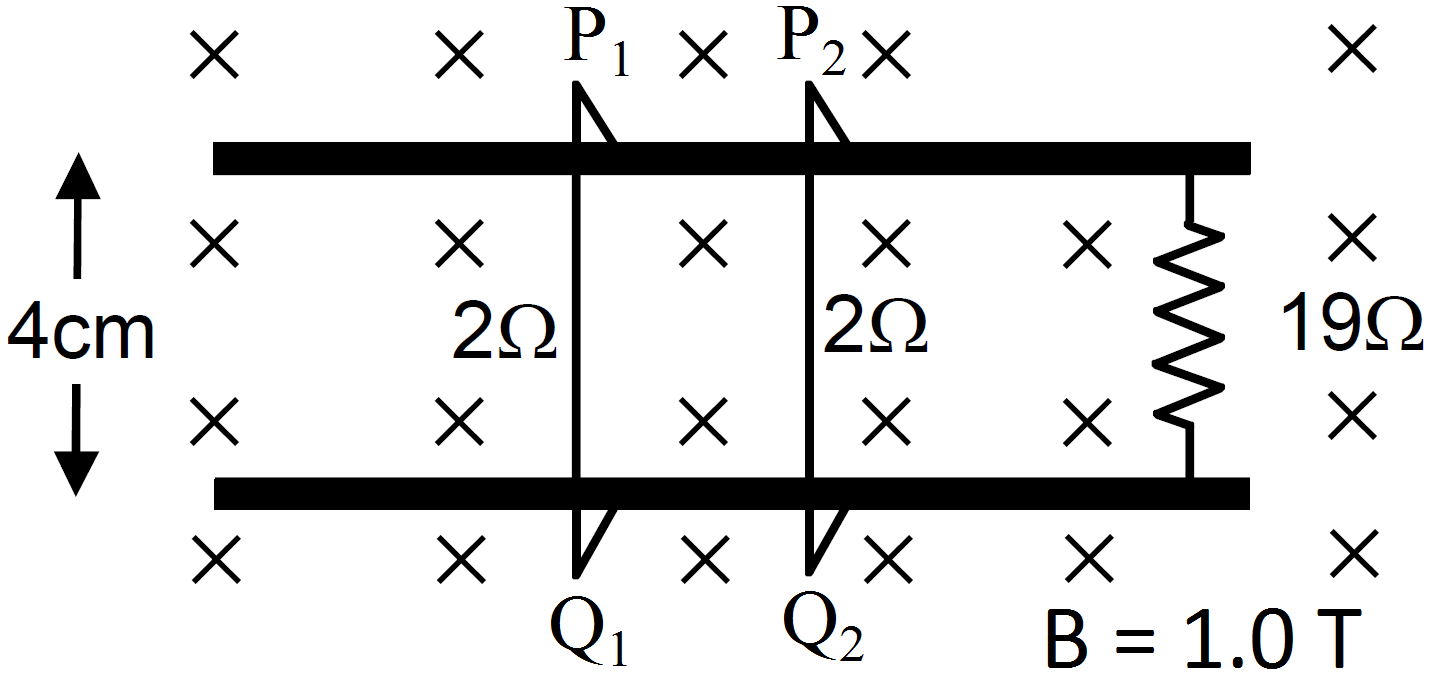
Consider the situation shown in figure. The wires $P_1Q_1$ and $P_2Q_2$ are made to slide on the rails with the same speed 5cm/s. Find the electric current in the $19\Omega$ resistor if:
  1. Both the wires move towards right.
  2. If $P_1Q_1$ moves towards left but $P_2Q_2$ moves towards right.
A person looks at different trees in an open space with the following details. Arrange the trees in decreasing order of their apparent sizes.
Tree Height(m) Distance form the eye(m)
A 2.8 50
B 2.5 80
C 1.8 70
D 2.8 100
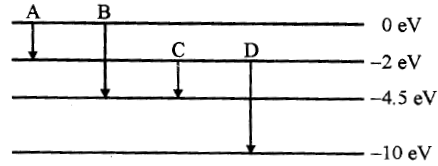
The energy levels of an atom are as shown below:
  1. Which of them will result in the transition of a photon of wavelength 275 nm?
  1. Which transition corresponds to emission of radiation of maximum wavelength?