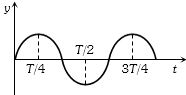
Find the ratio of time periods of two identical springs if they are first joined in series $\&$ then in parallel $\&$ a mass $m$ is suspended from them :
Medium


Download our appand get started for free
Experience the future of education. Simply download our apps or reach out to us for more information. Let's shape the future of learning together!No signup needed.*
Similar Questions
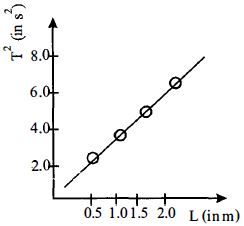
- 1In an experiment for determining the gravitational acceleration $g$ of a place with the help of a simple pendulum, the measured time period square is plotted against the string length of the pendulum in the figure. What is the value of $g$ at the place? ...... $m/s^2$View Solution
- 2Two masses ${m_1}$ and ${m_2}$ are suspended together by a massless spring of constant k. When the masses are in equilibrium, ${m_1}$ is removed without disturbing the system. Then the angular frequency of oscillation of ${m_2}$ isView Solution
- 3The bob of a pendulum was released from a horizontal position. The length of the pendulum is $10 \mathrm{~m}$. If it dissipates $10 \%$ of its initial energy against air resistance, the speed with which the bob arrives at the lowest point is : [Use, $\mathrm{g}: 10 \mathrm{~ms}^{-2}$ ]View Solution
- 4View SolutionIn a simple harmonic oscillator, at the mean position
- 5A trolley of mass $m_1$ is placed on horizontal rigid pair of rails at same height. A mass $m_2$ is suspended to the trolley vertically by me ans of a ideal massless rope. The rope hangs between rails without touching them. Trolley can move along smooth rails but can't move in any other direction. Suspended mass is given small oscillation and perform $SHM$ after displacing small from stable equilibrium position in two ways, first perpendicular to the rails and second parallel to the rails. The ratio of time period of these (second case to first case) two $SHM's$ isView Solution
- 6The $K.E.$ and $P.E.$ of a particle executing $SHM$ with amplitude $A$ will be equal when its displacement isView Solution
- 7The displacement $x$ (in metres) of a particle performing simple harmonic motion is related to time $t$ (in seconds) as $x = 0.05\cos \left( {4\,\pi \,t + \frac{\pi }{4}} \right)$. The frequency of the motion will be ..... $Hz$View Solution
- 8Two simple harmonic motions $y_1 = A \sin \omega t$ and $y_2 =A \cos \omega t$ are superimposed on a particle of mass $m.$ The total mechanical energy of the particle is :View Solution
- 9The displacement of a particle executing SHM is given by $x=10 \sin \left(\omega t+\frac{\pi}{3}\right) \mathrm{m}$. The time period of motion is $3.14 \mathrm{~s}$. The velocity of the particle at $\mathrm{t}=0$is_________. $\mathrm{m} / \mathrm{s}$.View Solution
- 10View SolutionThe graph shows the variation of displacement of a particle executing S.H.M. with time. We infer from this graph that