Question
Find the second order derivatives of the following functions:$\log(\sin\text{x})$

Answer

We have,
$\text{y}=\text{e}^\text{e}\sin(5\text{x})$
Differentiating w.r.t.x, we get
$\frac{\text{dy}}{\text{dx}}=\text{e}^\text{x}\sin5\text{x}+\text{e}^\text{x}\cos5\text{x}\times5$
Differentiating w.r.t.x, we get
$\frac{\text{d}^2\text{y}}{\text{dx}^2}=\text{e}^\text{x}\sin5\text{x}+\text{e}^\text{x}\cos5\text{x}\times5+5\text{e}^\text{x}\cos5\text{x}$
$=-24\text{e}^\text{x}\sin5\text{x}+10\text{e}^\text{x}\cos5\text{x}$
$=2\text{e}^\text{x}(5\cos5\text{x}-12\sin5\text{x})$

Need a full question paper?

Generate a complete, print-ready paper with questions like this in minutes — across 16+ boards, with answer keys.
Start Generating Free

Similar questions

The x-intercept of the tangent line to a curve is equal to the ordinate of the point of contact. Find the particular curve through the point (1, 1).
Using Lagrange's mean value theorem, prove that
$(\text{b}-\text{a})\sec^2\text{a}<\tan\text{b}-\tan\text{a}<(\text{b}-\text{a})\sec^2\text{b}$
where $0<\text{a}<\text{b}<\frac{\pi}{2}.$
If y(x) is a solution of the different equation $\Big(\frac{2+\sin\text{x}}{1+\text{y}}\Big)\frac{\text{dy}}{\text{dx}}=-\cos\text{x}$ and $\text{y}(0)=1,$ then find the value of $\text{y}\Big(\frac{\pi}{2}\Big).$
Evaluate the following integrals as limit of sum:
$\int\limits^2_{0}\big(\text{x}^2+4\big)\text{dx}$
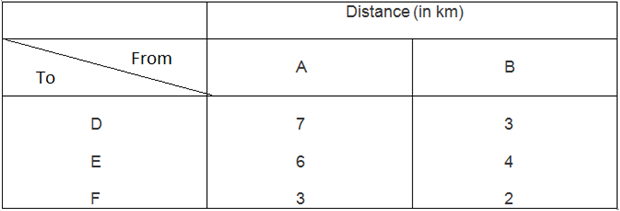
An oil company has two depots, $A$ and $B$, with capacities of $7000$ litres and $4000$ litres respectively. The company is to supply oil to three petrol pumps, $\text{D, E, F}$ whose requirements are $4500, 3000$ and $3500$ litres respectively. The distance $($in $\ km)$ between the depots and petrol pumps is given in the following table:

Assuming that the transportation cost per km is $Rs. 1.00$ per litre, how should the delivery be scheduled in order that the transportation cost is minimum?
Find $\frac{\text{dy}}{\text{dx}},$ when
$\text{x}=\text{e}^{\theta}\Big(\theta+\frac{1}{\theta}\Big)\text{ and y}=\text{e}^{-\theta}\Big(\theta-\frac{1}{\theta}\Big)$
A company manufactures two types of novelty Souvenirs made of plywood. Souvenirs of type A require 5 minutes each for cutting and 10 minutes each for assembling. Souvenirs of type B require 8 minutes each for cutting and 8 minutes each for assembling. There are 3 hours 20 minutes available for cutting and 4 hours available for assembling. The profit is 50 paise each for type A and 60 paise each for type B souvenirs. How many souvenirs of each type should the company manufacture in order to maximize the profit?
Find the point on the curve $y = x^2 - 2x + 3,$ where the tangent is parallel to $x-$axis.
If $\vec{\text{a}}=2\hat{\text{i}}-3\hat{\text{j}}+\hat{\text{k}},\vec{\text{b}}=-\hat{\text{i}}+\hat{\text{k}},\vec{\text{c}}=2\hat{\text{j}}-\hat{\text{k}}$are three vectors, find the aera of the parallelogram having diagonals $\big(\vec{\text{a}}+\vec{\text{b}}\big)$ and $\big(\vec{\text{b}}+\vec{\text{c}}\big).$
Verify Lagrange's mean value theorem for the following function on the indicated intervals. find a point 'c' in the indicated interval as stated by the Lagrange's mean value theorem.
$\text{f}(\text{x})=\sqrt{25-\text{x}^2}\text{ on }[-3,4]$