Question
Find the shortest distance between lines $\bar{r}=(2 \hat{i}-\hat{j})+\lambda(2 \hat{i}+\hat{j}-3 \hat{k})$ and $\bar{r}=\hat{i}-\hat{j}+2 \hat{k}+\mu(2 \hat{i}+\hat{j}-5 \hat{k})$

Answer

The shortest distance between lines $\bar{r}=\bar{a}_1+\lambda_1 \bar{b}_1$ and $\bar{r}=\bar{a}_2+\lambda_2 \bar{b}_2$ is $\left|\frac{\left(\bar{a}_2-\bar{a}_1\right) \cdot\left(\bar{b}_1 \times \bar{b}_2\right)}{\left|\bar{b}_1 \times \bar{b}_2\right|}\right|$
Here $\bar{a}_1=2 \hat{i}-\hat{j}, \bar{a}_2=\hat{i}-\hat{j}+2 \hat{k}, \bar{b}_1=2 \hat{i}+\hat{j}+3 \hat{k}, \bar{b}_2=2 \hat{i}+\hat{j}-5 \hat{k}$
$
\overline{a_2}-\overline{a_1}=(\hat{i}-\hat{j}+2 \hat{k})-(2 \hat{i}-\hat{j})=-\hat{i}+2 \hat{k}
$
And $\bar{b}_1 \times \bar{b}_2=\left|\begin{array}{ccc}\hat{i} & \hat{j} & \hat{k} \\ 2 & 1 & -3 \\ 2 & 1 & -5\end{array}\right|=-2 \hat{i}+4 \hat{j}$
$
\begin{aligned}
\therefore \quad & \left|\bar{b}_1 \times \bar{b}_2\right|=\sqrt{4+16}=\sqrt{20}=2 \sqrt{5} \\
& \left(\bar{a}_2-\bar{a}_1\right) \cdot\left(\bar{b}_1 \times \bar{b}_2\right)=(-\hat{i}+2 \hat{k}) \cdot(-2 \hat{i}+4 \hat{j})=2
\end{aligned}
$
The required shortest distance $\left|\frac{\left(\bar{a}_2-\bar{a}_1\right) \cdot\left(\bar{b}_1 \times \bar{b}_2\right)}{\left|\bar{b}_1 \times \bar{b}_2\right|}\right|=\left|\frac{2}{2 \sqrt{5}}\right|=\frac{1}{\sqrt{5}}$ unit.

Need a full question paper?

Generate a complete, print-ready paper with questions like this in minutes — across 16+ boards, with answer keys.

Start Generating Free

Similar questions

If $\bar{a}=\hat{i}-2 \hat{j}+3 \hat{k}, \bar{b}=4 \hat{i}-3 \hat{j}+\hat{k}$, and $\bar{c}=\hat{i}-\hat{j}+2 \hat{k}$, verify that $\bar{a} \times(\bar{b}+\bar{c})=\bar{a} \times$

$\bar{b}+\bar{a} \times \bar{c}$

Find $x^{m \cdot} \cdot y^n=(x+y)^{m+n}$, then prove that $\frac{d y}{d x}=\frac{y}{x}$.
If four points $A (\overline{ a }), B (\overline{ b }), C (\overline{ c })$ and $D (\overline{ d })$ are coplanar, then show that $\left[\begin{array}{lll}\overline{\bar{a}} & \overline{ b } & \overline{ c }\end{array}\right]+\left[\begin{array}{lll}\overline{ b } & \overline{ c } & \overline{ d }\end{array}\right]+\left[\begin{array}{lll}\overline{ c } & \overline{ a } & \overline{ d }\end{array}\right]=\left[\begin{array}{lll}\overline{ a } & \overline{ b } & \overline{ c }\end{array}\right]$.
The p.m.f. for $X =$ number of major defects in a randomly selected appliance of a certain type is
$X =x$01234
$P (x = x)$0.080.150.450.270.05

Find the expected value and variance of $X$.
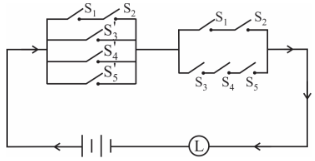
Simplify the following so that the new circuit has minimum number of switches. Also, draw the simplified circuit.
Image
Find the area of the region lying between the parabolas:

$y^2=x$ and $x^2=y$

Evaluate : $\int_0^{\pi / 4} \frac{\sec ^2 x}{2 \tan ^2 x+5 \tan x+1} \cdot d x$
Find the general solutions of the following :

$\tan ^3 \theta=3 \tan \theta$

$\int \frac{\sin 2 x}{3 \sin ^4 x-4 \sin ^2 x+1} d x$
Find the Cartesian and vector equation of the plane which makes intercepts $1, 1, 1$ on the coordinate axes