Question
Find the shortest distance between lines $\vec{\text{r}}=6\hat{\text{i}}+2\hat{\text{j}}+2\hat{\text{k}}+\lambda\Big(\hat{\text{i}}-2\hat{\text{j}}+2\hat{\text{k}}\Big)\ \text{and}\ \vec{\text{r}}=-4\hat{\text{i}}-\hat{\text{k}}+\mu\Big(3\hat{\text{i}}-2\hat{\text{j}}-2\hat{\text{k}}\Big).$
Answer

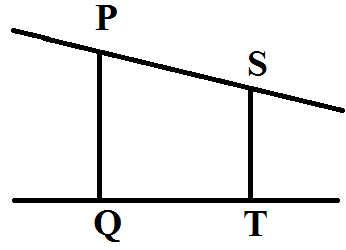
The equations of two lines are $\vec{\text{r}}=6\hat{\text{i}}+2\hat{\text{j}}+2\hat{\text{k}}+\lambda\Big(\hat{\text{i}}-2\hat{\text{j}}+2\hat{\text{k}}\Big)\ \ ...(1)$ $\vec{\text{r}}=-4\hat{\text{i}}-\hat{\text{k}}+\mu\Big(3\hat{\text{i}}-2\hat{\text{j}}-2\hat{\text{k}}\Big)\ \ \ \ .....(2)$ Comparing these equations with $\vec{\text{r}}=\vec{\text{a}_1}+\lambda\vec{\text{b}_1}\ \text{and}\ \vec{\text{r}}=\vec{\text{a}_2}+\mu\vec{\text{b}_2},$ we get, $\vec{\text{a}_1}=6\hat{\text{i}}+2\hat{\text{j}}+2\hat{\text{k}},\ \vec{\text{b}_1}=\hat{\text{i}}-2\hat{\text{j}}+2\hat{\text{k}}$ $\vec{\text{a}_2}=-4\hat{\text{i}}-\hat{\text{k}},\ \vec{\text{b}_2}=3\hat{\text{i}}-2\hat{\text{j}}-2\hat{\text{k}}$ Let 'S' be the point on line (1) with position vector $\vec{\text{a}_1}$ and T be the point on line (2) with position vector $\vec{\text{a}_2}$ so that
$\overrightarrow{\text{ST}}=\vec{\text{a}_2}-\vec{\text{a}_1}=-10\hat{\text{i}}-2\hat{\text{j}}-3\hat{\text{k}}$ Now, $\vec{\text{b}_1}\times\vec{\text{b}_2}=\begin{vmatrix}\hat{\text{i}}&\hat{\text{j}}&\hat{\text{k}}\\1&-2&2\\3&-2&-2\end{vmatrix}$ $=\hat{\text{i}}\begin{vmatrix}-2&2\\-2&-2\end{vmatrix}-\hat{\text{j}}\begin{vmatrix}1&2\\3&-2\end{vmatrix}+\hat{\text{k}}\begin{vmatrix}1&-2\\3&-2\end{vmatrix}$ $=(4+4)\hat{\text{i}}-(-2-6)\hat{\text{j}}+(-2+6)\hat{\text{k}}=8\hat{\text{i}}+8\hat{\text{j}}+4\hat{\text{k}}$ $\therefore\ \ \Big|\vec{\text{b}_1}\times\vec{\text{b}_2}\Big|=\sqrt{64+64+16}=\sqrt{144}=12$ Let $\overrightarrow{\text{PQ}}$ be the S.D. vector between given lines. Therefore, it is parallel to $\vec{\text{b}_1}\times\vec{\text{b}_2}.$ If $\vec{\text{n}}$ is a unit vector along $\overrightarrow{\text{PQ}},$ then $\vec{\text{n}}=\frac{\vec{\text{b}_1}\times\vec{\text{b}_2}}{\big|\vec{\text{b}_1}\times\vec{\text{b}_2}\big|}=\frac{1}{12}(8\hat{\text{i}}+8\hat{\text{j}}+4\hat{\text{k}})$ $=\frac{1}{3}(2\hat{\text{i}}+2\hat{\text{j}}+\hat{\text{k}})$ Now S.D. = Projection of $\overrightarrow{\text{ST}}\ \text{on}\ \overrightarrow{\text{PQ}}$ = Projection of $\overrightarrow{\text{ST}}\ \text{on}\ \vec{\text{n}}=\overrightarrow{\text{ST}}.\vec{\text{n}}$ $=\Big(-10\hat{\text{i}}-2\hat{\text{j}}-3\hat{\text{k}}\Big).\frac{1}{3}\Big(2\hat{\text{i}}+2\hat{\text{j}}+\hat{\text{k}}\Big)$ $=\frac{1}{3}[(-10)(2)+(-2)(2)+(-3)(1)]$ $=\frac{1}{3}(-20-4-3)=-\frac{27}{3}=-9=9\ \text{units}.(\text{in magnitude})$

Need a full question paper?

Generate a complete, print-ready paper with questions like this in minutes — across 16+ boards, with answer keys.

Start Generating Free

Similar questions

The mean and variance of a binomial variate with parameters n and p are 16 and 8, respectively. Find P(X = 0), P (X = 1) and P (X ≥ 2).
Find the points on the curve $x^2 + y^2 - 2x - 3 = 0$ at which the tangents are parallel to the $x-$axis.
A company manufactures two types of novelty Souvenirs made of plywood. Souvenirs of type A require 5 minutes each for cutting and 10 minutes each for assembling. Souvenirs of type B require 8 minutes each for cutting and 8 minutes each for assembling. There are 3 hours 20 minutes available for cutting and 4 hours available for assembling. The profit is 50 paise each for type A and 60 paise each for type B souvenirs. How many souvenirs of each type should the company manufacture in order to maximize the profit?
If $\text{xy}=4,$ prove that $\text{x}\Big(\frac{\text{dy}}{\text{dx}}+\text{y}^2\Big)=3\text{y}$
Find the equations of the tangent and the normal to the following curves at the indicated points.
$\text{x}=3\cos\theta-\cos^3\theta,\text{y}=3\sin\theta-\sin^3\theta$
Find the equation of the normal lines to the curve $3x^2 - y^2 = 8$ which are parallel to the line $x + 3y = 4$.
Find the equation of the containing the line $\frac{\text{x}+1}{-3}=\frac{\text{y}-3}{2}=\frac{\text{z}+2}{1}$ and the point$ (0, 7, -7)$ and show that the line $\frac{\text{x}}{1}=\frac{\text{y}-7}{-3}=\frac{\text{z}+7}{2}$ also lies in the same plane.
The side of an equilateral triangle is increasing at the rate of 2 cm/s. At what rate is its area increasing when the side of the triangle is 20 cm?
Differentiate the following functions with respect to x:
$\tan^{-1}\Big(\frac{\text{a}+\text{bx}}{\text{b}-\text{ax}}\Big)$
Find the area of the region $\Bigg\{(\text{x},\text{y}): \frac{\text{x}^{2}}{\text{a}^{2}}+\frac{\text{y}^{2}}{\text{b}^{2}}<1< \frac{\text{x}}{\text{a}}+\frac{\text{y}}{\text{b}}\bigg\}$