Question
Find the square of $a+\frac{1}{5 a}$

Answer

$ \left(\mathrm{a}+\frac{1}{5 \mathrm{a}}\right)^2$
$=(\mathrm{a})^2+\left(\frac{1}{5 \mathrm{a}}\right)^2+2 \times \mathrm{a} \times \frac{1}{5 \mathrm{a}}$
$ =\mathrm{a}^2+\frac{1}{25 \mathrm{a}^2}+\frac{2}{5}$

Need a full question paper?

Generate a complete, print-ready paper with questions like this in minutes — across 16+ boards, with answer keys.
Start Generating Free

Similar questions

Solve the following equation : $\frac{a+5}{6}-\frac{a+1}{9}=\frac{a+3}{4}$
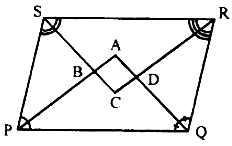
In the following diagram, the bisectors of interior angles of the parallelogram $PQRS$ enclose a quadrilateral $ABCD.$

Show that :$(i)\  \angle PSB + \angle SPB = 90^\circ\ (ii)\  \angle PBS = 90^\circ\ (iii)\  \angle ABC = 90^\circ
\ (iv)\  \angle ADC = 90^\circ\ (v)\  \angle A = 90^\circ\ (vi)\  ABCD$ is a rectangle Thus, the bisectors of the angles of a parallelogram enclose a rectangle.
Solve the inequation $18 – 3 (2x – 5) > 12; x \in W.$
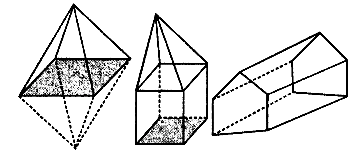
Verify Euler$\ ’$s formula for the following three$-$dimensional figures:
Evaluate : $(a+b) (a−b) (a^2+b^2)$
Three labourers A, B and C can individually build or break a wall in 30 days, 60 days and 20 days respectively.
1. In how many days can A and B together build the wall ?
(a) 15 days$\quad$(b) 20 days$\quad$(c) 45 days$\quad$(d) 90 days

2. In how many days will the wall be built, if A builds it and B breaks it simultaneously?
(a) 45 days$\quad$(b) 60 days$\quad$(c) 75 days$\quad$(d) 90 days

3. In how many days will the wall be built, if all the three labourers $A , B$ and C are employed to build it?
(a) 10 days$\quad$(b) 12 days$\quad$(c) 15 days$\quad$(d) 20 days

4. How many days will it take to build the wall, if A and B work together to build it while C breaks it simultaneously?
(a) 75 days$\quad$(b) 90 days
(c) 120 days$\quad$(d) The wall will never be built
Evaluate : $(4x^2 − 5y^2) (4x^2 + 5y^2)$
Construct a parallelogram $ABCD$, if : $AB = 3.6 \ cm, BC = 4.5 \ cm$ and $\angle ABC = 120^\circ .$
Draw angle $ABC$ of any suitable measure.$(i)$ Draw $BP$, the bisector of angle $ABC.(ii)$ Draw $BR$, the bisector of angle $PBC$ and draw $BQ$, the bisector of angle $ABP.(iii)$ Are the angles $ABQ, QBP, PBR$ and $RBC$ equal?$(iv)$ Are the angles $ABR$ and $QBC$ equal?
Mohan bought a certain number of note$-$books for $Rs. 600$ . He sold $\frac{1}{4}$ of them at $5$ percent loss. At what price should he sell the remaining note$-$books so as to gain $10 \%$ on the whole?