Question
Find the sum of all odd numbers between 0 and 50.

Answer

Odd numbers between 0 to 50 are
1, 3, 5, 7, ....., 49
Here
First term = a = 1
last term = l = 49
There are 25 such terms
So, n = 25
We need to find sum
So, we can use formula
$\text{S}_\text{n}=\frac{\text{n}}{2}(\text{a}+\text{l})$
Putting value in the formula
$\text{S}_\text{n}=\frac{\text{n}}{2}(\text{a}+\text{l})$
$=\frac{25}{2}(1+49)$
$=\frac{25}{2}\times50$
$=625$
Therefore, the sum of odd number between 0 & 50 is 625.

Need a full question paper?

Generate a complete, print-ready paper with questions like this in minutes — across 16+ boards, with answer keys.
Start Generating Free

Similar questions

The short and long hands of a clock are 4cm and 6cm long respectively. find the sum of distances travelled by their tips in 2 days. $[\text{Take }\pi\ =3.14]$
For what value of k, the following pair of linear equation has infinitely many solutions?
$10x + 5y - (k - 5) = 0$
$20x + 10y - k = 0$
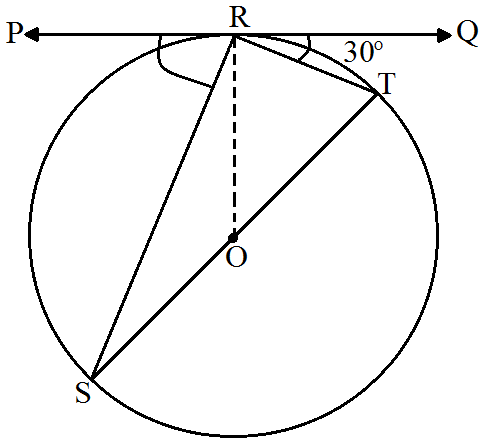
In the given figure, PQ is tangent at a point R of the circle with centre O. If $\angle\text{TRQ}=30^{\circ},$ find m $\angle\text{PRS}$.
Find the area of minor segment of a circle of radius 6 cm when its chord subtends an angle of 60° at its centre. $(\sqrt{3}=1.73)$
Prove : $\sin ^4 \theta-\cos ^4 \theta=1-2 \cos ^2 \theta$
In the following, determine whether the given quadratic equation have real root and if so, find the root:
$3\text{a}^2\text{x}^2+8\text{abx}+4\text{b}^2=0,$ $\text{a}\neq0$
Find the coordinates of the midpoint of the line segment joining P(0,6)and Q(12,20).

In a corner of a rectangular field with dimensions 35m × 22m, a well with 14m inside diameter is dug 8m deep. The earth dug out is spread evenly over the remaining part of the field. Find the rise in the level of the field.
The difference between outside and inside surface areas of cylindrical metallic pipe $14\ cm$ long is $44m^2$​​​​​​​. If the pipe is made of $99cm^3​​​​​​​$​​​​​​​ of metal, find the outer and inner radii of the pipe.
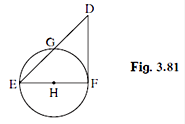
In figure 3.81, seg EF is a diameter and seg DF is a tangent segment. The radius of the circle is r. Prove that, $\mathrm{DE} \times \mathrm{GE}=4 \mathrm{r}^2$