Question
Find the sum of first n natural numbers.

Answer

The first n natural numbers are 1, 2, 3, 4, 5, ..., n.
Here, a = 1 and d = (2 - 1) = 1
Sum of n terms of an AP is given by
$\text{S}_\text{n}=\frac{\text{n}}{2}\big[2\text{a}+(\text{n}-1)\text{d}\big]$
$=\big(\frac{\text{n}}{2}\big)\times\big[2\times1+(\text{n}-1)\times1\big]$
$=\big(\frac{\text{n}}{2}\big)\times\big[2+\text{n}-1\big]=\big(\frac{\text{n}}{2}\big)\times(\text{n}+1)=\frac{\text{n}(\text{n}+1)}{2}$

Need a full question paper?

Generate a complete, print-ready paper with questions like this in minutes — across 16+ boards, with answer keys.
Start Generating Free

Similar questions

Draw a line segment of length 8cm and divide it internally in the ratio 4 : 5.
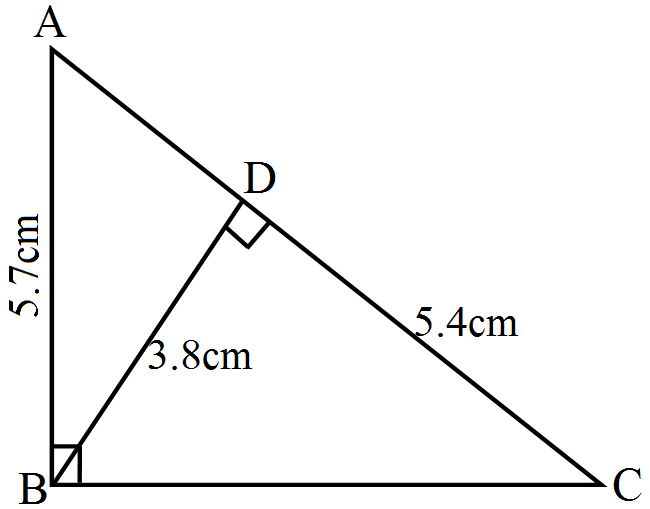
In the given figure, $\angle\text{ABC}=90^\circ$ and $\text{BD}\perp\text{AC}.$ If AB = 5.7cm, BD = 3.8cm, and CD = 5.4cm find BC.
A chord of a circle of radius 30cm makes an angle of 60° at the centre of the circle. Find the area of the minor and major segments. $\big[\text{Take }\pi=3.14\text{ and }\sqrt{3}=1.732\big]$
A train travels a distance of $90 \ km$ at a constant speed. Had the speed been $15 \ km/h$ more, it would have taken $30$ minutes less for the journey. Find the original speed of the train.
A two-digit number is such that the product of its digits is 20. If 9 is added to the number, the digits interchange their places. Find the number.
Solve the following quadratic equations by factorization:
$ax^2 + (4a^2 - 3b)x - 12ab = 0$
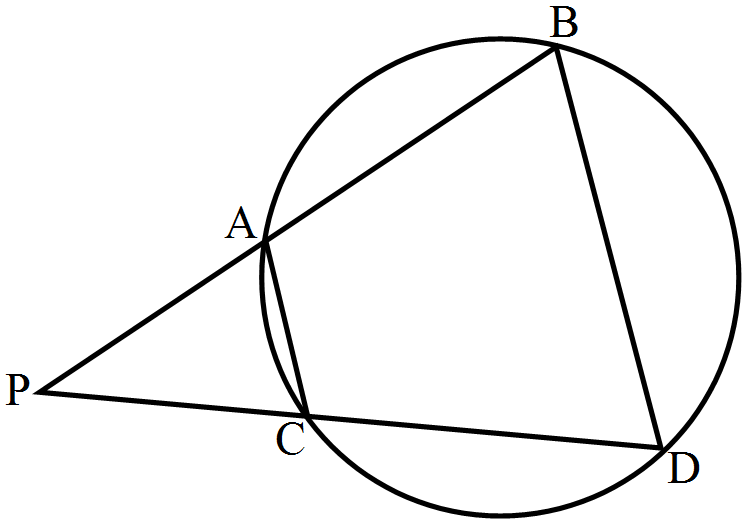
Two chords AB and CD of a circle intersect at a point P outside the ciecle. Prove that.
  1. $\triangle\text{PAC}\sim\triangle\text{PDB}$
  2. $\text{PA}.\text{PB}=\text{PC}.\text{PD}$
The median of the following data is 16. Find the missing frequencies a and b if the total of frequencies is 70.
Class
0-5
5-10
10-15
15-20
20-25
25-30
30-35
35-40
Frequency
12
a
12
15
b
6
6
4
Solve for x and y:
$\frac{35}{\text{x}+\text{y}}+\frac{14}{\text{x}-\text{y}}=19,$ $\frac{14}{\text{x}+\text{y}}+\frac{35}{\text{x}-\text{y}}=37$
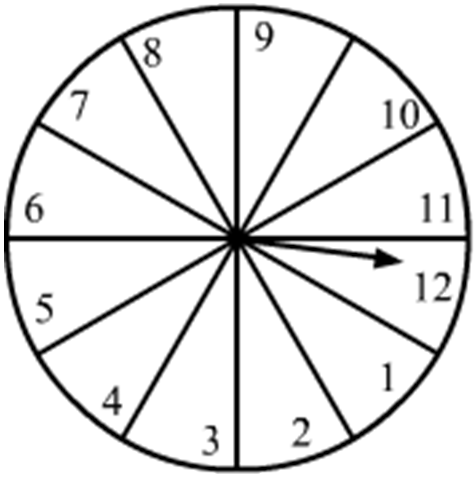
A game of chance consists of spinning an arrow which is equally likely to come to rest pointing to one of the number 1, 2, 3, ....., 12 as shown in following figure. What is the probability that it will point to:
  1. 10?
  2. An odd number?
  3. A number which is multiple of 3?
  4. An even number?