Question
Find the sums given below : 34 + 32 + 30 + … + 10

Answer

$\begin{aligned} & 34+32+30+\ldots+10 \\ & \text { Here, } a=34, d=32-34=-2, I=10 \\ & T_n=a+(n-1) d \\ & 10=34+(n-1)(-2) \\ & -24=-2(n-1) \\ & =\frac{-24}{-2} \\ & =n-1 \\ & =12 \\ & \therefore n=12+1=13 \\ & S_n=\frac{n}{2}[a+l] \\ & =\frac{13}{2}[34+10] \\ & =\frac{13}{2} \times 44 \\ & =286 .\end{aligned}$

Need a full question paper?

Generate a complete, print-ready paper with questions like this in minutes — across 16+ boards, with answer keys.
Start Generating Free

Similar questions

The Mean of n observation $x_1, x_2,..., x_n$ is $\overline{ X }$. $f (a - b)$ is added to each of the observation, show that the mean of the new set of observation is $\overline{ X } + (a - b).$
$\triangle \mathrm{ABC}$ with sides $\mathrm{AB}=12 \mathrm{~cm}, \mathrm{BC}=8 \mathrm{~cm}$ and $\mathrm{AC}=14 \mathrm{~cm}$ is enlarged to $\Delta \mathrm{A}^{\prime} \mathrm{B}^{\prime} \mathrm{C}^{\prime}$ such that the smallest side of $\Delta \mathrm{A}^{\prime} \mathrm{B}^{\prime} \mathrm{C}^{\prime}$ is 12 cm . Find the scale factor and use it to find the length of the other sides of the image $\Delta A^{\prime} B^{\prime} C^{\prime}$.
Find the equation of the line passing through: $(−1, −4)$ and $(3, 0)$
Solve the following quadratic equation by factorisation:
$x^2 + 3x - 18 = 0$
Zafarullah has a recurring deposit The list price of the television be? $12,500.$ account in a bank for $3^{1/2}$ years at $9.5\%$ S.I. p.a. If he gets $Rs. 78,638$ at the time of maturity. Find the monthly instalment.
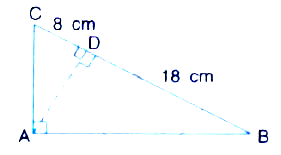
In the given figure, $ABC$ is a right angled triangle with $\angle BAC = 90^\circ.$

(i) Prove $\triangle ADB \sim \triangle CDA.$
(ii) If $BD = 18\ cm$ and $CD = 8\ cm,$ find $AD.$
(iii) Find the ratio of the area of $\triangle ADB$ is to area of $\triangle CDA.$
Find two consecutive integers such that the sum of their squares is $61$
Solve the following equation : $5x^2 - 11x + 2 = 0$
How many three-digit numbers are divisible by $87?$
Three consecutive natural numbers are such that the square of the first increased by the product of other two gives $154$. Find the numbers.