Question
Find the time required for a 50Hz alternating current to change its value from zero to the rms value.
Answer

$\text{f}=50\text{Hz}$
$=\text{I}=\text{I}_0\sin\omega\text{t}$
Peak value $\text{I}=\frac{\text{I}_0}{\sqrt{2}}$
$\frac{\text{I}_0}{\sqrt{2}}=\text{I}_0\sin\omega\text{t}$
$\Rightarrow\ \frac{1}{\sqrt{2}}=\sin\omega\text{t}=\sin\frac{\pi}{4}$
$\Rightarrow\ \frac{\pi}{4}=\omega\text{t}$
Or $\text{t}=\frac{\pi}{400}$
$=\frac{\pi}{4\times2\pi\text{f}}=\frac{1}{8\text{f}}$
$=\frac{1}{8\times50}=0.0025\text{s}=2.5\text{ms}$

Need a full question paper?

Generate a complete, print-ready paper with questions like this in minutes — across 16+ boards, with answer keys.

Start Generating Free

Similar questions

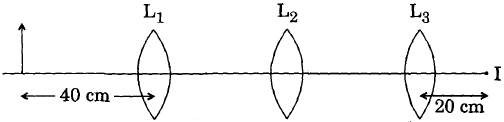
You are given three lenses L1, L2 and L3 each of focal length 20 cm. An object is kept at 40 cm in front of L1, as shown. The final real image is formed at the focus I of L3. Find the separations between L1, L2 and L3.

From molecular view point, discuss the temperature dependence of susceptibility for diamagnetism, paramagnetism and ferromagnetism.
What is the de Broglie wavelength of:
  1. A bullet of mass 0.040 kg travelling at the speed of 1.0 km/s,
  2. A ball of mass 0.060 kg moving at a speed of 1.0 m/s, and
  3. A dust particle of mass 1.0 × 10–9 kg drifting with a speed of 2.2 m/s?
Iron emits $\text{K}_\alpha$ X-ray of energy 6.4keV and calcium emits $\text{K}_\alpha$ X-rays of energy 3.69 keV. Calculate the times taken by an iron $\text{K}_\alpha$ photon to cross through a distance of 3km.
Describe the working principle of a moving coil galvanometer. Why is it necessary to use (i) a radial magnetic field and (ii) a cylindrical soft iron core in a galvanometer? Write the expression for current sensitivity of the galvanometer.
Can a galvanometer as such be used for measuring the current? Explain.
A tightly-wound, long solenoid carries a current of 2.00A. An electron is found to execute a uniform circular motion inside the solenoid with a frequency of 1.00 × 10⁸ rev/s. Find the number of turns per metre in the solenoid.
Can we perform Young's double slit experiment with sound waves? To get a reasonable "fringe pattern", what should be the order of separation between the slits? How can the bright fringes and the dark fringes be detected in this case?
A monkey of mass 15kg is climbing on a rope with one end fixed to the ceiling. If it wishes to go up with an acceleration of 1m/s2, how much force should it apply to the rope? If the rope is 5m long and the monkey starts from rest, how much time will it take to reach the ceiling?
The nucleus $^{235}_{92}\text{Y},$ initially at rest, decays into $^{231}_{90}\text{X}$ by emitting an $\alpha-$particle
$^{235}_{92}\text{Y}\xrightarrow{ \ \ \ \ \ \ \ \ } \ ^{231}_{90}\text{X}+ \ ^4_2\text{He}+\text{energy}.$
The binding energies per nucleon of the parent nucleus, the daughter nucleus and $\alpha-$particle are 7.8MeV, 7.835MeV and 7.07MeV, respectively. Assuming the daughter nucleus to be formed in the unexcited state and neglecting its share in the energy of the reaction, find the speed of the emitted $\alpha-$particle. (Mass of $\alpha-$particle = 6.68 × 10⁻²⁷kg).
A voltage V = Vo sin $\omega\text{t}$ is applied to a series LCR circuit. Derive the expression for the average power dissipated over a cycle. Under what condition is (i) no power dissipated even though the current flows through the circuit, (ii) maximum power dissipated in the circuit?