MCQ
Find the value of 12.9g - 7.05g.
  • A
    5.84g
  • B
    5.8g
  • C
    5.86g
  • D
    5.9g

Answer

  1. 5.8g

Need a full question paper?

Generate a complete, print-ready paper with questions like this in minutes — across 16+ boards, with answer keys.

Start Generating Free

Similar questions

A lift is moving down with acceleration $a$. A man in the lift drops a ball inside the lift. The acceleration of the ball as observed by the man in the lift and a man standing stationary on the ground are respectively
Force acting on $a$ body of mass $1 kg$ is related to its position $x$ as $F = x^3 - 3x\, N$. It is at rest at $x = 1$. Its velocity at $x = 3$ can be ......... $m/s$
Two parallel wires carry currents of 20A and 40A in opposite directions. Another wire carying a current anti parallel to 20A is placed midway between the two wires. T he magnetic force on it will be:
  1. Towards 20A.
  2. Towards 40A.
  3. Zero.
  4. Perpendicular to the plane of the currents.
A wheel completes 2000 rotations in covering a distance of $9.5\,km$. The diameter of the wheel is         
If the kinetic energy of a body increases by $0.1\%$, the percent increase of its momentum will be .............. $\%$
A circular disc A of radius r is made from an iron plate of thickness (t) and another circular disc B of radius 4r is made from an iron plate of thickness $\frac{\text{t}}{4}.$ The relation between the moments of inertia IA and IB is:
Two waves having the intensities in the ratio of $9 : 1$ produce interference. The ratio of maximum to the minimum intensity, is equal to
Diameter of a steel ball is measured using a Vernier callipers which has divisions of $0. 1\,cm$ on its main scale $(MS)$ and $10$ divisions of its vernier scale $(VS)$ match $9$ divisions on the main scale. Three such measurements for a ball are given as

    S.No.      $MS\;(cm)$ $VS$ divisions
   $(1)$      $0.5$       $8$
   $(2)$     $0.5$       $4$
   $(3)$     $0.5$       $6$

If the zero error is $- 0.03\,cm,$ then mean corrected diameter is  ........... $cm$
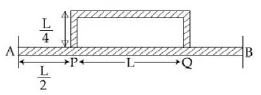
Temperature difference of $120\,^oC$ is maintained between two ends of a uniform rod $AB$ of length $2L$. Another bent rod $PQ$, of same cross-section as $AB$ and length $\frac{{3L}}{2}$,  is connected across $AB$ (See figure). In steady state, temperature difference between $P$ and $Q$ will be close to .......... $^oC$
$V\, = \,K\,{\left( {\frac{P}{T}} \right)^{0.33}}$ where $k$ is constant. It is an,