Question
Find the value of k, for which $\text{f}(\text{x}) = $ $ \begin{matrix} \frac{\sqrt{1 + \text{kx}} - \sqrt{1 - \text{kx}}}{\text{x}} , \text{if} - 1\leq\text{x} < 0\\ \frac{2\text{x} + 1}{\text{x} - 1} , \text{ if}0\leq\text{x}< 1 \end{matrix} $ is continuous at x = 0.
Answer

$\DeclareMathOperator*{\median}{\text{lim}} \median_{\text{x}\rightarrow0^{-}}\text{f}(\text{x}) = \DeclareMathOperator*{\median}{\text{lim}} \median_{\text{h}\rightarrow0}\text{f}(0 - \text{h}) [ \text{ Let x} = 0 - \text{h},\text{x}\rightarrow0^{-}\Rightarrow\text{h}\rightarrow0]$
$ = \DeclareMathOperator*{\median}{\text{lim}} \median_{\text{h}\rightarrow0}\text{f}(-\text{h}) = \DeclareMathOperator*{\median}{\text{lim}} \median_{\text{h}\rightarrow0}\frac{\sqrt{1 + \text{k}(-\text{h})} - \sqrt{1 - \text{k}(-\text{h})}}{-\text{h}}$
$ = \DeclareMathOperator*{\median}{\text{lim}} \median_{\text{h}\rightarrow0}\frac{\sqrt{1 - \text{kh}} - \sqrt{1 + \text{kh}}}{-\text{h}}\times\frac{\sqrt{1 - \text{kh}} + \sqrt{1 + \text{kh}}}{\sqrt{1 - \text{kh}} + \sqrt{1 + \text{kh}}}$
$ = \DeclareMathOperator*{\median}{\text{lim}} \median_{\text{h}\rightarrow0}\frac{(1 - \text{kh)} - (1 + \text{kh)}}{-\text{h}\left\{\sqrt{1 - \text{kh}} + \sqrt{1 + \text{kh}}\right\}} = \DeclareMathOperator*{\median}{\text{lim}} \median_{\text{h}\rightarrow0}\frac{2\text{k}}{\left\{\sqrt{1 - \text{kh}} + \sqrt{1 + \text{kh}}\right\}}$
$ =\frac{2\text{k}}{2}$
$ \Rightarrow \DeclareMathOperator*{\median}{\text{lim}} \median_{\text{x}\rightarrow0^{-}}\text{f}(\text{x}) = \text{k}$ - - - - - - - (i)
Again $ \DeclareMathOperator*{\median}{\text{lim}} \median_{\text{x}\rightarrow0^{+}}\text{f}(\text{x}) = \DeclareMathOperator*{\median}{\text{lim}} \median_{\text{h}\rightarrow0}\text{f}(0 + \text{h}) [ \text{Let x } = 0 \text{ h},\text{x}\rightarrow0^{+}\Rightarrow\text{h}\rightarrow0]$
$ \DeclareMathOperator*{\median}{\text{lim}} \median_{\text{h}\rightarrow0}\text{f}( - \text{h}) = \DeclareMathOperator*{\median}{\text{lim}} \median_{\text{h}\rightarrow0} \frac{2\text{h} + 1 }{\text{h} - 1 } = \frac{1}{-1}$
$ \Rightarrow\DeclareMathOperator*{\median}{\text{lim}} \median_{\text{x}\rightarrow0^{+}}\text{f}(\text{x}) = - 1 $ - - - - - - - - - (ii)
Also $\text{f}(0) = \frac{2\times0 + 1 }{0 - 1 } = - 1 $
$\because\text{ f is continuous at x } = 0$
$ \therefore\DeclareMathOperator*{\median}{\text{lim}} \median_{\text{x}\rightarrow0^{-}}\text{f}(\text{x}) = \DeclareMathOperator*{\median}{\text{lim}} \median_{\text{x}\rightarrow0^{+}}\text{f}(\text{x}) = \text{f}(0)\Rightarrow\text{k} = - 1.$

Need a full question paper?

Generate a complete, print-ready paper with questions like this in minutes — across 16+ boards, with answer keys.

Start Generating Free

Similar questions

A can hit a target 3 times in 6 shots, B : 2 times in 6 shots and C : 4 times in 4 shots. They fix a volley. What is the probability that at least 2 shots hit?
Solve:
$\sin\Big(\sin^{-1}\frac{1}{5}+\cos^{-1}\text{x}\Big)=1$
Evaluate the following integrals:
$\int\limits^1_{-1}\text{x|x|}\text{dx}$
Solve:
$\sin\Big(\sin^{-1}\frac{1}{5}+\cos^{-1}\text{x}\Big)=1$
Find the area of the parallelogram whose diagonals are:
$2\hat{\text{i}}+3\hat{\text{j}}+6\hat{\text{k}}$ and $3\hat{\text{i}}-6\hat{\text{i}}+2\hat{\text{k}}$
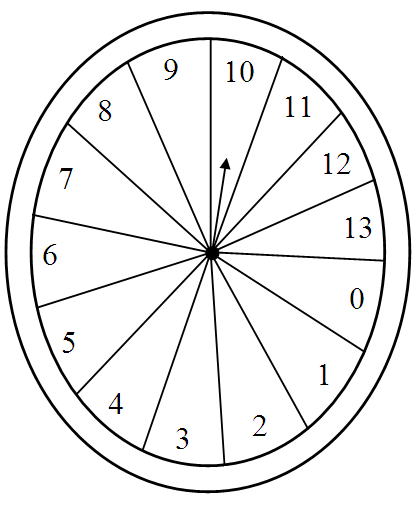
In roulette, Figure, the wheel has 13 numbers 0, 1, 2,...., 12 maked on equally spaced slots. A player sets Rs 10 on a given number. He recieves Rs 100 from the organiser of the game if the ball comes to rest in this slot; otherwise he gets nothing. If X denotes the players net gain/loss, Find E(X).
Find the angle between the given planes.
$\vec{\text{r}}\cdot(2\hat{\text{i}}+3\hat{\text{j}}-6\hat{\text{k}})=5$ and $\vec{\text{r}}\cdot(\hat{\text{i}}-2\hat{\text{j}}+2\hat{\text{k}})=9$
An unbiased coin is tossed. If the result is a head, a pair of unbiased dice is rolled and the sum of the numbers obtained is noted. If the result is a tail, a card from a well shuffled pack of eleven cards numbered $2, 3, 4, ....., 12$ is picked and the number on the card is noted. What is the probability that the noted number is either 7 or 8?
Find the angle between the given planes.
$\vec{\text{r}}\cdot(2\hat{\text{i}}-\hat{\text{j}}+2\hat{\text{k}})=6$ and $\vec{\text{r}}\cdot(3\hat{\text{i}}+6\hat{\text{j}}-2\hat{\text{k}})=9$
If $f, g: R \rightarrow R$ function is defined such that $f(x)=x^2+1, g(x)=2 x-3$ then find $f o g(x), gof (x)$ and $\operatorname{gog}(3)$.