Question
Find the value of $\lambda$ so that the following vectors are coplanar:
$\vec{\text{a}}=2\hat{\text{i}}-\hat{\text{j}}++\hat{\text{k}},\vec{\text{b}}=\hat{\text{i}}+2\hat{\text{j}}-3\hat{\text{k}},\vec{\text{c}}=\lambda\hat{\text{i}}+\lambda\hat{\text{j}}+5\hat{\text{k}}$
Answer

Given:
$\vec{\text{a}}=2\hat{\text{i}}-\hat{\text{j}}+\hat{\text{k}}$
$\vec{\text{b}}=\hat{\text{i}}+2\hat{\text{j}}-3\hat{\text{k}}$
$\vec{\text{c}}=\lambda\hat{\text{i}}+\lambda\hat{\text{j}}+5\hat{\text{k}}$
We know that vectors $\vec{\text{a}},\vec{\text{b}},\vec{\text{c}}$ are coplanar iff $\Big[\vec{\text{a}}\ \vec{\text{b}}\ \vec{\text{c}}\Big]=0.$
It is given that $\vec{\text{a}},\vec{\text{b}},\vec{\text{c}}$ are coplanar.
$\therefore\Big[\vec{\text{a}}\ \vec{\text{b}}\ \vec{\text{c}}\Big]=0$
$\Rightarrow\begin{vmatrix}2&-1&1\\1&2&-3\\\lambda&\lambda&5 \end{vmatrix}=0$
$\Rightarrow2(10+3\lambda)+1(5+3\lambda)+1(\lambda-2\lambda)=0$
$\Rightarrow 8\lambda +25=0$
$=-\frac{25}{8}$

Need a full question paper?

Generate a complete, print-ready paper with questions like this in minutes — across 16+ boards, with answer keys.

Start Generating Free

Similar questions

If $\text{A}=\text{diag}\begin{pmatrix}2&-5&9\end{pmatrix},\text{ B}=\text{diag}\begin{pmatrix}1&1&-4\end{pmatrix}$ and $\text{C}=\text{diag}\begin{pmatrix}-6&3&4\end{pmatrix},$ find.
$2\text{A}+3\text{B}-5\text{C}$
If $|\vec{\text{a}}|=\text{a}$ and $\big|\vec{\text{b}}\big|=\text{b},$ prove that $\Big(\frac{\vec{\text{a}}}{\text{a}^2}-\frac{\vec{\text{b}}}{\text{b}^2}\Big)^2=\Big(\frac{\vec{\text{a}}-\vec{\text{b}}}{\text{ab}}\Big)^2.$
In the following cases, determine whether the given planes are parallel or perpendicular, and in case they are neither, find the angles between them.
$2x + y + 3z - 2$ and $x - 2y + 5 = 0$
Differentiate the functions given in Exercise:
$(\log\text{x})^{\cos\text{x}}$
Evaluate: $\sin^{-1}\Big(\sin\frac{3\pi}{5}\Big).$
Evaluate:
$\cos\Big(\sin^{-1}\frac{3}{5}+\sin^{-1}\frac{5}{13}\Big)$
Evaluate the following integrals:
$\int^\limits{\frac{\pi}{4}}_{\frac{-\pi}{4}}|\sin\text{x}|\text{dx}$
If $\int\text{e}^{\text{x}}(\tan\text{x}+1)\sec\text{x dx}=\text{e}^{\text{x}}\text{ f}(\text{x})+\text{C},$ then write the value of f(x).
If $\vec{\text{a}}=2\hat{\text{i}}-\hat{\text{j}}+\hat{\text{k}},\vec{\text{b}}=\hat{\text{i}}+\hat{\text{j}}-2\hat{\text{k}}$ and $\vec{\text{c}}=\hat{\text{i}}+3\hat{\text{j}}-\hat{\text{k}}.$ find $\lambda$ such that $\vec{\text{a}}$ is perpendicular to $\lambda\vec{\text{b}}+\vec{\text{c}}.$
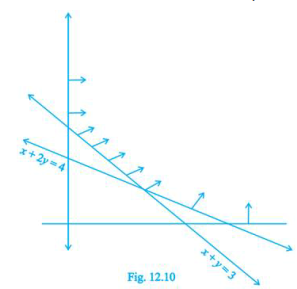
The feasible region for a LPP is shown in Figure. Evaluate Z = 4x + y at each of the corner points of this region. Find the minimum value of Z, if it exists.
Image