Question
Find the volume of a cube whose diagonals is $\sqrt{48} \ cm$.

Answer

Given that:
Diagonal of a cube $=\sqrt{48} \ cm$
i.e, $\sqrt{3} \times 1=\sqrt{48} \ldots[\because$ Diagonal of cube $=\sqrt{3} \times 1]$
$ I=\frac{\sqrt{48}}{\sqrt{3}}$
$I=\sqrt{\frac{48}{3}}$
$=\sqrt{16}$
$=4 \ cm$
$\therefore$ Side $( l )=4 \ cm$
Now,
Volume of cube
$=1^3$
$=|\times| \times \mid$
$=4 \times 4 \times 4$
$=16 \times 4$
$=64 \ cm ^3$
$\therefore$ Volume of Cube $=64 \ cm ^3$.

Need a full question paper?

Generate a complete, print-ready paper with questions like this in minutes — across 16+ boards, with answer keys.
Start Generating Free

Similar questions

If $\log x=a$ and $\log y=b$, write down $10^{2 b}$ in terms of $y$
Evaluate the following: $\frac{3 \sin 37^{\circ}}{\cos 53^{\circ}}-\frac{5 \operatorname{cosec} 39^{\circ}}{\sec 51^{\circ}}+\frac{4 \tan 23^{\circ} \tan 37^{\circ} \tan 67^{\circ} \tan 53^{\circ}}{\cos 17^{\circ} \cos 67^{\circ} \operatorname{cosec} 73^{\circ} \operatorname{cosec} 23^{\circ}}$
Calculate the amount and the compound interest on ₹ 64000 for 3 years at $7 \frac{1}{2} \%$ per annum compounded annually.
The diagonal of a rectangular plot is $34 \ m$ and its perimeter is $92 \ m$. Find its area.
Image
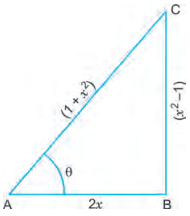
If $\cos \theta=\frac{2 x}{1+x^2}$, find the values of sin $\theta$ and tan $\theta$ in terms of x.
$\left[\right.$ Hint. $\cos \theta=\frac{\text { Base }}{H y p .}=\frac{A B}{A C}=\frac{2 x}{\left(1+x^2\right)}$
Perp. $B C=\sqrt{A C^2-A B^2}=\sqrt{\left(1+x^2\right)^2-4 x^2}=\sqrt{x^4-2 x^2+1}=\left(x^2-1\right)$
$\left.\therefore \sin \theta=\frac{\text { Perp. }}{\text { Hyp. }}=\frac{\left(x^2-1\right)}{\left(1+x^2\right)} ; \tan \theta=\frac{\text { Perp. }}{\text { Base }}=\frac{\left(x^2-1\right)}{2 x}\right]$
State whether the following number is rational or irrational:$(5-\sqrt{5})^2$
Evaluate the following without using tables :$\log 4+\frac{1}{3} \log 125-\frac{1}{5} \log 32$
Rationalise the denominator of each:-
$\frac{1}{(\sqrt{3}-1)}$
In $\triangle ABC, AD$ is the median and $DE$ is parallel to $BA,$ where $E$ is a point in $AC.$ Prove that $BE$ is also a median.
Draw the graph for the linear equation given below$:y - 2 = 0$