Question
Find two consecutive positive even integers whose product is $288.$

Answer

Let the required consecutive positive even integers be x and $(x + 2).$
Then, we have
$ x \times(x+2)=288$
$ \Rightarrow x^2+2 x-288=0$
$ \Rightarrow x^2+18 x-16 x-288=0$
$ \Rightarrow x(x+18)-16(x+18)=0$
$ \Rightarrow(x+18)(x-16)=0$
$ \Rightarrow x+18=0 \text { or } x-16=0$
$ \Rightarrow x=-18 \text { or } x=16$
$\text { Since } x \text { is a positive integer, } x \neq-18$
$ \Rightarrow x=16$
$ \Rightarrow x+2=16+2=18$
Hence, the required consecutive positive even integers are $16$ and $18.$

Need a full question paper?

Generate a complete, print-ready paper with questions like this in minutes — across 16+ boards, with answer keys.
Start Generating Free

Similar questions

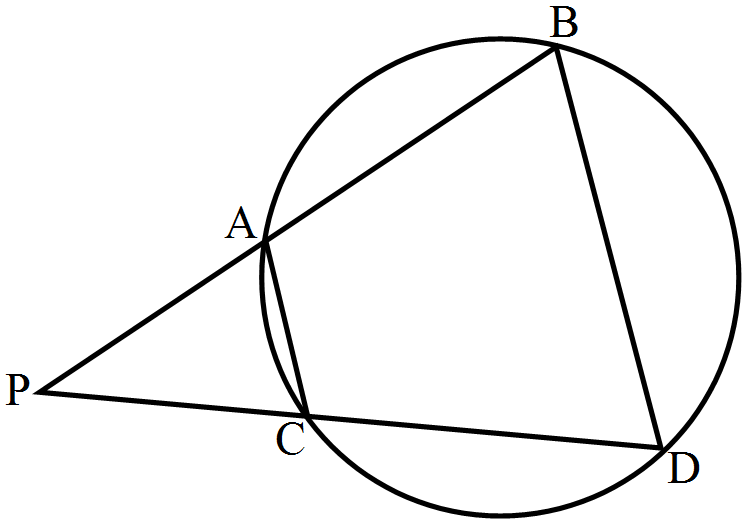
Two chords $AB$ and $CD$ of a circle intersect at a point $P$ outside the ciecle. Prove that.
  1. $\triangle\text{PAC}\sim\triangle\text{PDB}$
  2. $\text{PA}.\text{PB}=\text{PC}.\text{PD}$
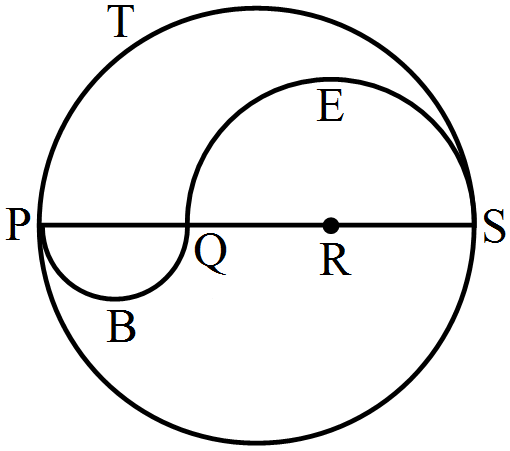
$PQRS$ is a diameter of a circle of radius $6 \ cm$ . The lengths $P Q Q R$ an $R S$ are equal. Semicircles are drawn with $P Q$ and QS as diameters, as shown in the given figure. If PS $=12 cm$, find the perimeter and area of the shaded region. $[$ Take $\pi=3.14]$
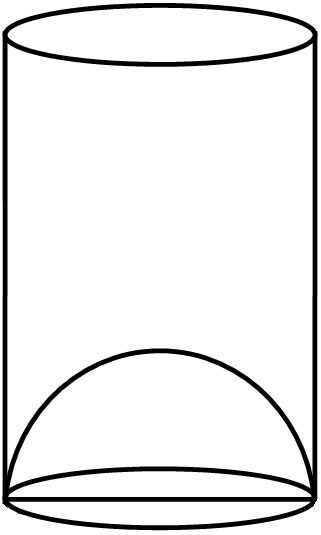
The inner diameter of a glass is $7\ cm$ and it has a raised portion in the bottom in the shape of a hemisphere, as shown in the figure. If the height of the glass is $16\ cm$, find the apparent capacity and the actual capacity of the glass.
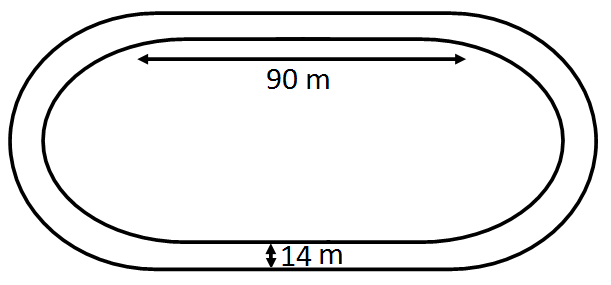
The inside perimeter of a running track (shown in the following figure) is $400\ m$. The length of each of the straight portion is $90\ m$ and the ends are semi-circles. If the track is everywhere $14\ m$ wide. find the area of the track. Also find the length of the outer running track.
A chord $10\ cm$ long is drawn in a circle whose radius $5\sqrt{2}\text{cm}.$ find the areas of both the segments. $[\text{Take }\pi=3.14]$
A sailor goes 8km downstream in $40$ minutes and returns in $1$ hour. Find the speed of the sailor in still water and the speed of the current.
How many terms of the $AP 21, 18, 15, .....$ must be added to get the sum $0?$
Find the solution of the pair of equations $\frac{\text{x}}{10}+\frac{\text{y}}{5}-1=0$ and $\frac{\text{x}}{8}+\frac{\text{y}}{6}=15.$ Hence, find $\lambda,$ if $\text{y}=\lambda\text{x}+5.$
The $4^{th}$ term of an $A.P$. is three times the first and the $7^{th}$ term exceeds twice the third term by $1$. Find the first term and the common difference.
Find the area of the rhombus, the lengths of whose diagonals are $3\ cm$ and $16\ cm$. Also find the perimeter of the rhombus.