Question
Find which of the function:
$\text{f(x)}=\begin{cases}|\text{x}-\text{a}|\sin\frac{1}{\text{x}},&\text{if x}\neq0\\0,&\text{if x }=\text{a}\end{cases}$
at x = a
Answer

We have, $\text{f(x)}=\begin{cases}|\text{x}-\text{a}|\sin\frac{1}{\text{x}},&\text{if x}\neq0\\0,&\text{if x }=\text{a}\end{cases}$ at x = a.
At x = a $\text{L.H.L}=\lim\limits_{\text{h}\rightarrow\text{a}^-}|\text{x}-\text{a}|\sin\frac{1}{\text{x}-\text{a}}$
$=\lim\limits_{\text{h}\rightarrow0}|\text{a}-\text{h}-\text{a}|\sin\Big(\frac{1}{\text{a}-\text{h}-\text{a}}\Big)$
$=\lim\limits_{\text{h}\rightarrow0}-\text{h}\sin\Big(\frac{1}{\text{h}}\Big)\ [\because\sin(-\theta)=-\sin\theta]$
= 0 × [an oscillating number between -1 and 1] = 0
$\text{R.H.L}=\lim\limits_{\text{x}\rightarrow\text{a}^+}|\text{x}-\text{a}|\sin\Big(\frac{1}{\text{x}-\text{a}}\Big)$
$=\lim\limits_{\text{h}\rightarrow0}|\text{a}+\text{h}-\text{a}|\sin\Big(\frac{1}{\text{a}+\text{h}-\text{a}}\Big)$
$=\lim\limits_{\text{h}\rightarrow0}\text{h}\sin\frac{1}{\text{h}}$
= 0 × [an oscillating number between -1 and 1] = 0
and f(a) = 0
$\therefore$ L.H.L = R.H.L = f(a)
So, f(x) is continuous at x = a.

Need a full question paper?

Generate a complete, print-ready paper with questions like this in minutes — across 16+ boards, with answer keys.

Start Generating Free

Similar questions

Find the values of x for which $f(x) = [x (x - 2)]^2$ is an increasing function. Also, find the points on the curve, where the tangent is parallel to x-axis.
Find the equation of a normal to the curve $y = x \log_e$ x which is parallel to the line $2x − 2y + 3 = 0.$
Show that the vectors $\vec{\text{a}},\ \vec{\text{b}},\ \vec{\text{c}}$ given by $\vec{\text{a}}=\hat{\text{i}}+2\hat{\text{j}}+3\hat{\text{k}},\ \vec{\text{b}}=2\hat{\text{i}}+\hat{\text{j}}+3\hat{\text{k}}$ and $\vec{\text{c}}=\hat{\text{i}}+\hat{\text{j}}+\hat{\text{k}}$ are non-coplanar. Express vector $\vec{\text{d}}=2\hat{\text{i}}-\hat{\text{j}}-3\hat{\text{k}}$ as a linear combination of the vectors $\vec{\text{a}},\ \vec{\text{b}}\text{ and }\vec{\text{c}}$.
Verify Rolle's theorem for the following function on the indicated intervals$f(x) = (x^2- 1)(x - 2)$ on $[-1, 2]$
A small manufacturer has employed 5 skilled men and 10 semi-skilled men and makes an article in two qualities deluxe model and an ordinary model. The making of a deluxe model requires 2 hrs. work by a skilled man and 2 hrs. work by a semi-skilled man. The ordinary model requires 1 hr by a skilled man and 3 hrs. by a semi-skilled man. By union rules no man may work more than 8 hrs per day. The manufacturers clear profit on deluxe model is Rs. 15 and on an ordinary model is Rs. 10. How many of each type should be made in order to maximize his total daily profit.
Evaluate the following integrals as limit of sum:
$\int\limits^1_{0}\big(3\text{x}^2+5\text{x}\big)\text{dx}$
Solve the following differential equation:
$(\text{x}+\tan\text{y})\text{dy}=\sin2\text{y dx}$
Find the absolute maximum and minimum values of the function f given by $f(x) = \cos^2 x + \sin x, x \in [0, \pi]$
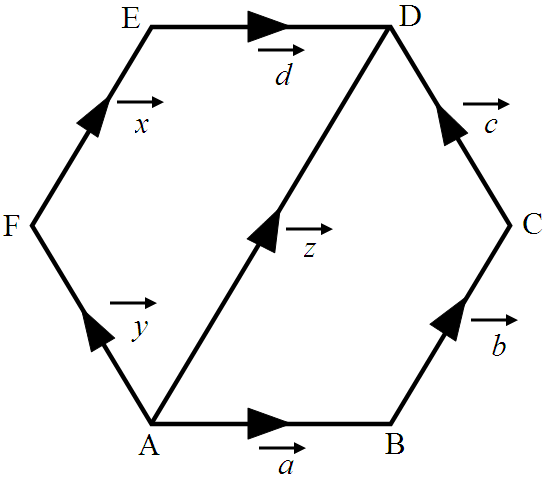
In Figure ABCD is a regular hexagon, which vectors are:
  1. Collinear.
  2. Equal.
  3. Co-initial.
  4. Collinear but not equal.
Find the area of the region bounded by the parabola $y^2 = 2x + 1$ and the line $x - y - 1 = 0.$