Question
Find:
Which term of the A.P. $3, 8, 13, .....$ is $248$?

Answer

In the given problem, we are given an A.P. and the value of one of its term. We need to find which term it is (n).
So here we will find the value of n using the formula, $a_n = a + (n - 1)d.$
Here,
A.P. is $3, 8, 13, .....$
$a_n = 248$
$a = 3$
Now,
Common difference $(d) = a_1 - a$
$= 8 - 3$
$= 5$
Thus, using the above mentioned formula
$a_n = a + (n - 1)d$
$248 = 3 + (n - 1)5$
$248 - 3 = 5n - 5$
$245 + 5 = 5n$
$\text{n}=\frac{250}{5}$
$n = 50$
Thus, $n = 50$
Therefore 248 is the $50^{th}$​​​​​​​ term of the given A.P.

Need a full question paper?

Generate a complete, print-ready paper with questions like this in minutes — across 16+ boards, with answer keys.
Start Generating Free

Similar questions

Very-Short-Answer Question:
If $\alpha,\ \beta$ are the zeros of a polynomial such that $\alpha+\beta=6$ and $\alpha\beta=4$ the write the polynomial.
Find a point which is equidistant from the point $A(-5, 4)$ and $B(-1, 6)$. How many such points are there?
A bucket is in the form of a frustum of a cone and holds $28.490$ litres of water. The radii of the top and bottom are $28cm$ and $21cm$, respectively. Find the height of the bucket. 
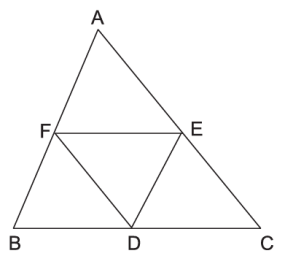
In $\triangle A B C, D, E$ and $F$ are midpoints of $B C, C A$ and $A B$ respectively. Prove that $\triangle F B D \sim \triangle DEF$ and $\triangle DEF \sim \triangle ABC$

Image
For what value of k(k > 0) is the area of the triangle with vertices (-2, 5), (k, -4) and (2k + 1, 10) equal to 53 square units?
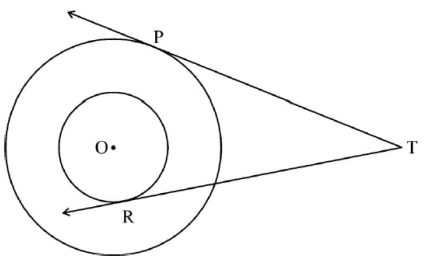
In the given figure, two concentric circles have radii $3 \ cm$ and $5 \ cm$ . Two tangents $TR$ and $TP$ are drawn to the circles from an external point $T$ such that $TR$ touches the inner circle at $R$ and $TP$ touches the outer circle at $P$. If $T R=4 \sqrt{10} \ cm$, then find the length of $T P$.
Image
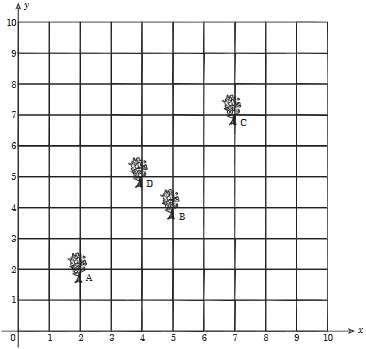
Krishna has an apple orchard which has a $10 m \times$ 10 m sized kitchen garden attached to it. She divides it into a $10 \times 10$ grid and puts soil and manure into it. She grows a lemon plant at A, a coriander plant at B , an onion plant at C and a tomato plant at D. Her husband Ram praised her kitchen garden and points out that on joining A , B, C, D they may form a parallelogram. Look at the below figure carefully and answer the following questions:
Image
(i) Write the coordinates of the points $A , B , C$ and D , using the $10 \times 10$ grid as coordinate axes.
(ii) Find whether ABCD is a parallelogram or not.
Find the zeros of the following quadratic polynomial and verify the relationship between the zeros and the coefficients:
$x^2 + 3x - 10$
Find the indicated terms in the following sequences whose $n ^{\text {th }}$ terms are:
$a_n=n(n-1)(n-2) ; a_5$ and $a_8$.
Let there be an A.P. with first term ' $a$ ', common difference ' $d$ '. If $a_n$ denotes in $n^{\text {th }}$ term and $S_n$ the sum of first $n$ terms, find. n and $a _{ n }$, if $a =2, d=8$ and $S _{ n }=90$.