MCQ
First law of thermodynamics:
  • A
    Explains temperature.
  • B
    Defines heat
  • C
    Expresses the maximum limit mechanical energy being converted into heat.
  • Expresses the equivalence of heat and mechanical energy.

Answer

Correct option: D.
Expresses the equivalence of heat and mechanical energy.
D

Need a full question paper?

Generate a complete, print-ready paper with questions like this in minutes — across 16+ boards, with answer keys.
Start Generating Free

Similar questions

The angle made by the vector $A = \hat i + \hat j$ with $x-$ axis is ....... $^o$
A beaker contains a fluid of density $\rho \, kg / m^3$, specific heat $S\, J / kg\,^oC$ and viscosity $\eta $. The beaker is filled upto height $h$. To estimate the rate of heat transfer per unit area $(Q / A)$ by convection when beaker is put on a hot plate, a student proposes that it should depend on $\eta \,,\,\left( {\frac{{S\Delta \theta }}{h}} \right)$ and $\left( {\frac{1}{{\rho g}}} \right)$ when $\Delta \theta $ (in $^oC$) is the difference in the temperature between the bottom and top of the fluid. In that situation the correct option for $(Q / A)$ is
An aeroplane moving horizontally at a speed of $200\;m/s$ and at a height of $8\;km$ is to drop a bomb on a target. At what horizontal distance from the target should the bomb be released..........$km$
The magnetic susceptibility is negative for:
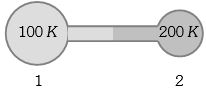
Figure shows two flasks connected to each other. The volume of the flask $1$ is twice that of flask $2.$ The system is filled with an ideal gas at temperature $100\, K$ and $200 \,K $ respectively. If the mass of the gas in $1$ be $m$ then what is the mass of the gas in flask $2$
The area under the velocity time graph between any two instants $t = t_1$ and $t = t_2$ gives the distance covered in a time $\Delta\text{t}=\text{t}_2-\text{t}_1:$
Two circular loops of equal radii are placed coaxially at some separation. The first is cut and a battery is inserted in between to drive a current in it. The current c~anges slightly because of the variation in resistance with temperature. During this period, the two loops:
According to the kinetic theory of gases, at absolute temperature
The limiting value of static friction between two contact surfaces is ........... 
At  ..... $K$ temperature average speed of $O_2$ will be ${\left( {\frac{7}{4}} \right)^{th}}$ of rms speed of $N_2$ at $47\,^oC$